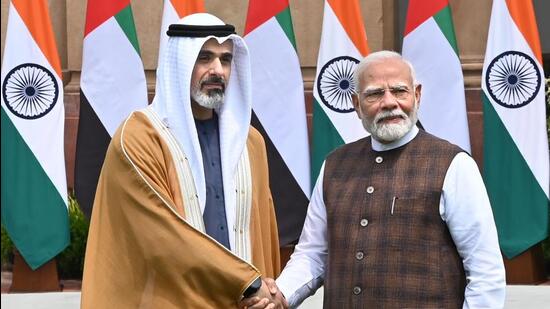
India and the United Arab Emirates (UAE) on Monday concluded agreements for the long-term supply of liquefied natural gas (LNG) and civil nuclear cooperation as Prime Minister Narendra Modi and Abu Dhabi Crown Prince Khaled bin Mohamed bin Zayed Al Nahyan explored opportunities to broaden cooperation to new areas such as AI and critical minerals.
The two sides also concluded agreements for the UAE to enhance its participation in India’s strategic petroleum reserves, for an Indian state-run firm to bring crude oil from Abu Dhabi Onshore Block 1 to India, and for Abu Dhabi Developmental Holding Company to develop a food park in Gujarat.
The Indian side rolled out the red carpet for Sheikh Khaled, effectively next in line after UAE President Mohamed bin Zayed Al Nahyan, and the Crown Prince was accorded the protocol usually associated with visits by heads of state or government. Sheikh Khaled, also chairman of the Abu Dhabi Executive Council, was accompanied by a delegation that includes ministers, senior officials and business leaders.
Modi and Sheikh Khaled discussed the multifaceted relations and “avenues to broaden the comprehensive strategic partnership to new and emerging areas”, external affairs ministry spokesperson Randhir Jaiswal said on X.
The two leaders emphasised the need to explore new areas of collaboration, especially nuclear energy, critical minerals, green hydrogen, AI and cutting-edge technologies.
{{/usCountry}}The two leaders emphasised the need to explore new areas of collaboration, especially nuclear energy, critical minerals, green hydrogen, AI and cutting-edge technologies.
{{/usCountry}}Modi posted on X that he had fruitful talks on a range of issues with Sheikh Khaled. “His passion towards strong India-UAE friendship is clearly visible,” he said. Sheikh Khaled conveyed the wishes of UAE President Mohamed bin Zayed for India’s further progress and prosperity.
The 15-year agreement for LNG supply between Abu Dhabi National Oil Company (ADNOC) and Indian Oil Corporation Limited envisages the supply of one million metric tonnes per annum (MMTPA) from ADNOC’s lower-carbon Ruwais gas project.
This is the third such contract signed by India in a little more than a year to strengthen energy security. IOCL and GAIL earlier signed long-term agreements for 1.2 MMTPA and 0.5 MMTPA respectively with ADNOC.
The memorandum of understanding (MoU) between the Nuclear Power Corporation of India Limited (NNPCIL) and the Emirates Nuclear Energy Corporation (ENEC) is to enhance cooperation in operation and maintenance of nuclear power plants, sourcing of nuclear goods and services from India, and exploring mutual investment opportunities. It will also create a framework to share knowledge and expertise in all areas of nuclear energy development.
Last week, the UAE announced the completion of the Arab world’s first nuclear power plant. Abu Dhabi’s Barakah Nuclear Energy Plant will produce 40 terawatt-hours of electricity a year once its fourth and final reactor begins commercial operations.
The MoU between ADNOC and India Strategic Petroleum Reserve Limited (ISPRL) allows the UAE to ramp up its participation in crude storage in India and the renewal of an existing storage and management agreement. This builds on ADNOC’s involvement in crude storage at ISPRL’s Mangaluru cavern since 2018.
India decided in 2004 to construct strategic petroleum reserves to ensure energy security. ISPRL has completed the filling of crude oil in underground rock caverns with a total capacity of 5.33 MMT at three locations, including Mangaluru (1.5 MMT). ADNOC has stored 5.86 million barrels of crude in the Mangaluru cavern. These reserves can be used in emergencies, such as serious disruptions in the global crude supply chain.
The production concession agreement for Abu Dhabi Onshore Block 1 between ADNOC and Urja Bharat, a joint venture of IOCL and Bharat Petro Resources Ltd, is the first pact of its kind for any Indian company operating in the UAE. The concession allows Urja Bharat to bring crude oil to India, contributing to the country’s energy security.
The MoU between the Gujarat government and Abu Dhabi Developmental Holding Company (ADQ) envisages the development of a food and agriculture park at Gundanpara in Ahmedabad district by the second quarter of 2025.
During Sheikh Khaled’s visit to Mumbai on Tuesday, there will the soft launch of work on the India-UAE virtual trade corridor (VTC) and the MAITRI interface to facilitate the VTC. People familiar with the matter said this VTC will be part of the India–Middle East–Europe Economic Corridor (IMEC).
Sheikh Khaled will also participate in the India-UAE Business Forum in Mumbai, a platform for business leaders and officials from both sides to brainstorm future cooperation in various areas.
Modi and Sheikh Khaled expressed satisfaction at progress under the bilateral comprehensive strategic partnership in recent years and discussed opportunities to widen and deepen the partnership in all areas, the external affairs ministry said in a statement. They also acknowledged that the success of the Comprehensive Economic Partnership Agreement (CEPA) and the recent entry into force of the Bilateral Investment Treaty (BIT) will provide impetus to the economic and commercial partnership.
Sheikh Khaled, who is on his first visit to India since becoming crown prince last year, also met President Droupadi Murmu and discussed the historic and comprehensive ties between the two sides. Murmu expressed her gratitude to the UAE’s leadership for hosting more than 3.5 million Indian nationals.
Murmu said during Sheikh Khaled’s visit, India and the UAE have expanded their forward looking partnership through several agreements in new areas of cooperation.