India on Friday welcomed the full normalisation of ties between the United Arab Emirates (UAE) and Israel, both key allies in West Asia, and called for early resumption of direct talks between the Israeli and Palestinian leadership for a “two-state solution”.
External affairs minister S Jaishankar received a phone call on Friday afternoon from his UAE counterpart, Abdullah bin Zayed Al Nahyan, who briefed him on the normalisation of relations that was announced on Thursday.
“Deeply appreciate the call today from FM HH @ABZayed of UAE. Discussed the full normalisation of relations between UAE and Israel announced yesterday,” Jaishankar tweeted.
The development is significant for the Narendra Modi government, which has assiduously courted key Arab states such as Saudi Arabia, the UAE, Qatar, Kuwait, Oman and Bahrain even as it continued developing security and trade ties with Israel.
West Asia was home to nearly 8 million Indians before the Covid-19 outbreak, and New Delhi has a deep interest in the peace and stability of the region. As external affairs ministry spokesperson Anurag Srivastava pointed out during a regular news briefing, India perceives West Asia as its “extended neighbourhood”.
“India has consistently supported peace, stability and development in West Asia, which is its extended neighbourhood. In that context, we welcome the full normalisation of ties between the UAE and Israel. Both nations are key strategic partners of India,” he said.
{{/usCountry}}“India has consistently supported peace, stability and development in West Asia, which is its extended neighbourhood. In that context, we welcome the full normalisation of ties between the UAE and Israel. Both nations are key strategic partners of India,” he said.
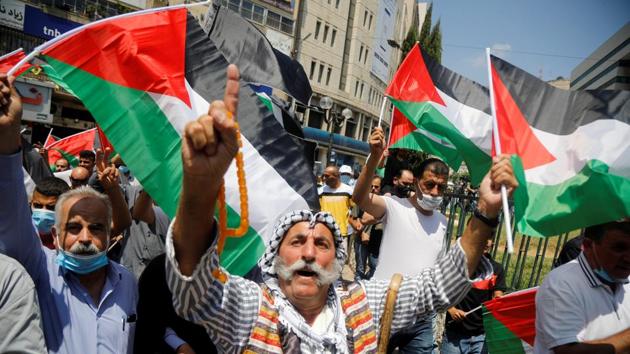
{{/usCountry}}However, Srivastava noted that India “continues its traditional support for the Palestinian cause”. He added, “We hope to see early resumption of direct negotiations to find an acceptable two-state solution.”
Thursday’s agreement, announced following a conversation between Abu Dhabi Crown Prince Sheikh Mohammed bin Zayed, Israeli Prime Minister Benjamin Netanyahu and US President Donald Trump, makes the UAE only the third Arab country, after Egypt and Jordan, to have full diplomatic relations with Israel.
Delegations from the UAE and Israel will meet in the coming weeks to sign agreements regarding the establishment of embassies, security, direct flights, investment, tourism, technology and energy. As a result of the breakthrough, Israel will suspend declaring its planned extension of sovereignty to parts of Judea and Samaria and focus on expanding relations with other Arab and Muslim countries.
The suspension of the annexation of Palestinian areas is crucial for countries such as India, which have had to walk a fine line in their ties with both Arab states and Israel. There are also reports that Oman and Bahrain could be next in normalising ties with Israel.
However, the agreement has upset Iran, another key ally of India in the region, especially in view of New Delhi’s stake in developing the strategic port of Chabahar.
On the other hand, common fears about Iran played a key role in bringing Israel and the Arab states closer. Iranian foreign minister Javad Zarif described the deal as “dangerous and illegitimate” and said “this is stabbing the Palestinians in the back”.
The deal has also upset Turkey, which said the people of the region “will never forget and will never forgive this hypocritical behaviour” by the UAE. The Turkish foreign ministry also said the UAE has no authority to negotiate with Israel on behalf of the Palestinians or “to make concessions on matters vital to Palestine”.