Delivering a firm rebuttal to a widely held but factually inaccurate perception of India’s energy relationship with Russia, external affairs minister S Jaishankar has said those who are looking at India’s energy purchases from Russia would be better served if they turned their attention to Europe.
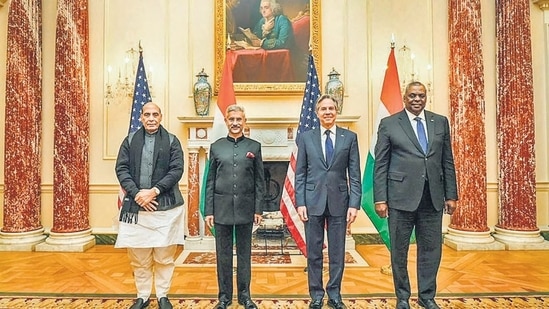
At the press meeting after the conclusion of the 2+2 dialogue in Washington DC on Monday, Jaishankar said, “If you are looking at energy purchases from Russia, I would suggest that your attention should be focused on Europe…We do buy some energy which is necessary for our energy security. But I suspect, looking at the figures, probably our total purchases for the month would be less than what Europe does in an afternoon. So you might want to think about that.”
The US has asked India not to “accelerate its imports” from Russia — but both the White House and State Department have repeatedly clarified that India’s energy imports from that country are in the range of merely 1-2% of its total energy basket and there is a carve out on energy in the sanctions regime. Officials on both sides have told HT that it is not a major issue of discord in bilateral conversations. But India’s energy relationship with Russia continues to be a talking point in the US, especially in the media and policy community. Europe, on the other hand, has not joined the US in its ban on Russian energy imports and continues to be substantially dependent on Moscow for its requirements.
In his remarks, Jaishankar, instead, pointed to the deepening India-US energy relationship — “which didn’t exist some years ago”. While saying that every country would look at its best options, the minister pointed out that the US was not just the second largest LNG supplier to India, but also the fourth or fifth largest crude oil supplier, and a big partner on the renewable energy side.
{{/usCountry}}In his remarks, Jaishankar, instead, pointed to the deepening India-US energy relationship — “which didn’t exist some years ago”. While saying that every country would look at its best options, the minister pointed out that the US was not just the second largest LNG supplier to India, but also the fourth or fifth largest crude oil supplier, and a big partner on the renewable energy side.
{{/usCountry}}The minister also focused on the implications of the Ukraine on the global economy and ways to mitigate it. Referring to his bilateral meeting with Secretary of State Antony J Blinken, the minister said, “A good part of my meeting…went to the ongoing conflict in Ukraine that has many ramifications. Even countries far away are worrying about energy security, food security, commodities prices, and logistics disruption.”
The minister pointed out that the disruptions caused by the Ukraine conflict come on top of disruptions caused by the pandemic, as well as the situation in Afghanistan, and spoke of ways in which India was seeking to mitigate these consequences.
“I think part of what we are doing is to press for a cessation of hostilities, which I think everybody would agree would mitigate matters and clearly make the world less unpredictable.” He pointed out that India had already provided humanitarian relief to Ukraine and some of its neighbours and a shipment of medicines was on its way to being delivered to Kiev.
On the economic consequences, the minister said, “I think a big concern we have – and not just we, I think the world has – is of energy security, of rising prices, of increasing premiums, of limited supplies. So today, you have to understand it is a legitimate concern of countries to ensure their energy security. But an equally big worry which is emerging is of food security. There are concerns across geographies of societies who are importing wheat or sugar or other foodstuff out of the conflict region.”
The issue of what India could do to help stabilise the situation, he said, was discussed both during the virtual discussion between US President Joe Biden and Prime Minister Narendra Modi as well as the 2+2.
“We are quite willing, and in fact we have already started responding to the need for greater food supplies, especially wheat most of all but to some degree, sugar as well. At this moment, a number of countries are discussing with us the possibility of greater food supplies, including the World Food Program.”
For his part, Blinken said Russia’s aggression against Ukraine was having profound impact across the board, and pointed to the US administration’s decision to proceed with the release of strategic petroleum reserves for the next six months “to ensure that there is adequate energy in world markets, both to have an impact on availability as well as on price to deal with the disruptions caused by the Russian aggression”.
He added that India was the third largest energy consumer in the world, its electricity demand was set to double by 2030, and US energy exports to India were now to the tune of $11 billion. He also spoken of specific initiatives of India-US collaboration in the field of clean energy, adding, “We are working both to deal with the impact of the Russian aggression on energy but much more broadly with this combination of helping India meet its energy needs while advancing together the vital climate agenda we share.”