By the end of 2019, the first Integrated Battle Group (IBG) of the Indian Army should be rolling.
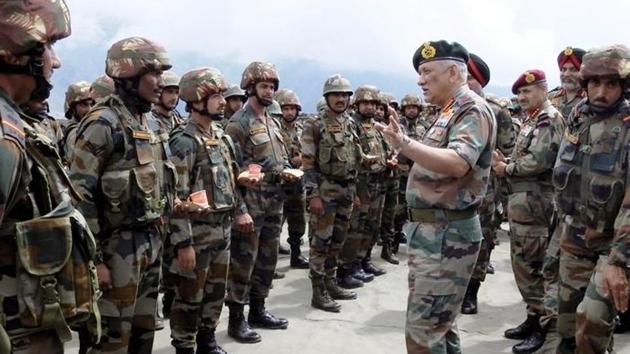
The central idea behind the reorganisation – perhaps the biggest and most far-reaching reform of the military in recent years – under Chief of Army Staff General Bipin Rawat is to achieve the biggest victory with the smallest cost at the shortest possible time.
In all, the army wants at least 11-13 IBGs to be deployed along the western and northern borders of the country.
IBGs will use division-sized forces with bulked-up brigades. Apart from signalling a shift in how India fights future conflicts, the change is also an acknowledgement and a step towards making the forces a leaner, meaner fighting force within budgetary constraints. Once implemented, these will be “game-changers” in the conventional domain.
The IBGs comprising elements of airpower, armour, artillery, mechanised and traditional infantry engineering and ordnance units are self-sustained fighting components that can be activated without delay. These composite waging units comprising about 20,000 fighting men deployed on “hot-spots or vantage points along the border with a specific order of battle” can move as a cohesive section at a short notice projecting power, tying enemy forces down and threatening adversaries at unlikely places. In addition, there are associated advantages of cost as well as training, equipping and mobilisation is likely to be less expensive.
IBGs essentially mean that the Indian Army is moving away from the World War-II vintage “Strike Corps” to Short Notice Intense Pre-Escalatory Operations (SNIPEs). India has four Strike Corps – 1, 2, 21 and 17. The Yol-based 9 Corps will be the first to be re-organised into IBGs and will be deployed along the western border. Subsequently, the XXXIII Corps in Siliguri and newly-raised Mountain Strike Corps in Panagarh will follow.
{{/usCountry}}IBGs essentially mean that the Indian Army is moving away from the World War-II vintage “Strike Corps” to Short Notice Intense Pre-Escalatory Operations (SNIPEs). India has four Strike Corps – 1, 2, 21 and 17. The Yol-based 9 Corps will be the first to be re-organised into IBGs and will be deployed along the western border. Subsequently, the XXXIII Corps in Siliguri and newly-raised Mountain Strike Corps in Panagarh will follow.
{{/usCountry}}Considering that future conflicts are unlikely to be lengthy, a lethal blow delivered quickly will hold the key. And, although the army has made efforts to cut down on the “mobilisation” time, it still takes considerable time to completely mobilise the lumbering strike corps. In addition to a nimbleness, the smaller IBGs will preserve the “element of surprise.”
Simply put, IBGs are to the Strike Corps what James Bond’s specially-manufactured Aston Martin is to a posse of policemen. The latter need to be assembled and briefed before being directed to provide back-up. In contrast, just Bond and his Aston Martin can jump an obstacle, fire a missile, interdict opponent when least expected with speed and surprise and in the process cripple the adversary completely.
With the simultaneous cross-border commando raids after the 2016 Uri attack and Balakot airstrikes after the Pulwama attack this year, the Narendra Modi government introduced an element of “unpredictability” in its foreign policy. The formation of IBGs will give India the teeth to deliver the “unpredictable” response with ease.