
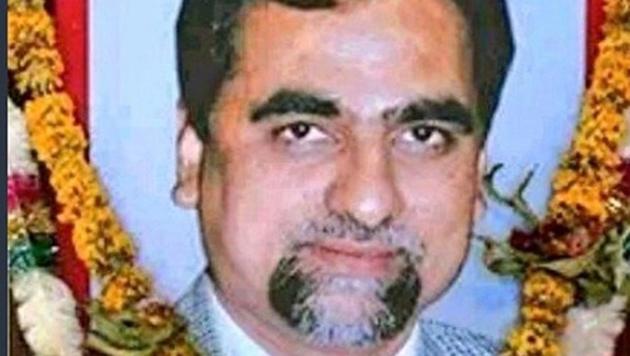
A division bench of the Nagpur high court heard a case that seeks all details of CBI special court judge BH Loya’s death in late 2014 and alleges that he was poisoned using a radioactive isotope.
The bench allowed the petitioner, lawyer and activist Satish Uke to amend the so-called prayer clause, where a plaintiff lists expectations of the court, and deferred hearing by two weeks. Two earlier benches refused the hear the case.
Judge Loya, who was presiding over the Sohrabuddin Shaikh encounter case, died of a heart attack in 2014 while staying at the government guest house Ravi Bhavan in Nagpur.
Amit Shah, who was Gujarat’s minister of state for home at the time of the alleged fake encounter, was once named in the case but subsequently discharged.
A CBI special court recently acquitted all the accused in the case and the judge also said the investigation by CBI was politically motivated. The Bharatiya Janata Party says the Congress tried to use the CBI to frame Shah.
Senior counsel Sunil Manohar appeared for the government along with government pleader Sumant Deopujari and demanded the petition’s dismissal, pointing out that the issue was already decided by the Supreme Court.
{{/usCountry}}Senior counsel Sunil Manohar appeared for the government along with government pleader Sumant Deopujari and demanded the petition’s dismissal, pointing out that the issue was already decided by the Supreme Court.
{{/usCountry}}The SC ruled on April 19, 2018 that it did not have reason to believe there was anything mysterious about Judge Loya’s death. Uke clarified that he was not demanding a reinvestigation into the case, but wants all records pertaining to judge’s death.
ABOUT THE AUTHOR
Follow the latest breaking news, major developments and agenda-setting stories from India and around the world with the newsdesk at Hindustan Times. Operating round the clock, the desk brings together experienced editors, reporters and correspondents to deliver fast, accurate and contextual reporting across subjects that influence public policy, governance, business, society and international affairs. The HT News Desk covers politics, elections, government policies, the economy, business and markets, science and technology, the environment, law and order, infrastructure, education, climate issues and geopolitics, while closely tracking developments across states, institutions and global capitals. The team also leads coverage of major breaking news events, policy announcements, court proceedings, natural disasters, public emergencies and significant international developments. Reports published by the newsdesk are based on information gathered from reporters on the ground, official statements, government agencies, court records, regulatory filings, recognised institutions and other authoritative sources. Stories undergo editorial scrutiny and verification processes to ensure accuracy, fairness and relevance, and are updated as events evolve and additional information becomes available. Whether covering a key political decision in New Delhi, an economic policy shift affecting millions, a landmark court ruling or a major global event, the HT News Desk aims to provide readers with reliable, fact-based journalism that delivers not only the latest developments but also the context and analysis needed to understand their wider implications.