
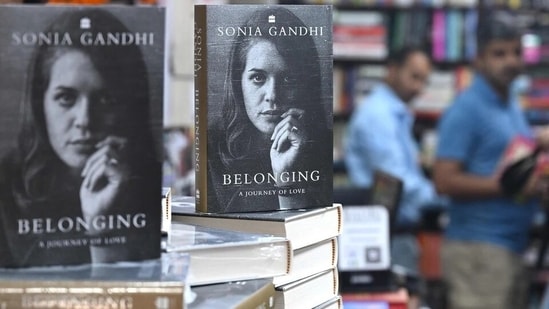
I have just finished reading Sonia Gandhi’s memoir, Belonging: A Journey of Love. As an author, I found it highly readable. Of course, it was predictable that there would be political controversy relating to some aspects of her narrative. She is a highly prominent politician and public persona. Anything she writes will be dissected, discussed, critiqued or appreciated, depending often on the political proclivities of individual readers. In such a situation, even though she emphasises that her book is a ‘personal memoir’, it is bound to become a subject of public debate. Nothing really remains ‘personal’ in politics.
I read the book as an author, whose published works include two detailed biographies, one of Mirza Ghalib and the other of Adi Shankaracharya. For me, the most interesting part of her book is her account of the daunting challenges she faced in negotiating the cultural barriers—visible and invisible—that confronted her as a person from a middle-class Italian family adjusting to the complexities of Indian culture and, ultimately, adopting India as her home.
It has become a fashionable truism among the apostles of globalisation to describe our interconnected planet as a seamless ‘global village’, converging towards a uniform, cosmopolitan sensibility. On the surface, the evidence appears compelling. Whether you walk down a boulevard in New Delhi, Tokyo, Nairobi or New York, you will encounter the exact same golden arches of McDonald’s, the familiar red buckets of Kentucky Fried Chicken, travellers wearing identical denim, and living rooms tuned into the breaking news cycles of CNN or the BBC. Yet, beneath this glittering veneer of global consumerism lies a profound, unyielding reality: surface commonalities do not obliterate the deep, civilisational fault lines of culture.
To assume that sharing a fast-food menu or watching the same television network equates to cultural homogeneity is to mistake the wrapper for the substance. Culture is not a coat one can casually slip on and off at an airport immigration counter; it is etched into our civilisational DNA. It manifests in the subtle cadences of language, traditional modes of dress, unconscious mannerisms, ancestral customs, intricate codes of social etiquette, deeply held religious beliefs and visceral food preferences. While technology has shrunk physical distances, it has barely scratched the surface of the psychological and cultural universes that separate human societies.
{{/usCountry}}To assume that sharing a fast-food menu or watching the same television network equates to cultural homogeneity is to mistake the wrapper for the substance. Culture is not a coat one can casually slip on and off at an airport immigration counter; it is etched into our civilisational DNA. It manifests in the subtle cadences of language, traditional modes of dress, unconscious mannerisms, ancestral customs, intricate codes of social etiquette, deeply held religious beliefs and visceral food preferences. While technology has shrunk physical distances, it has barely scratched the surface of the psychological and cultural universes that separate human societies.
{{/usCountry}}Consequently, navigating—let alone overcoming—these imperceptible yet substantive cultural barriers remains a daunting task. For an outsider attempting to genuinely assimilate into another country’s cultural fabric, what looks effortless from afar often proves to be an arduous, lifelong odyssey.
A compelling, contemporary illustration of this profound struggle is offered in Sonia Gandhi’s newly released memoir. Having moved from a small village in post-war Italy to the heart of India’s premier political household in 1968, Gandhi’s account strips away any romanticised notions of effortless cultural assimilation. She candidly describes the acute, recurring vulnerability of being an outsider in a completely unfamiliar world—constantly conscious of being watched, anxious about committing an unintended faux pas, and grappling with what she terms the ‘unstated dictates’ of an intricate Indian family structure. From forcing herself to adapt to fiery Indian spices and learning the nuances of wearing a sari, to agonising over how to address her formidable mother-in-law, Indira Gandhi—resisting the expectation to call her "Ma" because, in her Italian soul, there could only ever be one Mamma—her narrative underscores how deeply ingrained cultural instincts resist overnight transformation. Even after more than half a century of residing in India and rising to the pinnacle of its public life, her reflections reveal that true ‘belonging’ is never an automatic gift of globalisation, but a slow, deliberate and often painful negotiation with an alien civilisational grammar.
How intangible such cultural opacity can be is illustrated in my book, Becoming Indian: The Unfinished Revolution of Culture and Identity (Penguin), by a humorous but true story of an Indian woman bureaucrat on an official trip to Paris that coincided with the Karva Chauth fast. Desperate to see the moon after a long day of work during which she had neither eaten nor taken a sip of water, she opened the door to the rooftop of the hotel where she was staying. The area was restricted, and her action set off an alarm. The French police were there in a jiffy. The lady spoke very little French, and the gendarmerie spoke very little English. There was no way she could explain to them that all she wanted to do was to frame the moon in a sieve before breaking her fast for the benefit of her husband, who was far away in India, where the moon would have risen several hours earlier!
I found Sonia Gandhi’s Belonging a compelling read particularly in those chapters where she honestly speaks of her struggle to belong to a culture and civilisation so different from her own. This requires courage, patience, tenacity, humility, and an openness to learn and absorb that are commendable. The motivation for her—as she writes with refreshing candour—was, of course, her deep love for her husband, Rajiv Gandhi, with whom she fell deeply in love at first sight and remained in love forever.
Pavan K Varma is an author, diplomat, and former member of Parliament (Rajya Sabha). The views expressed are personal