Karnataka has joined the list of Bharatiya Janata Party-ruled states where the incumbent government has made an assertive declaration of its ideological commitment to implement the uniform civil code (UCC) and identify illegal residents through the creation of a national register of citizens (NRC).
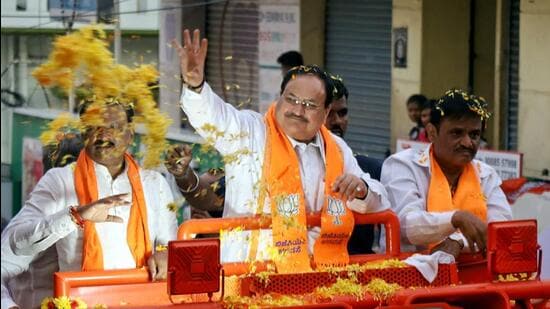
On Monday, at the release of the party’s manifesto for the May 10 polls, BJP president JP Nadda said UCC implementation in the state will be “based on the recommendations given by a high-level committee”, which will be constituted for the purpose. He also said that NRC will be implemented for “speedy deportation of all illegal migrants”.
This is the same template that was followed in Uttarakhand, Uttar Pradesh and Gujarat, where the BJP announced its intent to adhere to its core ideological issue of implementing UCC even as it made development a key poll plank for its election campaign. All these states, where the BJP was re-elected, have set up committees to woek on the law. In April, Uttarakhand Chief Minister, Pushkar Dhami announced that the final draft of the law would be ready in the next few months.
UCC aims to replace laws based on religious texts or traditions, to set common laws for marriage, divorce, succession, adoption, guardianship and partition of land and assets for all citizens. It has been a long-pending demand of the Rashtriya Swayamsevak Sangh (RSS), the ideological mentor of the BJP and has been part of the BJP’s election manifesto for decades.
{{/usCountry}}UCC aims to replace laws based on religious texts or traditions, to set common laws for marriage, divorce, succession, adoption, guardianship and partition of land and assets for all citizens. It has been a long-pending demand of the Rashtriya Swayamsevak Sangh (RSS), the ideological mentor of the BJP and has been part of the BJP’s election manifesto for decades.
{{/usCountry}}Consolidation of Hindu vote
The BJP’s bid to consolidate the Hindu vote by renewing its commitment to UCC and NRC has not been dampened by the limited support it received for its campaign in the state to proscribe halal or the wearing of the hijab in schools. To be sure, the lack of pan Karnataka support for such issues was read as a cue to tone down the rhetoric against practices restricted to minority communities and senior leaders including the former Chief Minister and Lingayat strongman, BS Yediyurappa publicly distanced the party from controversies such as the call for banning hijab.
But anticipating the mobilisation of the minority votes in favour of the Congress, the BJP wants to ensure that its core vote bank is not disappointed by the lack of attention to ideological issues. So, while it has set out to woo the fence sitters with promises of economic growth, gleaming infrastructure and investment opportunities, it does not want to loosen its hold over the electorate that saw merit in laws passed to impose strict punishment for religious conversion and slaughter of cattle.
In 2022, the BJP created a controversy by bringing in a law, the Karnataka Protection of Right to Freedom of Religion Act 2022, that invokes jail time and levies monetary fines on those convicted of forced religious conversions through misrepresentation, coercion, allurement, fraud, or the promise of marriage.
The most recent attempt to consolidate the Hindu votebank was the BS Bommai government’s decision to redistribute reservation among the politically dominant communities, the Vokkaligas and the Lingayats, and increasing the quotas for the Scheduled Castes and Scheduled Tribes by taking away 4% reservation for Muslims. The party has dubbed the reservation for Muslims as “unconstitutional” and refers to the Congress’s assurance of restoring it as “appeasement politics.” The move to scrap Muslim reservation, though, is on hold after the Supreme Court’s reservation.
While on the one hand the party manifesto underscores commitment to all sections of society through sops such as 10 kg grains and 5 kg rice for the poor, increasing the cover under Ayushaman Bharat Yojana from ₹5 Lakh to ₹10 lakh and free annual master health check-up for senior citizens, the party is vociferous in its stand on issues such as not giving in to pressure to reinstate reservation for Muslims or relaxing its view towards organisations such as the now-banned Popular Front of India (PFI).
At a public rally last week in coastal Karnataka, union home minister, Amit Shah trained his guns at the Congress by claiming that the party if voted to power would reverse restrictions on cattle slaughter and the “courage of the PFI would return”. He also underscored the involvement of PFI in carrying out killings of those affiliated to the RSS and the BJP.
Therefore, the assurance of rolling out the contentious NRC that saw hundreds of citizens lodged in detention centres in Assam, and the promise to implement UCC in Karnataka. In the coastal belt, in parts of North and Central Karnataka, the party is hopeful that the issues will provide it with the edge that it needs to overtake its opponents.