Ten years ago when Kalyan Singh from Bareilly in Uttar Pradesh, had enrolled his eldest daughter in a government school in Kollam (south Kerala), he had little hope but was happy that she would get food twice a day. A decade later, his daughter Priyanka Singh has cleared her class 10 examination with A+ distinction in all subjects including Malayalam. Not just that, she has ensured that her parents are also literate.
Two weeks ago a 26-year-old woman Romiya Kahtun, wife of a migrant worker from Bihar, topped the Malayalam literacy examination scoring cent per cent in all papers. Now she is planning to appear for class 12 equivalent examination and them go for graduation.
The state literacy mission has introduced a new scheme ‘Changathi’ (friend) to target illiterate migrant labourers and its planners say it is doing wonders. Besides giving succour to many, the state is also turning into a learning ground. “We are very happy that many are learning their first letters here,” said Dr P S Sreekala, state literacy mission director adding 4000 migrant workers have enrolled in literacy classes, till date.
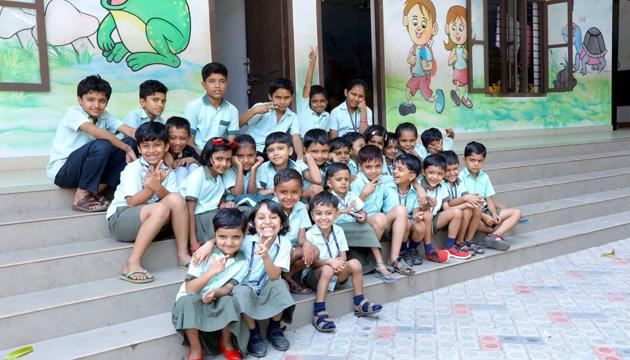
Once many of the Kerala’s government schools were facing closure for lack of students but now children of the migrants are filling them up. The state’s dipping birth rate, aging population and migration by the youth have ensured that there is a big vacuum but people from other states, especially from north-east, are filling it steadily. Steady flow of people from other states has led to visible changes in social, economic and cultural spheres of the state.
“We have 200 children studying here. Out of them 40 children are originally from other states. They learn all subjects including Malayalam. Some of them are really bright,” says Beena Sarojam, head teacher of the Government Upper Primary school in Chala, in the heart of the state capital. When enrolled, many of them were suffering from fluorosis and iron deficiency but not anymore. During festivals, many schools give leaves to students and others celebrate it in schools.
{{/usCountry}}“We have 200 children studying here. Out of them 40 children are originally from other states. They learn all subjects including Malayalam. Some of them are really bright,” says Beena Sarojam, head teacher of the Government Upper Primary school in Chala, in the heart of the state capital. When enrolled, many of them were suffering from fluorosis and iron deficiency but not anymore. During festivals, many schools give leaves to students and others celebrate it in schools.
{{/usCountry}}“We ensure nutritional food to them including milk and eggs at least two days a week,” said Sarojam.
Even a casual visit to village or a construction site in Kerala, one can hear people speaking in Hindi, Bangla, Assamese or Oriya. There are now separate markets, paan bhandars or eateries catering to the floating population from the north and eastern parts of the country. What sets Kerala apart is the level of migration happening to even rural areas of the state. Even in countryside one can spot migrants from other states busy weaving Kerala ‘parotta’ dough or making crispy dosas. In state school athletics and other teams there are numerous students whose parents are from other states of the country.
In Vivek Express, the country’s longest distance train running between Dibrugrah to Kanyakumari covering 4320 kms running through nine states in five days, one can see many fortune-hunters. The southern railway says it is one of the most sought after trains. Many workers say there are agents in the Northeast who regularly supply labour to the state and they take a cut from them for better placement in Kerala.
As people from Kerala still flock to the West Asia in large numbers for blue collar jobs (there are 20 lakh Keralites in GCC countries) migrant workers from north India and north-east are filling the gap in the state. With high wages and better working conditions for most of them, Kerala has turned into a magnet for them. Migrants say that since Kerala needs them desperately there is no ‘sons of the soil’ discrimination.
There are an estimated 4 million migrant workers in the state. A survey conducted by the Gulati Institute says their numbers will rise to 5 million shortly. Recently the state labour department has devised a guideline to end their possible exploitation and it regularly conducts surprise inspections on their dwellings and work places to improve their living conditions. The state has also started a free health insurance scheme worth ₹15,000 to each registered migrant worker.
“It has been happening for almost a decade. We don’t have much work force in the state so it is natural a replenishment migration is taking place here,” said author and demographer S Irudaya Rajan of the Centre for Development Studies adding the inward migration to the state compensates the outward migration.
With its unique country leading social development indicators, especially in education and health, Kerala has been witnessing a demographic transition with declining birth rate and rapid rise of aged people, says the latest state economic review tabled by Finance Minister Thomas Issac in the state assembly in the first week of February.
The state has been witnessing this peculiar situation for quite some time but the latest statics shows the state is greying fast surpassing the national average, says the review. Out of 3.34 crore population (census 2011) 48 lakh people are above 60 years of age and out of these 15 per cent are above 80, it says. With better healthcare, life expectancy is on the rise in the state, say health experts. According to the economic review, the rise in the number of aged people and the fall in the number of youth pose serious demographic challenges to the state.
“In 1961, Kerala’s 60-plus population was 5.1 per cent, which was just below the national average of 5.6 percent. Since 1980, Kerala has overtaken the rest of India and in 2001 the proportion of the old age population rose to 10.5 per cent as against all India average of 7.5 per cent. By 2011, 12.6 per cent of Kerala’s population was past 60 years, compared to the all India average of 8.6 percent. By 2015, population data show that it increased to 13.1 per cent in Kerala against the all India average of 8.3 per cent (SRS Statistical Report 2015),” says the economic review.
More worryingly, a large number aged people in the state are widows. As per Census 2011, among the old age in the range of 60-69, 23 per cent are widows and among those above 70 years, it is 43.06 per cent. By 2025, about 20 per cent of the population would be elderly and the consequent demand on the social security system would be really demanding, says the review.
According to a study conducted by Mahathma Gandhi University by 2031, almost half of Kerala and neighbouring Tamil Nadu will be above the age of 40 years even as some states like Bihar and Uttar Pradesh will remain young. Worried about the trend a couple of years ago Catholic church had announced rewards for parents who procreate more. Statistics show Christian numbers are dwindling fast in the state.
Eyeing their rising numbers many entrepreneurs have started geriatric care centres and old age homes in many parts of the state. With high longevity associated with better health care and education, Kerala has one of the highest numbers of healthy geriatric population in the country.
Keeping the rising geriatric population in mind, the state has devised many programmes for them. At least three districts have zero growth and many houses are occupied by grandparents only. The situation was quite evident during the flood of the century two years ago. In worst affected Pathanamthitta the government had recently trained around 500 people to take care of the needs of the elderly.