Twenty-three years ago, this day, the Indian Armed Forces declared victory after driving out the intruding Pakistan regular army along with jihadist mercenaries from the heights in Kargil.
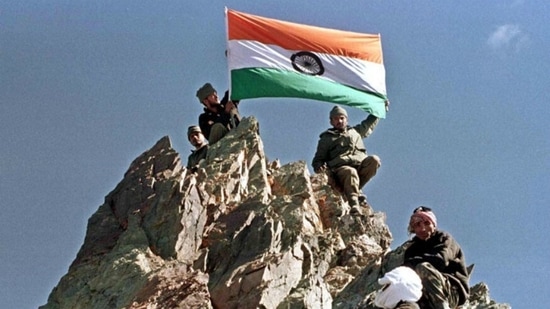
Much has been said about the perfidy of Pakistan, who threw February 1999 Lahore Declaration into dustbin and allowed its army to cross the Line of Control (LoC) in Mushkoh-Drass-Kargil-Batalik sectors with the objective to severe the logistics line to southern Siachen Glacier and occupy Indian territory in Ladakh sector. The military plan of then Pakistan Army General Pervez Musharraf, who currently is hospitalized in Dubai, and his chief of General Staff Mohammed Aziz was audacious and premised on the notion that the Indian Army under the leadership of then Prime Minister Atal Behari Vajpayee would not retaliate as this could lead to full-fledged nuclear confrontation between two newly declared nuclear weapon states. And this the international community led by the then friend of Islamabad, the US, would not allow. Pakistan lost the war the day the Indian Cabinet Committee on Security (CCS) headed by then PM Vajpayee ordered the Indian Armed Forces to throw out the Pakistani intruders in May 1999.
While the brave Indian officers and men of the Indian Army with force multipliers of the Indian Air force and the Indian Navy wrested every inch of territory on the glaciated heights of Kargil from the Pakistani intruders with their blood, the then PM Vajpayee invited the then Pakistani dictator Gen Pervez Musharraf (who overthrew PM Nawaz Sharif in a military coup in October 1999) for a bilateral dialogue at Agra in July 2001. The talks ended in a abject failure as the NDA leadership, much to the chagrin of Left-Liberal media, wanted only to discuss cross-border terrorism emanating from Pakistan and refused to cede an inch on Jammu and Kashmir. All the Jhelum, Chenab and soft LoC plans touted by the pro-Pakistan media at that time were consigned to flames.
That Pakistan considers India its eternal enemy was the key external lesson from Kargil, which has often been learnt and unlearnt by the Indian leadership in the past two decades. The key internal lesson was the urgent need for structures to inculcate synergy and jointmanship between the three arms of the Indian Armed Forces. One must not forget that the IAF joined the Kargil war a week later after the Indian Army as it wanted specific cabinet approval. The Indian Navy’s principal weapon, the aircraft carrier, was under maintenance at the time of Kargil war as it coincidentally is under repairs even today.
{{/usCountry}}That Pakistan considers India its eternal enemy was the key external lesson from Kargil, which has often been learnt and unlearnt by the Indian leadership in the past two decades. The key internal lesson was the urgent need for structures to inculcate synergy and jointmanship between the three arms of the Indian Armed Forces. One must not forget that the IAF joined the Kargil war a week later after the Indian Army as it wanted specific cabinet approval. The Indian Navy’s principal weapon, the aircraft carrier, was under maintenance at the time of Kargil war as it coincidentally is under repairs even today.
{{/usCountry}}Despite discussing the issue threadbare, the armed forces are still to come to terms with jointmanship and continue to raise questions and offer opinions publicly on the compact joint military theatre commands. Even though cold start war and integrated battlegroups have been internally discussed by the national security planners, the theatrization of commands is hanging fire as a section of the top brass believes that India is one theatre and hence there should be one command. In this context, Defence Minister Rajnath Singh’s statement last Sunday in Jammu, at a function to honor Kargil heroes, that India will have joint theatre commands of tri-services is very important and sets the tone for the future military reforms. It would be in fitness of things that the joint theatre commands should be announced in the 75th year of Independence.
Just like military jointmanship for integrated full spectrum warfare, India needs an integrated intelligence mechanism to counter terror, cyber and espionage threat to the country. India needs to add teeth to its counter-intelligence capabilities as the penetration from northern and western neighbors with pliable proxies within grows by the day. When Prime Minister Narendra Modi took over as head of government in 2014, there was a proposal that the two major intelligence services of India should join hands operationally to cut the time lag on actionable intelligence as well as counterintelligence. Time has come to remove the dust from that proposal.