Lightning strikes killed nearly 2,000 people every year in India since 2004, which is nearly twice the number of deaths recorded since the late 1960s, according to the India Meteorological Department (IMD) that pointed to a trend of increasing danger from the weather phenomenon.
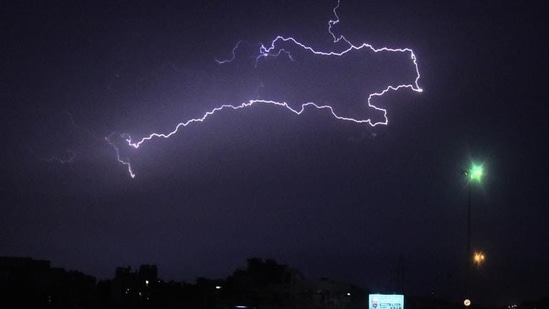
On Monday, during an awareness workshop on lightning and thunderstorms, IMD scientists said lightning strikes were claiming more lives than cyclones.
“Between 1995 and 2014, we saw a jump of nearly 30% to 40% in lightning incidents in India. The number of deaths has also increased significantly between the 1990s and now,” said SD Pawar, project director thunderstorm dynamics, Indian Institute of Tropical Meteorology, Pune.
He said the reason behind the increase in lightning incidents may be directly related to the climate crisis, and the availability of more moisture over land due to warming.
Pawar shared data showing a doubling of annual lightning deaths from 1,000 to over 2,500 between 1968 and 2019.
On June 7, lightning strikes in several districts of West Bengal killed at least 27 people, more than Cyclone Yaas, which hit Odisha and West Bengal in May. Scientists said tropical cyclones have, in recent years, left fewer than people 50 dead, but deaths due to lightning strikes have been 50 times more.
Atul Sahai, vice president, Indian Meteorological Society, said the June 7 deaths were despite timely warnings by IMD. Lightning is an extremely localised phenomenon, and the warnings often don’t reach the last mile, he said.
{{/usCountry}}Atul Sahai, vice president, Indian Meteorological Society, said the June 7 deaths were despite timely warnings by IMD. Lightning is an extremely localised phenomenon, and the warnings often don’t reach the last mile, he said.
{{/usCountry}}While Pawar’s research indicated that lightning deaths were higher in areas where forest cover and tree cover had reduced, M Mohapatra, director general of IMD, said that changes in the rural lifestyle over the past 30 years may have also increased the exposure of people to lightning strikes.
“When there is dense tree cover, lightning strikes the tree and dissipates in the ground. But if the number of trees is less, people working outside are more exposed. In Marathwada, for example, we have noticed that tree cover is very thin. People working outside often run to a lone tree to take shelter underneath and are then struck by lightning,” said Pawar, adding that trees should be avoided during thunderstorms.
Mohapatra said more people working in the fields or orchards could be pushing the casualty count upwards. “The use of electrical appliances has also increased significantly in the past 30 years — from mobile phones to TVs to power lines. Lightning can interfere with their electromagnetic field,” Mohapatra said.
Several research studies have pointed to the relationship between increase in lightning activity and the climate crisis. Lightning strikes have been more in the Arctic region in the past decade. The number of summertime bolts detected above Alaska has increased more than six times, from about 35,000 in 2010 to about 240,000 in 2020, according to a study in Geophysical Research Letters published in April.