The government is considering expanding the eligibility criteria for Covid-19 testing to include loss of smell and taste and the matter was discussed by the national task force constituted to fight the outbreak, said two members of the panel on Wednesday.
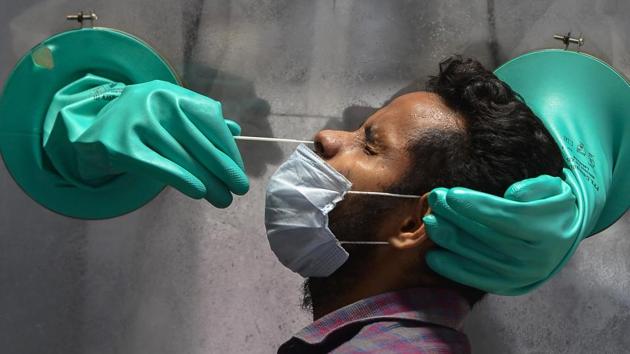
The issue was brought up in the Indian Council of Medical Research (ICMR)-constituted national task force on Covid-related matters because several cases have been reported where the patients showed a loss of smell or taste.
“This was in discussion as there were some people of the opinion that this could be looked at, too. However, no decision has been taken over it yet,” said a member who did not wish to be identified.
The first set of criteria for Covid testing was fixed in January and comprised fever, cough, and breathlessness as symptoms. Later, in May, gastrointestinal issues such as diarrhoea or vomiting were also added.
There are currently 13 clinical symptoms and signs in the specimen referral form that was revised last month. The symptoms are fever, cough, diarrhoea, vomiting, abdominal pain, breathlessness, nausea, haemoptysis (coughing up of blood), body ache, sore throat, chest pain, nasal discharge and sputum. Any patient with one or more symptoms are allowed to get tested for Covid-19. If loss of taste and smell are added to the list, a patient would have to report one or more of 15 symptoms to get tested.
The national task force members go through latest clinical data available around the world, and in India, to update the testing criteria.
{{/usCountry}}The national task force members go through latest clinical data available around the world, and in India, to update the testing criteria.
{{/usCountry}}In April, the World Health Organization (WHO), along with many European Union (EU) countries, the USA, and Australia, added loss of smell and taste as one of the key Covid-19 symptoms. The United Kingdom also added these to its list of Covid-19 symptom on May 18.
An article published in the medical journal Lancet last week titled “Quantifying Additional Covid-19 Symptoms Will Save Lives” mentioned that in many countries, regular mass swab testing was still inadequate. “To reduce the number of infectious people in the community, it is therefore crucial to use the symptom combinations that can identify them,” the researchers said.
“Using self-reported symptoms data from 18 401 users of the COVID Symptom Study app, who underwent an official SARS-CoV-2 test (7104 testing positive, 11 297 testing negative)… The prevalence of loss of smell and taste was three-fold higher in individuals testing positive (65·03%) than in those testing negative (21·71%),2 suggesting that people with loss of smell and taste should self-isolate.”
Doctors treating Covid-19 patients in India say that expanding the eligibility criteria will help in identifying cases.
“There is a percentage of Covid positive people who do report with symptoms wherein they have lost their sense of smell and taste even though the number does not seem too big when compared with people who report with fever, sore throat and cough. However, we do see Covid patients with these symptoms so it’s not a bad idea to include this in the list of criteria for Covid testing,” said Dr Yatin Mehta, chairman, critical care department, Medanta Hospital, Gurugram.
Some other experts argued that the eligibility criteria for testing should be expanded further.
“Apart from loss of smell and taste, I think, weakness, muscle pain and chills should also be added into the eligibility list as these are also listed as clinical signs of Covid patients,” says Dr Giridhara Babu, head, life course epidemiology, Indian Institute of Public Health, Public Health Foundation of India.