
The capital city has never been so decked up for a party conclave. Prime Minister Narendra Modi dots the skyline. Next to him in every second poster is his trusted lieutenant and BJP chief Amit Shah. The politician duo from Gujarat and more than 300 other senior BJP leaders from different parts are meeting in Odisha’s capital for a two-day brainstorming session on the party’s “Mission 2019”. Past victories will be hailed and future electoral challenges discussed at this BJP national executive meeting beginning Saturday.
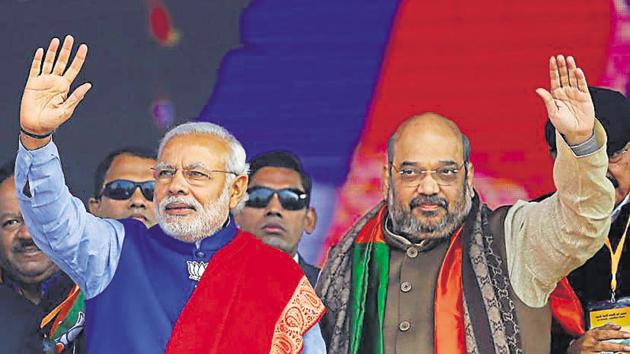
Modi and Shah have set their eyes on unconquered territories, Odisha being one of them, to win the 2019 Lok Sabha election. India’s eastern coast disappointed the BJP in the last election, despite a phenomenal jump in its vote share.
Shah wants this growth in popular support to translate into seats for the BJP in states such as West Bengal, Kerala, Andhra Pradesh, Tamil Nadu and Kerala. “We want to increase our numbers from these states,” says petroleum minister Dharmendra Pradhan, who bears much of the responsibility for organising this mega show.
Featured Video
“The venue for BJP meet is crucial in that regard.” The BJP held its last national council meeting in Kerala, a Left bastion where it won an assembly seat for the first time in the 2016 assembly election.
{{/usCountry}}“The venue for BJP meet is crucial in that regard.” The BJP held its last national council meeting in Kerala, a Left bastion where it won an assembly seat for the first time in the 2016 assembly election.
{{/usCountry}}At its executive meeting in Allahabad last June, the BJP said despite enthusiastic support from voters in the 2014 Lok Sabha elections, it could win very few seats along the coast from West Bengal to Tamil Nadu and Kerala.
“The National Executive calls upon the karyakartas in these states to work with single-minded devotion in a mission mode for the next three years and prepare the party for big gains in the 2019 Lok Sabha elections,” reads a resolution adopted at Allahabad meeting in June last year.
Of all the new territories that Shah is aiming to win, Odisha is crucial for many reasons. The BJP emerged as a serious challenge to the Biju Janata Dal in the just concluded panchayat election, pushing the Congress to a distant third position.
“In these panchayat elections, we demonstrated that BJP’s influence is not limited to the tribal dominated western Odisha. We won in such coastal constituencies where nobody expected BJD to lose,” said Pradhan, who is widely seen as a potential CM face for the BJP in Odisha.
Chief minister Naveen Patnaik is ageing and dealing with, what some observers say, a fatigue among people who have seen him on the top seat since 2000. The unrest is also visible within his party, with some seniors openly asking for introspection over the defeat in local polls.
Odisha has 36,000 polling booths wherein votes are polled simultaneously for 21 Lok Sabha and 147 assembly seats. “We are building our organisation on these booths,” claims BJP general secretary Arun Singh, also the party in-charge for Odisha.
The BJP has kept its doors open for leaders from the rival parties, a strategy that also helped it win Uttar Pradesh and Uttarakhand with a three fourths majority. “We don’t mind bringing in leaders who have a clean track record,” Pradhan said.
ABOUT THE AUTHOR
Follow the latest breaking news, major developments and agenda-setting stories from India and around the world with the newsdesk at Hindustan Times. Operating round the clock, the desk brings together experienced editors, reporters and correspondents to deliver fast, accurate and contextual reporting across subjects that influence public policy, governance, business, society and international affairs. The HT News Desk covers politics, elections, government policies, the economy, business and markets, science and technology, the environment, law and order, infrastructure, education, climate issues and geopolitics, while closely tracking developments across states, institutions and global capitals. The team also leads coverage of major breaking news events, policy announcements, court proceedings, natural disasters, public emergencies and significant international developments. Reports published by the newsdesk are based on information gathered from reporters on the ground, official statements, government agencies, court records, regulatory filings, recognised institutions and other authoritative sources. Stories undergo editorial scrutiny and verification processes to ensure accuracy, fairness and relevance, and are updated as events evolve and additional information becomes available. Whether covering a key political decision in New Delhi, an economic policy shift affecting millions, a landmark court ruling or a major global event, the HT News Desk aims to provide readers with reliable, fact-based journalism that delivers not only the latest developments but also the context and analysis needed to understand their wider implications.