
 E-Paper



Modi likely to meet top bureaucrats, review agenda, progress of new govt
The PM may also review their individual department-related plans for the first 125-day agenda of the government and the progress so far.


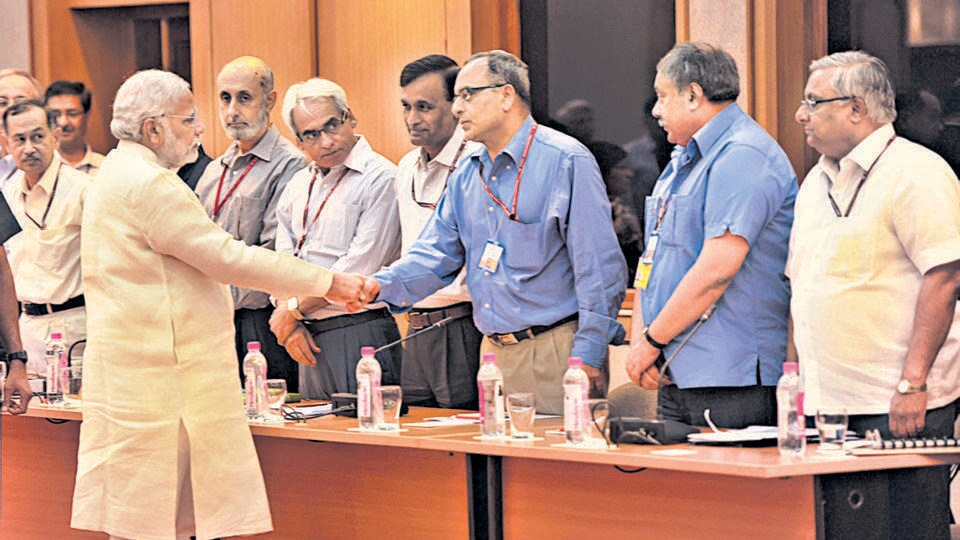
Prime Minister Narendra Modi is likely to meet top bureaucrats this weekend and instruct them to implement with greater efficacy good governance measures on public welfare, ease of living for citizens and last-mile service delivery, two people aware of the development said on Thursday.
Also Read: PM Modi’s Russia visit is to prepare for global uncertainty ahead
The PM may also review their individual department-related plans for the first 125-day agenda of the government and the progress so far, while reiterating the government’s key governance principle of antodaya (welfare of the people at the bottom of the pyramid), said the people cited above, requesting anonymity.
“The meeting is also expected to lay a five-year development roadmap of the government that would make the Indian economy the third largest in the world,” one of them said.
In Modi’s earlier two terms, India rose to become the fifth largest economy from the eleventh.
Also Read: View from the Himalaya | Continuity in ‘neighbourhood first’ policy evident in Modi 3.0
Modi often meets bureaucrats to understand practical issues in implementing key schemes on the ground, to help them set priorities and give them necessary directions for effective last-mile delivery, they said. In his first term, after assuming charge, Modi held the first such meeting on June 4, 2014, which went on for two-and-a-half hours, people aware of the matter said.
A similar meeting took place on October 17, 2016 where his ministers were also present. At a June 5, 2017 meeting with bureaucrats, the PM called for making institutions “outcome-oriented” and asked them to implement GST with full energy, something that turned out to be the biggest indirect tax reform that unified India as one market. In his second term, the PM met bureaucrats on June 10, 2019 and asked them to take the lead in implementing the new government’s agenda.
“The review is expected to be focused on already given parameters of good governance with special emphasis on the poor, women, youth and farmers,” one of the people said. Ideas related to better delivery of free ration to 800 million poor are expected to be discussed. Measures to check inflation of essential commodities such as food grains, edible oils, pulses and vegetables are likely to be discussed so that the poor can be shielded against any sudden spike in these items, they added.
Audit reports of flagship programmes such as health, education, housing and the drinking water mission may also draw Modi’s attention as feedback from the ground would become the basis to improve last-mile delivery, one of the persons said.
“The Prime Minister may ask departments to fix timelines for achieving different milestones related to key schemes, and the same could be routinely monitor by the PMO or the cabinet secretariat,” he said, citing the example of the PM Aawas Yojana. In the first two terms of the Modi government, almost 40 million houses were allotted to beneficiaries, mostly women, and Modi 3.0 plans to provide 30 million more.
The PM’s review may include action plans related to environment protection, labour reforms, issues related to urbanisation, rural development, farming green revolution, white revolution and blue revolution, a second person said. “Secretaries and heads of the departments were aware of the requirements under Modi 3.0 even before the elections, hence most of them are prepared with detailed reports along with a future road map,” he said.
“Modi 3.0 is likely to see policy continuity with far-reaching reforms in all sectors so that India can claim the position of the third largest economy in the world at the earliest, which will lead to Viksit Bharat (developed India) by 2047,” he added.


