E-Paper



No backup plan, serious lapses: Delhi fire probe that killed 9 in Palam Vihar finds tangled trail of missteps
The damning report raises concerns about fire safety, the unpreparedness of agencies to tackle emergencies and the brittle backbone of Delhi’s civic systems.

 Prefer HTon Google


The lift firefighters were using during operations to douse the March 18 blaze in a Palam Vihar building was delayed and derailed by a tangle of illegal overhead cables; the Delhi Fire Services (DFS) had no backup plan when the equipment failed and by the time a second lift arrived, the blaze had already spread; the official tasked with the investigation in the aftermath of the fire, which killed nine people, “lacked technical training” and had not unearthed the cause of any fire he had investigated.
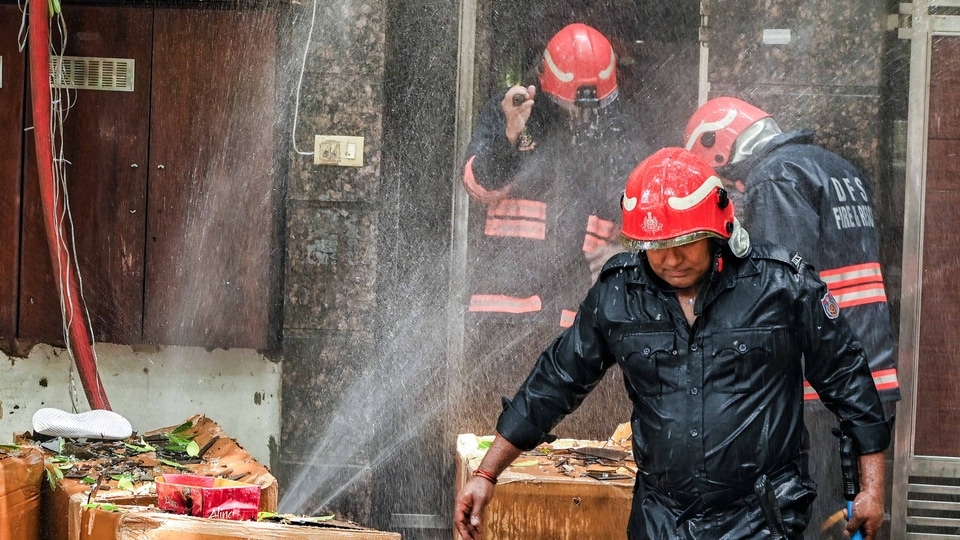
These are among the clutch of findings in an 85-page magisterial inquiry sent to the Delhi government’s home department highlighting lapses by the Municipal Corporation of Delhi (MCD) as well as the Delhi Fire Services (DFS).
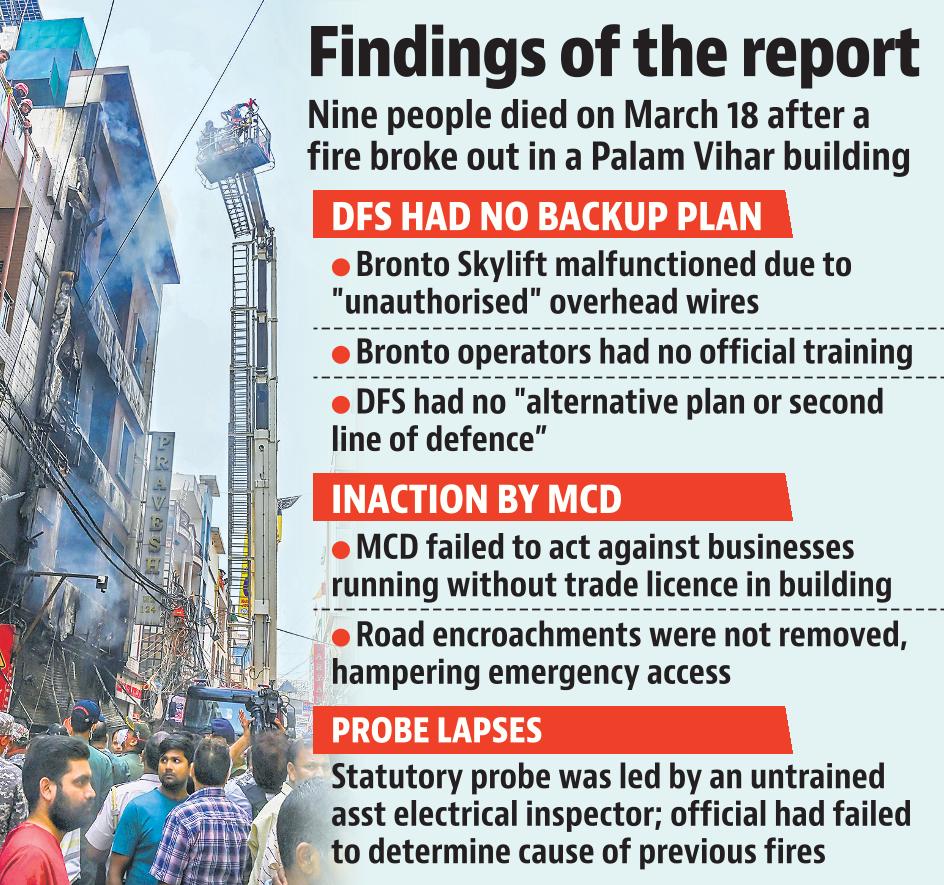
The damning report raises fresh concerns about fire safety in the Capital, the unpreparedness of agencies to tackle emergencies and the brittle backbone of Delhi’s civic systems.
Bruising year for Delhi’s infrastructure
It comes in the wake of a bruising year for Delhi’s infrastructure and its administrative responses, which have triggered questions over weak regulation, lethargic enforcement and questionable fire safety rules.
MCD officials did not respond to queries for comment.
Delhi’s chief fire officer AK Malik said, “We have not seen the report. We can only comment after going through it.”
The report, submitted by the district magistrate (south-west), concluded that the blaze most likely began due to an electrical short circuit near the ground-floor miniature circuit breaker (MCB) unit and rapidly engulfed the building, because of combustible material stored inside.
Indictment of agencies
According to the report, the Bronto Skylift, a truck-mounted aerial platform generally required for high-rise rescue operations, was taken to the site of the fire, but was unable to help with the rescue.
Witnesses and fire officials told the inquiry that “fault in Bronto Skylift (BS-III) could be due to trapped cables/wires hammers in the boom”, which hampered its functioning.
“During the inquiry, the Fire Operators informed that they faced difficulty in reaching the said building due to the presence of many unauthorised overhead wires… For the Bronto Skylift to reach the said building, the operators had to move the low-lying unauthorised cables manually with the help of ceiling hook and the banners were removed with help of local people to enable the Bronto to reach the incident site,” said the report.
It also noted that “there was no effective alternate plan or second line of defence available with officers, causing delay in rescue operations”.
By the time the second Bronto Skylift arrived, “it was too late” and all nine trapped people had died, said the report.
To compound matters, the officers assigned to the vehicle for nearly two years, had never received official training to operate the equipment. Instead, they learnt to operate the machine from their seniors.
However, the investigation turned the blame on the maze of unauthorised overhead telecom and internet cables.
It said the area’s discom, BSES Rajdhani, permitted only one telecom operator to use electricity poles in the lane and that several local internet operators installed cables without authorisation. So, the inquiry recommended bringing all internet and cable operators under a regulatory framework, making identification markings mandatory and initiating penal action against companies named in a BSES Rajdhani report submitted as part of the magisterial inquiry.
The investigator also held the MCD responsible for poor enforcement of licensing norms, underlining that trade licences were issued only for commercial activity in the basement and ground floor, but that these established extended into the first floor as well.
It also said licensing officials had failed to remove encroachments and banners from the road, narrowing the approach and hampering emergency access.
One of the strongest observations was directed at the Electrical Inspectorate, a wing under the Delhi labour department comprising officers who inspect electrical infrastructure in the wake of accidents.
It records that the assistant electrical inspector leading the statutory investigation under the inspectorate said he received no technical training after joining the service and had failed to determine the cause of any of the “eight or nine” previous fire incidents he investigated.
“It is sad and shocking that the Electrical Inspector, who is a qualified engineer mandated to conduct the statutory inquiry, is completely untrained and could not ascertain the cause of fire even in a single case during his service.”
The inquiry also highlighted severe manpower shortages and inadequate training within the Delhi Fire Services.
“...We could not save nine precious human lives for want of hassle free functioning of Bronto Skylift and also in the absence of the second line of defence,” it said.
The report added that firefighters “cannot be blamed” as they made their “best possible efforts” despite equipment failure, but called for “a complete overhauling in order to revamp the entire firefighting mechanism.”
It also recommended specialised training for operators of sophisticated equipment such as the Bronto Skylift, filling vacant posts, preparing standard operating procedures after every major fire and setting up an expert committee to determine the exact cause of the Skylift malfunction. The inquiry further criticised the fire department’s communication strategy, saying the absence of an official statement allowed speculation to dominate public discourse.
Previous blaze incidents in Delhi
A string of civic incidents have rattled Delhi this year.
On June 3, a fire at a bed-and-breakfast in Hauz Rani killed at least 21 people, including 12 foreign nationals. That came four days after the collapse of an illegal building in adjacent Saidulajab killed six people.
In May, a fire ripped through a residential building in Vivek Vihar, killing nine people.