E-Paper



PM Modi outlines BJP's roadmap for 2024:'Time for Uniform Civil Code'
Modi spoke for a full 110 minutes at the ’Mera Booth Sabse Majbut’ programme, addressing around 2500 raucous Bhartiya Janata Party booth workers in Bhopal

 Prefer HTon Google


Two days after he returned from the United States and Egypt, Prime Minister Narendra Modi made a sharp pivot to domestic politics, setting the contours of the BJP’s 2024 Lok Sabha push to his party’s booth workers, backing the demands for a Uniform Civil Code, reaching out to backward Muslims, attacking the opposition on dynasty and corruption and framing the choice facing voters as between “tushtikaran”(appeasement) and “santushtikaran”(the politics of satisfaction).
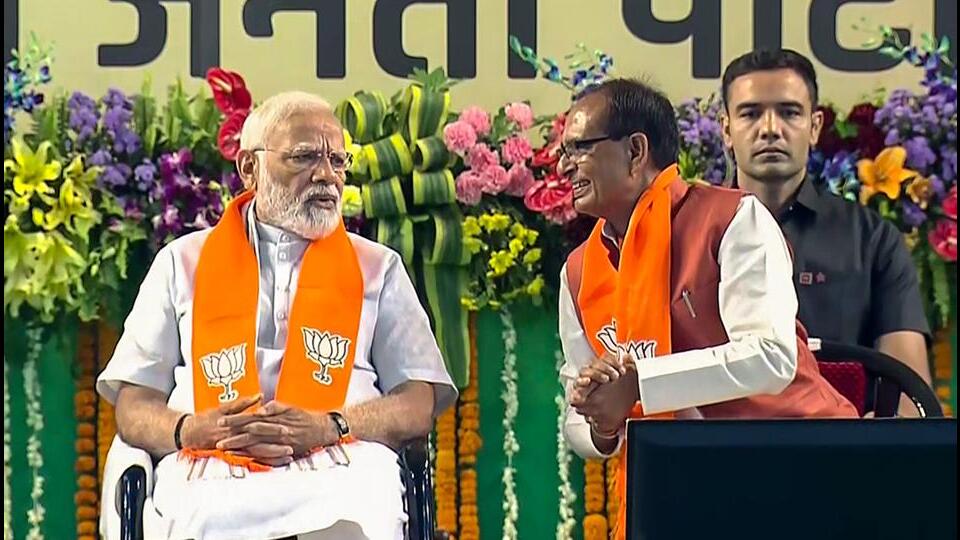
Modi spoke for a full 110 minutes at the ’Mera Booth Sabse Majbut’ programme, addressing around 2500 raucous Bhartiya Janata Party booth workers in Bhopal that often broke into chants of “Modi, Modi” or “Jai Shri Ram,” and over a million more booth workers watching online from across the country, in an event, he said, was likely unique anywhere in the world. “The organisation of an event on this scale, of ground workers of a political party, has perhaps never happened anywhere else in the world,” Modi said.

On the Uniform Civil Code
A little short of two weeks after the Law Commission of India solicited suggestions on the controversial Uniform Civil Code, in what is set to be a key fault-line ahead of the 2024 elections, Prime Minister Modi said that “Muslim brothers and sisters” would have to understand that political parties were “destroying them by taking advantage of them.”
Read | Muslims being instigated over Uniform Civil Code, says Modi, slams opposition
“These days, people are being provoked by the UCC. You tell me, if there is one law for one person in a home, and another law for another person, can that house function?” Modi asked. As the crowd roared in denial, Modi said, “Then how can a country work with such a hypocritical system? We have to remember that even the Constitution of India talks of common rights but the Muslim community has been deprived of education, of employment, and forced to live a difficult life. Even the Supreme Court says bring the Uniform Civil Code.”
Also read | ‘Why getting inspiration from Pak law’?: Owaisi on PM Modi's triple talaq remark
On Muslims
The Prime Minister specifically spoke of Pasmanda or backward Muslims, continuing an outreach he also made in February 2023, and argued that they had been left marginalised by those that do “vote bank politics.”
“A section of their own religion has exploited Pasmanda Muslims, something that hasn’t been discussed in the country. Several generations have had to suffer. But the BJP works in the spirit of ‘Sabka Saath, Sabka Vikaas,’” Modi said.
Modi said that “vote bank hungry” people had also been doing a great injustice to Muslim women by backing the practice of “teen (triple) talaq,” a mechanism of instant divorce outlawed by an act of parliament in July 2019. “If this was an essential practice in Islam, then no Muslim majority country would end teen talaq. I was in Egypt the day before where 90% of the population is Sunni Muslim. Ninety years ago, they ended teen talaaq. If it is so necessary, why does it not happen in Pakistan? In Indonesia? In Qatar, Jordan, Bangladesh? Why has it been ended there? This is why my Muslim sisters and daughters stand with the BJP, stand with Modi,” the Prime Minister said.
On Opposition unity and dynastic politics
Modi’s speech was framed as a series of answers to questions posed by booth workers from across the country, with one of those questions on the members of the Opposition gathering to begin the process of a united front against the BJP. Modi however pointed to both the 2014 and the 2019 Lok Sabha results and said that even in those two campaigns, the Opposition had not displayed the sense of desperation they are showing now. “There are some that called each other the enemy but today they are bowing down to each other. It is clear from their nervousness that the country has made up its mind to bring the BJP back in 2024,” he said.
With “guarantees” being a big part of a successful Congress campaign in Karnataka, where the BJP was soundly beaten earlier this year, and state specific “guarantees” now the cornerstone of the party’s Madhya Pradesh campaign, Modi said that it was the responsibility of the BJP worker to tell people the true meaning of the word. “All these people guarantee corruption of scams worth lakhs and crores of rupees. There was a photograph(of the opposition meeting)…all of them together are a guarantee of scams worth at least 20 lakh crores,” Modi said.
He named the allegations against the Congress, that, he said, had committed corruption from “helicopters to submarines”,RJD, TMC, DMK and the NCP. Thumping his chest, Modi said he had a guarantee of his own. “My guarantee is the guarantee of action against every scamster. The accounts of those who looted the poor and looted this country will be settled,” Modi said.
The Prime Minister said that the people had to decide what welfare they wanted to see. “If you want to see the development of the sons and daughters of the Gandhi family, vote for the Congress. If you want the welfare of the son of Mulayam Singh Yadav, vote for the Samajwadi Party. If you want the development of Lalu Yadav’s family, vote for the RJD. If you want the development of Sharad Pawar’s daughter, vote for the NCP. If you want the development of the Abdullah family, vote for the National Conference. But listen carefully, if you want the growth of your son, your daughter, your grandson and your grand daughter, then vote for the BJP,” the PM said.
Appeasement vs politics of satisfaction
The Prime Minister framed the choice that presented itself to the Indian voter in 2024 as one between the politics of “tushtikaran”(appeasement) and the politics of “santushtikaran”(satisfaction.) “The path of santushtikaran is one of hard work. If electricity comes, everyone will get it, and everyone will be satisfied. If nal se jal abhiyan (piped water) is being there, everyone will get it, the attempt will be made for every home to get it. There will be no discrimination, not on caste, not on community,” Modi said.
He targeted parties of “social justice” (read: the SP, JDU and RJD mainly) and said that they had done great damage to the fabric of India, erecting walls between people and deepening cleavages. “In UP, our Paasi brothers and sisters, Khatik brothers and sisters, Kori brothers and sisters, and small communities like Dhanuk became the victims of politics, and remained separated from development. If we look at Bihar, there are Dalits and Mahadalits. Because of this, one community looked at another with suspicion,” Modi said.
As the crowd cheered as he named one caste after another, Modi took care to underline marginalisation of communities in southern India, a region where, outside of Karnataka, the BJP still has little national footprint, calling out deprived castes in Karnataka, Andhra Pradesh, Kerala and Tamil Nadu.
Government’s achievements
Modi lauded his government’s achievements over the past nine years, and said that India was one of the few countries where inflation is under control. “There are several countries where after Covid 19, inflation has broken all records. Look at our neighbourhood. The inflation rate in Pakistan is more than 38%…in India it is less than 5%,” Modi said.
He spoke of a string of government schemes such as the Prime Minister Swanidhi scheme that provides monetary incentives to street vendors, the Har Ghar Jal scheme that promises running tap water in every home by 2024, and the Prime Minister Kisan Samman Nidhi. “The BJP government today directly sends the money to the farmers accounts. 2.25 lakh crore have already been transferred under the scheme.”
The PM’s reference to UCC is an indication that it may become an election plank for the 2024 polls, said Ajay Gudavarthi, a professor at the Jawaharlal Nehru university.
“It is becoming clear that 2024 will be fought on the basis of mandir and UCC. His comment needs to be seen considering the upcoming monsoon session of Parliament and a possible Opposition rancour over the recent questioning in the US regarding the situation of minorities in India and violence in Manipur,” he added.
The experts feel that the PM set the agenda of 2024 elections and also cleared that party leadership is more focused on Lok Sabha election. “The PM Narendra Modi has clear all the agendas for booth managers. In the speech, the PM focused only on union government issues so it clear that BJP leadership wants to focus on Lok Sabha elections only. He tried to bring clarity in the mind of booth managers that how to attack on oppositions,” said Girija Shankar political analyst and author.
However, the expert said it is hard to say will it work or not. “Undoubtedly, BJP saw a setback in state elections in Himachal Pradesh and Karnataka because people didn’t rely on the promises of BJP. It will be interested to see that whether people will trust BJP on these issues or not,” said senior journalist Deepak Tiwari.