Chaos in Nagaland as govt decides to go ahead with civic polls after HC order
Chaos prevailed in several parts of Nagaland on Tuesday evening following the state government’s announcement to roll back its earlier decision and hold elections to urban local bodies on February 1 following a directive from the Gauhati High Court.
Chaos prevailed in several parts of Nagaland on Tuesday evening following the state government’s announcement to roll back its earlier decision and hold elections to urban local bodies on February 1 following a directive from the Gauhati High Court.
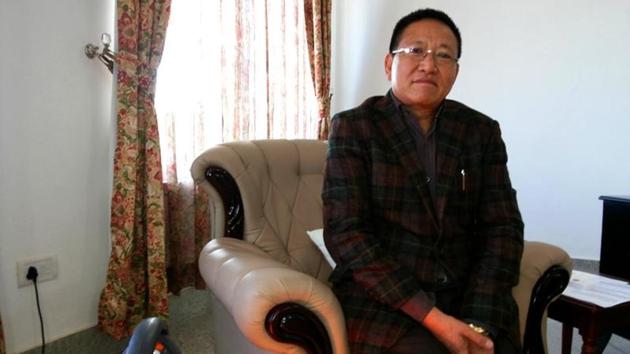
An agreement between the Nagaland government and a group of tribal organisations opposing to reservation for women was signed in the presence of Nagaland chief minister TR Zeliang (in pic). (File photo)
{{^htLoading}} {{/htLoading}}
The move comes a day after the state government signed an agreement with the Joint Coordination Committee (JCC), comprising tribal bodies opposed to giving 33% reservation to women candidates, to postpone the polls by two months.
The mood in Nagaland changed quickly on Tuesday night, when the Naga Peoples’ Front (NPF) government headed by TR Zeliang acting on the HC directive decided to conduct polls in 12 of the 32 municipal bodies in the state.
As soon as the news spread, hundreds of youths came out on the streets in commercial hub Dimapur with spears, daggers and other arms to register their protest. They also appealed to others to do the same to prevent the polls from being held. The administration was forced to clamp curfew in some areas.
{{^htLoading}} {{/htLoading}}
{{^usCountry}}
Subsequent to the deal with the state government on Monday, JCC had called off its ongoing bandh to protest against the polls. But following Tuesday’s HC order, the ‘bandh’ call was enforced again.
{{/usCountry}}
{{#usCountry}}
Subsequent to the deal with the state government on Monday, JCC had called off its ongoing bandh to protest against the polls. But following Tuesday’s HC order, the ‘bandh’ call was enforced again.
{{/usCountry}}
Due to a boycott call and threat of ex-communication by JCC, no candidate had filed nomination in 10 municipalities and in 3 urban bodies the candidates had won unopposed.
Following the state government’s request to the state election commission to postpone polls in seven ULBs, including Dimapur, for fear of law and order problems, election to those civic bodies have been postponed by two months.
Tuesday’s HC order came after a petition was filed seeking the court’s intervention to hold polls as “some extra-constitutional bodies, opposed to the elections, were creating hurdles”.
{{^htLoading}} {{/htLoading}}
Nagaland has never elected a women legislator to the assembly since it gained statehood in 1963. The lone woman MP from the state was late Rano M Shaiza, who got elected in 1977.
A seasoned senior journalist, I have nearly three decades of experience across print, digital, and online platforms, covering political transitions, insurgencies, environmental issues, and development stories in India and Nepal. I am skilled in breaking news, leading editorial teams and launch of newspaper editions. I am adept at leveraging digital trends and social media to expand global reach, with a strong ethical foundation and a reputation for impactful journalism. An alumnus of Asian College of Journalism, I joined Hindustan Times in New Delhi as a trainee reporter in May 1997. Over the years, I have been posted in Dehradun, Kathmandu (Nepal) and Guwahati. Currently, as Senior Assistant Editor at Hindustan Times, I lead a team reporting on India’s northeastern states. My work involves in-depth analysis, and engaging multimedia storytelling across formats, including text, photo, video, and interactive content. I am skilled in producing timely, shareable content, leveraging digital platforms and social media to engage global audiences. Throughout my career with the Hindustan Times, I have led diverse editorial teams, designed capacity-building activities, and supported reporters in developing strong story ideas, ethical reporting practices, digital skills, and fact-checking techniques. As Senior Assistant Editor for Northeast India, I have been responsible for guiding correspondents through complex political, humanitarian, and community-level stories using multimedia formats. Earlier, as Foreign Correspondent in Nepal, I produced extensive reporting during Nepal’s democratic transition and the 2015 earthquake and its aftermath.
Get Latest News, breaking headlines, and top India News, and today real-time updates from across the nation. Stay informed on politics, government policies, crime, Today Weather, and major developments on Hindustan Times
Get Latest News, breaking headlines, and top India News, and today real-time updates from across the nation. Stay informed on politics, government policies, crime, Today Weather, and major developments on Hindustan Times