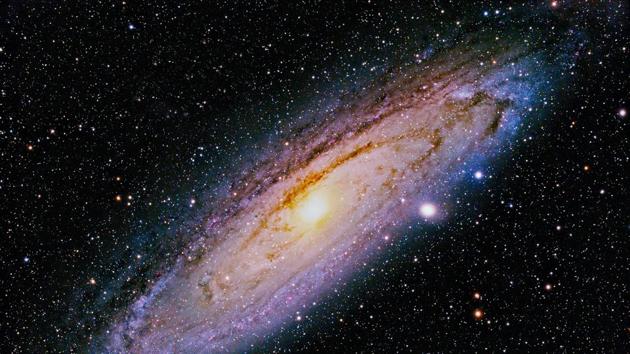
NASA congratulates Indian astronomers on Star Galaxy discovery
India’s AstroSat/UVIT was able to achieve this unique feat because the background noise in the UVIT detector is much less than one on the Hubble Space Telescope of US-based NASA.
The National Aeronautics and Space Administration (NASA) on Wednesday congratulated Indian astronomers on the discovery of one of the farthest Star galaxies in the universe estimated to be located 9.3 billion light-years away from Earth.
India’s first Space Observatory AstroSat, was launched by the Indian Space Research Organization (ISRO) on September 28, 2015. (Getty Images/iStockphoto (Representative Image))
{{^htLoading}} {{/htLoading}}
“NASA congratulates researchers on their exciting discovery. Science is collaborative effort around the world and discoveries like these help further humankind’s understanding of where we come from, where are we going, & are we alone,” NASA Public Affairs Officer, Felicia Chou told ANI.
{{^htLoading}} {{/htLoading}}
{{^usCountry}}
India’s first Multi-Wavelength Space Observatory AstroSat detected extreme-UV light from a galaxy located 9.3 billion light-years away from Earth. The galaxy called AUDFs01 was discovered by a team of astronomers led by Dr Kanak Saha from the Inter-University Centre for Astronomy and Astrophysics(IUCAA) Pune.
{{/usCountry}}
{{#usCountry}}
India’s first Multi-Wavelength Space Observatory AstroSat detected extreme-UV light from a galaxy located 9.3 billion light-years away from Earth. The galaxy called AUDFs01 was discovered by a team of astronomers led by Dr Kanak Saha from the Inter-University Centre for Astronomy and Astrophysics(IUCAA) Pune.
{{/usCountry}}
{{^htLoading}} {{/htLoading}}
India’s AstroSat/UVIT was able to achieve this unique feat because the background noise in the UVIT detector is much less than one on the Hubble Space Telescope of US-based NASA.
India’s first Space Observatory AstroSat, was launched by the Indian Space Research Organization (ISRO) on September 28, 2015.
Follow the latest breaking news, major developments and agenda-setting stories from India and around the world with the newsdesk at Hindustan Times. Operating round the clock, the desk brings together experienced editors, reporters and correspondents to deliver fast, accurate and contextual reporting across subjects that influence public policy, governance, business, society and international affairs. The HT News Desk covers politics, elections, government policies, the economy, business and markets, science and technology, the environment, law and order, infrastructure, education, climate issues and geopolitics, while closely tracking developments across states, institutions and global capitals. The team also leads coverage of major breaking news events, policy announcements, court proceedings, natural disasters, public emergencies and significant international developments. Reports published by the newsdesk are based on information gathered from reporters on the ground, official statements, government agencies, court records, regulatory filings, recognised institutions and other authoritative sources. Stories undergo editorial scrutiny and verification processes to ensure accuracy, fairness and relevance, and are updated as events evolve and additional information becomes available. Whether covering a key political decision in New Delhi, an economic policy shift affecting millions, a landmark court ruling or a major global event, the HT News Desk aims to provide readers with reliable, fact-based journalism that delivers not only the latest developments but also the context and analysis needed to understand their wider implications.
Get the latest India News, breaking headlines, and real-time updates from across the nation. Stay informed on politics, government policies, crime, weather, and CEC Gyanesh Kumar row Live.
Get the latest India News, breaking headlines, and real-time updates from across the nation. Stay informed on politics, government policies, crime, weather, and CEC Gyanesh Kumar row Live.