NEET-UG: IIT-Delhi expert panel submits report on right answer to physics question before Supreme Court
The top court bench comprising CJI DY Chandrachud and Justice JB Pardiwala asked the IIT-Delhi to set up an expert panel to look into the controversial question
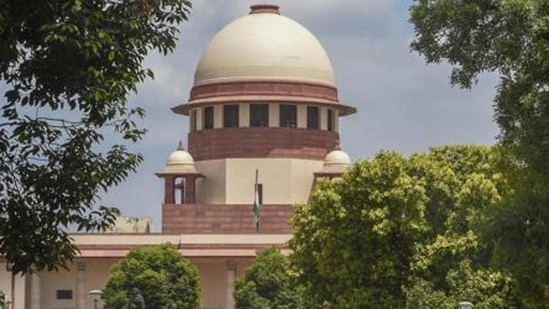
A panel of experts from Indian Institute of Delhi (IIT-D) told the Supreme Court on Tuesday that there is only one correct answer and not two to a controversial physics question asked in the NEET-UG 2024 examination. The top court bench comprising Chief Justice DY Chandrachud and Justice JB Pardiwala had asked the IIT-Delhi director to set up a team of experts for looking into the particular question and submit a report by today afternoon.
Supreme Court had asked the IIT-Delhi to set up a panel of experts and look into the correct answer of the contentious physics question
{{^htLoading}} {{/htLoading}}
“We have received the IIT Delhi report. The IIT Director Rangan Banerjee...constituted a committee from the department of physics and they say a team of three experts examined the question. They say that the option four is the correct answer,” the CJI was quoted by the PTI as saying.ALSO READ: NTA refutes conflict of interest claims in NEET-UG report by IIT-Madras director
What was the question?
{{^usCountry}}{{/usCountry}}
The question read- Given below are two statements: Statement I: Atoms are electrically neutral as they contain equal number of positive and negative charges. Statement II: Atoms of each element are stable and emit their characteristic spectrum.
"In the light of the above statements, choose the most appropriate answer from the options given below:
{{^htLoading}} {{/htLoading}}
{{^usCountry}}
(1) Statement I is incorrect but Statement II is correct.
{{/usCountry}}
{{#usCountry}}
(1) Statement I is incorrect but Statement II is correct.
{{/usCountry}}
(2) Both Statement I and Statement II are correct.
(3) Both Statement I and Statement II are incorrect.
(4) Statement I is correct but Statement II is incorrect.
"The committee has opined clearly that there was only one option which is option four (4). So the National Testing Agency (NTA) was correct in its answer key which was option four (4)," the apex court bench said.
The Supreme Court is hearing on submission by candidates who argued that the question had two correct answers and a set of examinees who gave one particular answer of the two correct ones were awarded four marks. ALSO READ: Over 11,000 NEET-UG candidates scored zero, negative marks
{{^htLoading}} {{/htLoading}}
According to the lawyers, one set of aspirants got minus five for the correct answer, the second lot got four marks for another correct answer and the third group comprised those who skipped it for either want of knowledge or due to the fear of getting negative marks.
This would have a significant impact on the merit list of successful candidates, a bench was told.
Follow the latest breaking news, major developments and agenda-setting stories from India and around the world with the newsdesk at Hindustan Times. Operating round the clock, the desk brings together experienced editors, reporters and correspondents to deliver fast, accurate and contextual reporting across subjects that influence public policy, governance, business, society and international affairs. The HT News Desk covers politics, elections, government policies, the economy, business and markets, science and technology, the environment, law and order, infrastructure, education, climate issues and geopolitics, while closely tracking developments across states, institutions and global capitals. The team also leads coverage of major breaking news events, policy announcements, court proceedings, natural disasters, public emergencies and significant international developments. Reports published by the newsdesk are based on information gathered from reporters on the ground, official statements, government agencies, court records, regulatory filings, recognised institutions and other authoritative sources. Stories undergo editorial scrutiny and verification processes to ensure accuracy, fairness and relevance, and are updated as events evolve and additional information becomes available. Whether covering a key political decision in New Delhi, an economic policy shift affecting millions, a landmark court ruling or a major global event, the HT News Desk aims to provide readers with reliable, fact-based journalism that delivers not only the latest developments but also the context and analysis needed to understand their wider implications.
Get Latest News, breaking headlines, and top India News, and today real-time updates from across the nation. Stay informed on politics, government policies, crime, Today Weather, and major developments on Hindustan Times
Get Latest News, breaking headlines, and top India News, and today real-time updates from across the nation. Stay informed on politics, government policies, crime, Today Weather, and major developments on Hindustan Times
Home/India News/NEET-UG: IIT-Delhi expert panel submits report on right answer to physics question before Supreme Court
{{^htLoading}}
Advertisement
{{/htLoading}}
SHARE THIS ARTICLE ON
{{#usCountry}}{{/usCountry}}
Notifications
Get breaking alerts directly from the newsroom
Notifications are on!You'll be notified when news breaks