
 E-Paper



Nitish Kumar soldiers on, his relevance endures as NDA heads to landslide victory
Kumar’s Janata Dal (United) or JD(U) is set to improve its tally, with continued backing from women, extremely backward castes (EBCs), and the Maha Dalits

 Prefer HTon Google


Bihar’s longest-serving chief minister, Nitish Kumar, 74, has been the fulcrum of the National Democratic Alliance (NDA)’s rule in the state for almost two decades. With the NDA headed for a landslide victory, the “sushasan (good governance) babu” soldiers on. His relevance has endured over 20 years despite switching alliances and getting fewer seats than his partners.
Kumar’s Janata Dal (United) or JD(U) is set to improve its tally, with continued backing from women, extremely backward castes (EBCs), and the Maha Dalits, after registering a dismal performance five years earlier. In 2020, the JD(U) got just 43 seats in the 243-member House. It was the third-largest party after alliance partner Bharatiya Janata Party (BJP) and Opposition Lalu Yadav’s Rashtriya Janata Dal (RJD).
An 8.8% point increase in women’s turnout appears to have played a key role in JD(U)’s improved performance. The women’s turnout was highest since 1962, when gender-based polling was first recorded in the state elections. Overall, 71.6% of women voted compared to 62.8% men.
The disbursal of ₹10,000 each to 14.1 million women under a scheme to promote their empowerment through self-employment in the run-up to the polls is seen to have consolidated Kumar’s support among women. The scheme promises up to ₹two lakh more for women who start businesses.
Kumar, who has crafted a formidable social coalition even as his Kurmi caste accounts for less than 3% of Bihar’s population, has made the most of his reputation as an inclusive, incorruptible leader and a competent administrator. He also has a higher acceptability among all castes, including Yadavs and Muslims, who have traditionally supported the RJD.
Two days before the first phase of voting on November 6, he reminded voters, in a four-minute video, that he had served them with “honesty and transformed” the state. Kumar said the “world Bihari” was no longer about “insult” but “pride”. He added that he had worked day and night since 2005 with full honesty and hard work.
Kumar reminded people of his government’s inclusive approach. He said he had worked for the development of all sections of society while doing nothing for his family in a veiled swipe at the RJD chief.
Kumar’s administrative record has stood him in good stead. He has been credited with improving law and order, rebuilding infrastructure, championing women’s empowerment, and improving education.
He took over when Bihar was known for lawlessness, broken roads, and misgovernance. Kumar, an engineering graduate, has symbolised tangible governance that improved lives for a generation of voters.
Born in the small Bakhtiyarpur town in 1951 to a middle-class family, Kumar joined politics under socialist leader Ram Manohar Lohia’s influence. He was elected to the Bihar assembly for the first time in 1985. Kumar was a close aide to Lalu Prasad Yadav before their falling out and Janata Dal’s split. He supported Yadav’s bid to be the leader of the Opposition in 1989 and the chief minister a year later.
In 1994, Kumar was instrumental in the revolt against Yadav and the formation of the Samata Party under George Fernandes’s leadership. Kumar was inducted as the railway minister in the Atal Bihari Vajpayee government, when the Samata Party aligned with the BJP.
In 2000, Kumar became chief minister for the first time. But the tenure lasted just seven days, as he failed to prove a majority. He never looked back after taking over in 2005 in alliance with the BJP.
In 2013, he quit NDA when Narendra Modi was named the BJP’s prime ministerial candidate. He contested the 2015 assembly polls in alliance with the RJD and became the chief minister despite getting fewer seats. Two years later, he ditched the RJD and formed the government with the BJP.
The JD(U) was reduced to 43 seats in 2020, even as the NDA won the state assembly election with Kumar at the helm again. In 2022, Kumar returned to the RJD-led alliance. The delay in naming him the convenor of the Congress-led Indian National Developmental Inclusive Alliance (INDIA) prompted Kumar to rejoin the NDA in January 2024 and retain the chief minister’s post.
The frequent stitches, which his supporters called pragmatism and his critics opportunism, kept him relevant in Bihar politics, even though they hurt his image. Kumar has successfully mastered the art of coalition management and caste arithmetic. The 2025 election results show Kumar continues to be indispensable, proving critics who have often written him off wrong again.
Kumar held 84 election rallies as part of Samadhan Yatra across the state despite much speculation about his health. The BJP was forced to repeatedly project Kumar as the chief minister, underscoring his importance in the absence of an alternative.
As Kumar embarked on what may well be the final stretch of his career, voters appeared to reward him for his good work by sticking with him. Many voters across Bihar said they wanted him to be the chief minister again, as it could be his last election. This was particularly true about EBCs and women voters, many of whom credited him with empowering them like no other leader.
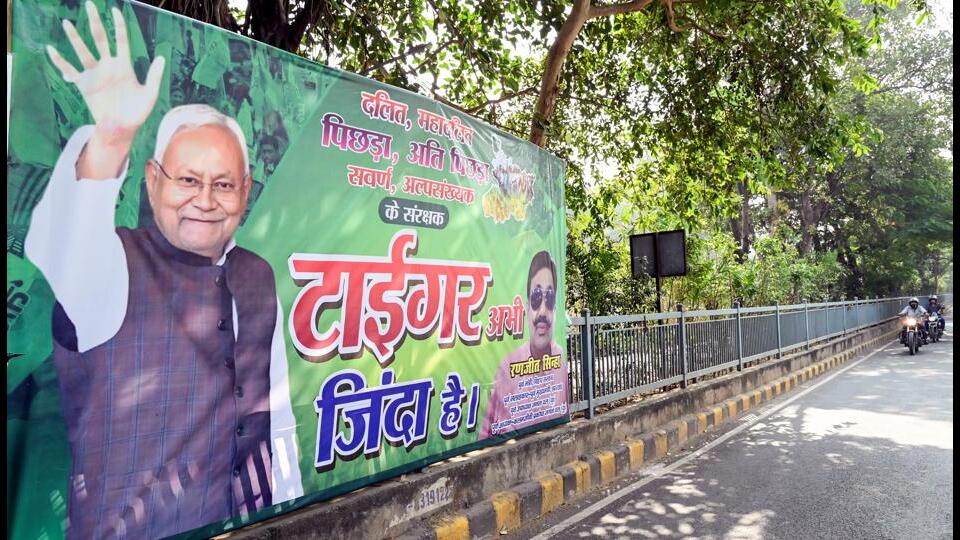
Written off more than once, a poster outside the JD(U) office in Patna summarised his determination: “Tiger Abhi Zinda Hai [Tiger Is Still Alive],” it said.


