E-Paper



32 million population, 4 million more homes: Inside Delhi's 2047 master plan
The population projection of 32 million for 2047 means that it will grow 10 million from what it is estimated to be right now.

 Prefer HTon Google


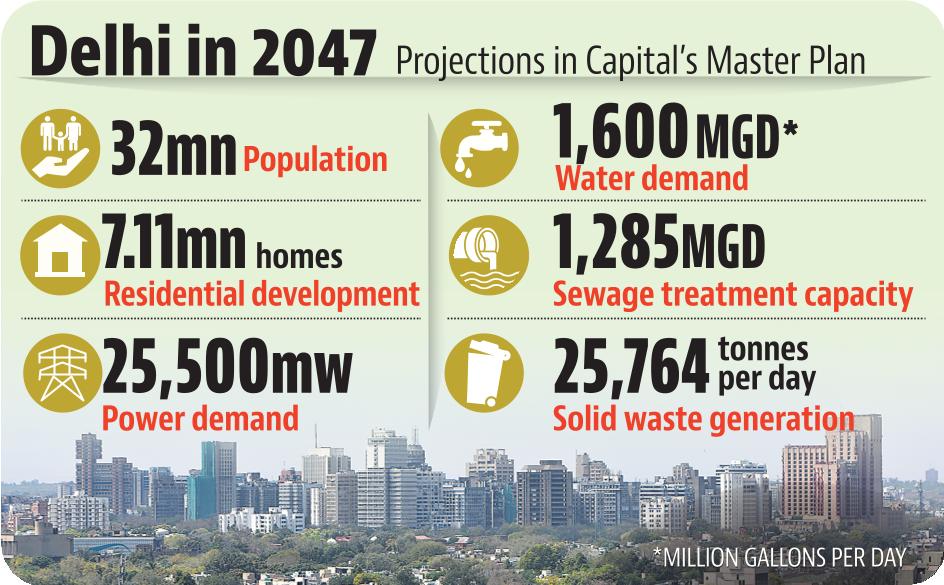
The Capital’s population will likely touch 32 million by 2047 and require nearly four million additional houses, triple the current power generation capacity and double the current solid waste management capability, projections in the Master Plan for Delhi (MPD)-2047 say.
The plan — seen by HT, which sets out a long-term framework for the Capital’s housing, mobility, infrastructure, environment and economic development — was approved by the Delhi Development Authority (DDA) on Wednesday.
It will now be sent to the Union ministry of housing and urban affairs (MoHUA) for final approval and subsequent notification.
Also read: New master plan to allow commercial development in 70 peripheral villages
The plan outlined infrastructure interventions – including augmenting water supplies, expanding sewage treatment capacity, improving drainage, and implementing measures – to manage a substantial increase in municipal solid waste.
Migration likely to contribute 41% of population rise
The population projection of 32 million for 2047 means that it will grow 10 million from what it is estimated to be right now.
By 2041, the document stated that the Capital’s population will be 29.2 million.
The MPD-2047 added that “migration is estimated to contribute 41% of the population increase in Delhi during the plan period”, compared to 50% in the previous 2021 plan period.
The city was expected to see a rise in its working-age population, while the share of people aged 60 and above was also projected to increase, the plan added.
Delhi's housing requirements to rise
The increase in population will necessitate a proportional rise in housing requirements. The plan estimates the housing demand for the period 2011-47 at nearly four million dwelling units, based on an average household size of 4.5 persons. In 2011 – the last year when the census was conducted – Delhi had 3.11 million houses.
The demand calculation depended on the existing housing backlog, new demand arising from population growth, replacement of obsolete housing stock and vacant housing stock.
The MPD asked for new housing units in greenfield projects and regenerating or developing existing areas such as unauthorised colonies, including Sangam Vihar, or old areas.
Also read: DDA clears Delhi 2047 plan, opens door to development in 70 villages, parts of Yamuna floodplain
The increased population is set to place significant strains on the city infrastructure and require massive capacity augmentation.
Roadmap for meeting Delhi's water requirements
On drinking water, the MPD projected Delhi’s potable water requirement to reach around 1,600 million gallons per day (MGD) by 2047.
In 2021, the city’s water supply was 935 MGD against an estimated demand of 1,380 MGD. Now, the supply capacity is 1,000 MGD and the demand is at least 1,200 MGD.
The Delhi Jal Board has projected an additional water requirement of 401 MGD by 2047 in the master plan.
To bridge the gap, the plan proposes augmenting supply by 110 MGD through medium-term interventions over the next four to five years and another 291 MGD through medium - to long-term measures over the following 10-15 years.
These measures include replacing Yamuna water currently used for irrigation with treated wastewater, procuring additional raw water from Uttar Pradesh and developing upstream storage projects at Renukaji, Lakhwar and Kishau dams that are currently under construction.
“The plan also says achieving the augmentation targets will require coordinated efforts with neighbouring states, particularly Uttar Pradesh, Haryana and Himachal Pradesh, along with facilitation by the Centre,” said an official aware of the matter.
On sewage treatment, the MPD said the infrastructure will need significant expansion.
The city currently has an installed sewage treatment capacity of 814 MGD and treats 744 MGD of wastewater.
By 2047, the plan proposes increasing the capacity to around 1,285 MGD, equivalent to 80% of the projected water supplied to the city.
The plan also identified gaps in sewer connectivity and untreated sewage entering drains as key infrastructure concerns.
Of the 22 major drains in Delhi, 11 have already been intercepted to prevent untreated effluent from reaching the Yamuna.
It proposed 28 decentralised treatment plants along all drains, along with decentralised wastewater treatment and interceptor sewer systems along smaller drains in areas where conventional sewer lines cannot be laid.
Waste generation to double in 20 years
Municipal solid waste generation is expected to almost double over the next two decades.
The master plan estimated that the national capital will generate around 13,500 tonnes per day (TPD) of municipal solid waste by the end of 2026, which will rise to 25,764 TPD by 2047.
“The existing landfill sites at Bhalswa, Ghazipur and Okhla have already exceeded their capacity. The plan notes that Delhi is flattening legacy landfills through biomining, with the process aimed at segregating, processing and clearing accumulated waste,” the official cited above added.
Higher electricity requirements
Electricity demand was projected to increase sharply alongside population and economic growth.
Delhi’s conventional power supply capacity was 7,161 megawatt in 2021, while renewable operational power purchase agreements accounted for another 923 MW.
The plan estimated that peak power demand could reach 25,500 MW by 2047, which is currently around 9,500 MW.
The plan called for the city to shift towards cleaner energy sources while expanding infrastructure to meet future demand.
The MPD asks for greater infrastructure requirements to address flooding and waterlogging.
It noted that the national capital’s drainage system was shaped by the Aravalli foothills, with stormwater generally moving from higher elevations in the west towards the Yamuna.
The proposed measures included rejuvenation of water bodies, using parks for rainwater harvesting, regulating solid-waste dumping in drains and preparing a Delhi Drainage Master Plan to meet requirements over the next 30 years.
What Delhi needs to meet housing requirements
Real estate experts said that meeting the housing requirement of 4 million homes by 2047 will require a substantial and skilled construction workforce.
This will create significant employment opportunities across construction, engineering, architecture and allied sectors. “Greater adoption of modern construction technologies can also improve productivity and reduce dependence on conventional labour-intensive methods. Delhi should focus on planned, high-density and efficient development, including group housing, TOD, redevelopment and affordable and mid-income housing. Greater use of modern and technology-driven construction methods will also help Delhi meet its housing requirements efficiently,” said Harsh Vardhan Bansal, President, NAREDCO Delhi.