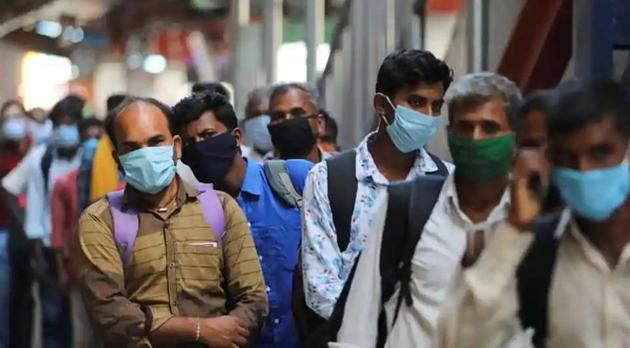
People not wearing masks in public spaces are violating the fundamental right to life of everyone else, the Supreme Court said on Thursday as it implored all states to enforce the guidelines on wearing masks and social distancing scrupulously in the face of the Covid-19 pandemic.
At the same time, the apex court stayed a Gujarat high court order that sought to punish those not wearing masks in public by assigning them to Covid-19 centres to perform non-medical duties, terming the punishment “disproportionate”.
A bench headed by justice Ashok Bhushan regretted that people have been recently showing a lack of will to follow the guidelines meant to prevent the spread of the virus, and the authorities were apathetic in implementing the norms on masks and social distancing.
“Those who are not wearing masks are affecting fundamental rights of others. They may hamper health of other people,” remarked the bench, which also included justices RS Reddy and MR Shah.
When solicitor general Tushar Mehta, appearing for the Centre and the Gujarat government, said there was nothing to show that the police could be encouraging the trend, the bench retorted: “Truth can easily be seen. And we are not talking only about one state but the problem across the nation.”
The court added that these guidelines and standard operating procedures had been issued by the Union health ministry and states too, but the major hurdle was of their implementation.
{{/usCountry}}The court added that these guidelines and standard operating procedures had been issued by the Union health ministry and states too, but the major hurdle was of their implementation.
{{/usCountry}}“There is a lack of will everywhere. There is no implementation. Everybody is moving without masks in markets, malls, marriages and all kinds of ceremonies. There are more than 1,000 people in a marriage ceremony? How is this happening? What is police doing,” the bench asked Mehta.
It also took a dim view of large gatherings in marriages and processions, observing that some states had even done away with the necessity of seeking prior approval from the authorities for organising such congregations.
Mehta accepted that it was a pan-India problem, and that certain urgent measures, including imposition of a higher fine on violators, can be ordered by the apex court.
At this, the bench reiterated that enhancing the fine may not suffice until there is proper implementation.
Mehta, on behalf of the Gujarat government, had sought a stay of the high court order to send those not wearing masks in public to perform non-medical duties in Covid-19 centres as punishment.
The bench concurred with the solicitor general that such punishment may pose serious health risks even to non-Covid-19 persons, and stayed this part of the order.
But at the same time, the court underlined that the stay order cannot be construed as encouraging people to not wear masks.
Thus, the bench directed Gujarat’s additional secretary, home, to ensure the requirement of wearing mask and social distancing were rigorously implemented. It also directed the state police to make certain all guidelines are implemented in the state.
It further asked all state governments to submit suggestions by Monday on how to control public gatherings and ensure compliance with the requirement of wearing masks and maintaining social distancing.
The bench said it will consider issuing directions for all states after the responses are received.