There is no evidence yet to assume that the next wave of infections will hit children harder, the government’s top experts said on Monday, citing data that suggests the impact of Covid-19 on different age groups was similar in the second wave of cases to what it was in the first, last year.
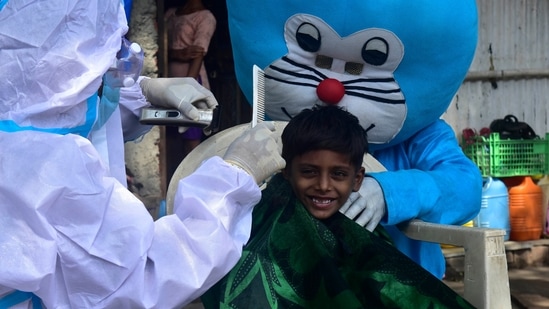
The clarifications come at a time when several officials, and some experts, have said that children may be at higher risk in the future. Most experts, however, say that this could be because children are not yet eligible for vaccines and getting doses to them could take longer.
“If we look at the data, and compare both the Covid-19 waves, children are usually protected as the numbers are fewer. Even if they get infection, the disease is usually mild. The virus is the same; it has not changed, and there is no indication that in the third Covid-19 children will be more impacted,” said Dr Randeep Guleria, director, All India Institute of Medical Sciences (AIIMS).
“Another hypothesis is that the virus enters the body with the ace receptor, and in children you find less OF such receptors as compared to adults. This is one hypothesis why the disease is less in children. So far, there is no data to show children are getting more affected, so in future too we cannot say for sure if children will be impacted more. There could also be another theory that says since kids aren’t exposed much yet, in the next wave there’s a possibility that proportionally they may get more affected by virtue of greater exposure,” he added.
Guleria also said that in AIIMS, a routine death audit was being done in people who succumbed to Covid-19 and comparing the data from the past one-and-a-half months to the previous Covid-19 wave showed age-group and comorbidity parameters were almost similar. Older people, and people with more than one comorbidities, were most affected.
{{/usCountry}}Guleria also said that in AIIMS, a routine death audit was being done in people who succumbed to Covid-19 and comparing the data from the past one-and-a-half months to the previous Covid-19 wave showed age-group and comorbidity parameters were almost similar. Older people, and people with more than one comorbidities, were most affected.
{{/usCountry}}“We try to present the bigger picture in front of people. In the past it has been clarified that in both the waves, the level of infection in different age groups has remained the same. Overall, the infection pattern in both the waves is the same. There is not much difference. Also, mortality is higher in people above 60 years, and those suffering from comorbidities, which is why in our vaccination programme this category is the priority age group,” said Lav Agarwal, joint secretary, health ministry.
Dr Guleria also warned that with rise in Covid-19 recovery numbers, doctors and members of the public will have to be watchful of post-Covid-19 issues such as breathing difficulty, fatigue, chest tightness, cough, and other conditions that recovered people tend to experience for a long time.
“There are various symptoms that remain even after one has recovered from Covid-19. Now we even roughly know at what interval roughly people remain affected. For example, if your symptoms stay for 4 to 12 weeks, then we call it ongoing symptomatic Covid-19 or post acute Covid-19 syndrome; and if the symptoms stay for more than 12 weeks than it is termed as post Covid-19 syndrome or long Covid-19. There are many Covid-19 patients who may show symptoms even for 12 weeks, and require treatment,” said Dr Guleria.
As a solution, Dr Guleria said that there was a need for setting up multi disciplinary post covid clinics where these people can be rehabilitated, and also to encourage people to perform yoga etc. to improve lung capacity and overall well-being.