
 E-Paper



No terror sanctuary safe: Army warns Pakistan on Op Sindoor anniversary
‘Operation Sindoor stands as a defining testimony to India’s resolve against terror and to the decisive strategic vision of the country’s national leadership’

 Prefer HTon Google


Terror sanctuaries in Pakistan are no longer safe as India will hit them hard on its own terms, choosing the timing, conditions, and method of action, deputy chief of army staff (strategy) Lieutenant General Rajiv Ghai said on Thursday.
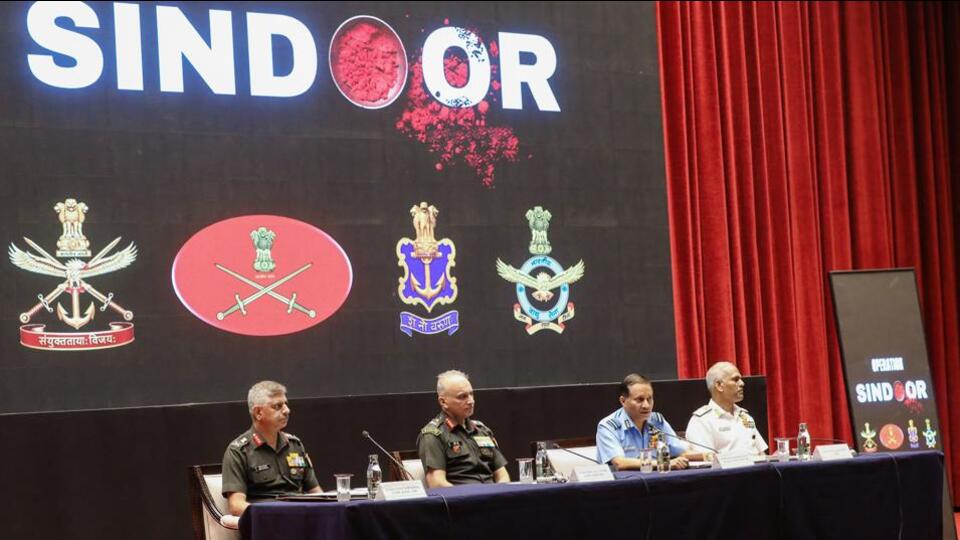
“We will hit everything,” he said at a joint press briefing by top officials from the three services to mark the first anniversary of Operation Sindoor. Ghai oversaw the operation last year as the army’s director general of military operations. He described it as “a defining moment in India’s strategic journey.”
The operation, which began in the early hours of May 7, 2025, was New Delhi’s muscular response to the Pakistan-backed Pahalgam terror attack that killed 26 people. It triggered four days of strikes and counterstrikes with fighter jets, missiles, drones, long-range weapons and heavy artillery before the two sides reached an understanding on stopping all military action on May 10.
Ghai said standoff precision strikes were timed to perfection, achieved total surprise, and inflicted maximum damage in each terror hub that the Indian forces hit deep inside Pakistan-occupied Kashmir (PoK) and heartland Pakistan, signalling that no sanctuary is safe.
Some terror camps, he said, have moved deeper into Pakistan after the four-day military confrontation between the two countries under Operation Sindoor.
“I think people on the other side are also wise. So yes some of these camps and launch pads have moved further to ‘depth’ areas of Pakistan where they feel they will be safer. But no terror sanctuary is safe. We spoke about depths…We will go after everything,” Ghai said.
Pakistan-sponsored terror groups such as Jaish-e-Mohammed (JeM) and Hizbul Mujahideen (HM) began relocating to that country’s Khyber Pakhtunkhwa (KPK) province after Indian forces bombed nine terror camps in Pakistan and PoK and killed at least 100 terrorists in the early hours of May 7.
The IAF struck two terror sites at Markaz Subhanallah in Bahawalpur and Markaz Taiba near Muridke, both in Pakistan’s Punjab province, while the army hit targets at seven places, including Mehmoona Joya in Sialkot, Sawai Nala and Syed Na Bilal in Muzaffarabad, Gulpur and Abbas in Kotli, Barnala in Bhimber, and Sarjal.
Operation Sindoor saw India go beyond its erstwhile approaches and methods, and target terror across the LoC and international boundary with Pakistan, with precision, proportionality, and clarity of purpose, Ghai said, adding it was a statement of resolve, responsibility, and strategic restraint by India.
“When our desire for peace is mistaken for weakness, there is no choice but to act. And when we act, there are no half measures --- it is decisive, it is lethal and it translates into Operation Sindoor,” said IAF deputy chief Air Marshal AK Bharti, who was DG (Air Operations) last year.
On May 9-10, the IAF struck military targets in Rafiqui, Murid, Chaklala, Rahim Yar Khan, Sukkur, Chunian, Pasrur, Sialkot, Skardu, Sargodha, Jacobabad, Bholari and Malir Cantt in Karachi. Pakistan lost as many as 12 to 13 aircraft, including fighter jets such as US-made F-16s and Chinese-origin JF-17s, to the air force’s precision strikes on ground and in the air during the military clash.
“Our fight was with the terrorists and their support infrastructure. And that’s what we hit, ensuring no collateral damage. We had achieved our objectives and our mission was complete (on May 7) but when the Pakistani establishment decided to side with terror and make it their own fight, we had no choice…When we responded, it was lethal and ruthless.” Bharti said.
Operation Sindoor stands as a defining testimony to India’s resolve against terror and to the decisive strategic vision of the country’s national leadership, said director general of naval operations Vice Admiral AN Pramod. He said the operation marked “the emergence of a new dimension of deterrence.”
The press was briefed by Bharti, Ghai, Pramod, and Lieutenant General Zubin A Minwalla, Deputy Chief of Integrated Defence Staff (Operations). Bharti, Ghai and Pramod had addressed the media during Operation Sindoor last year as they were heading operations for their respective services. Minwalla’s presence on stage on Thursday signalled a sharp focus on jointness in the armed forces --- an essential prerequisite to the creation of theatre commands.
“Operations were seamlessly integrated across not just traditional domains, but also cyber, space and information domains, marking a decisive evolution in our warfighting philosophy. Operation Sindoor demonstrated our ability to deliver integrated effects with speed, precision and clarity of purpose, serving as a foundational step towards multi-domain operations,” Minwalla said.
The operation showcased indigenous capability—a significant percentage of the weapon systems, munitions, rockets and missiles, sensors and electronic warfare suites that were employed were developed and produced in India, Ghai said.
“Indigenous equipment meant not only just self-reliance, but the flexibility to tailor these to our operational requirements, sustain and maintain supply chains, and to respond with speed and confidence. Operation Sindoor proved Atmanirbharta is not just a slogan, it is a force multiplier,” he said.
Talking about India’s exit strategy and escalation control, Ghai added, “In an era of prolonged conflicts around the world, we struck hard, achieved clearly defined objectives and then decided to cease hostilities when the Pakistanis were compelled to negotiate and requested us to stop. The objectives were achieved through a calibrated, short and sharp shock that altered the enemy’s risk appetite and disrupted his command and control, without locking India into a long drawn war or conflict…the ill effects of which we are seeing in ongoing conflicts around the world.”


