E-Paper



Lt Gen Arvind Mahajan (Retd): ‘We were hailed as the generation of New India’
Serving during the Kargil War, he says, was among the most defining experiences of his military career.

 Prefer HTon Google


Lieutenant General Arvind Mahajan (retired) takes pride in being part of a generation born into a free nation, one that held the promise of a newly independent India, witnessed its remarkable journey, and helped shape its transformation.
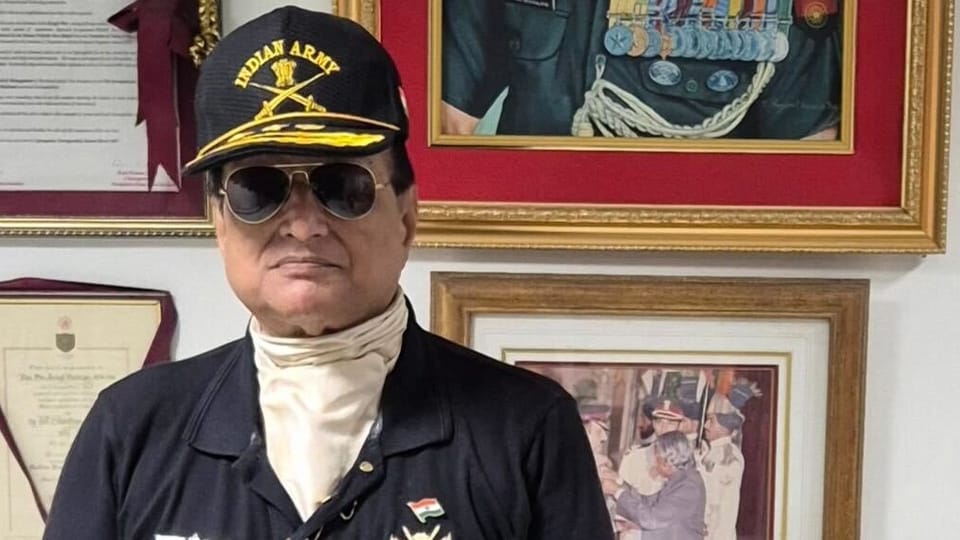
“While Gen Z may be the flavour of the times today, back then, it was we who were hailed as the generation of a New India. We were destined to witness and participate in the journey of a country determined to build its own future,” he says, sipping hot coffee in the basement of his Gurugram home on a rain-soaked afternoon.
Born on December 24, 1947, he retired in 2007 as director general of the Indian Army’s Corps of Electronics and Mechanical Engineers (EME), bringing down the curtain on a distinguished military career spanning almost four decades.
Also Read |‘Beginning of another’: How Hindustan Times reported freedom on August 15, 1947
A quiet corner in the basement serves as his study, where a fading photograph from his days as a cadet at the National Defence Academy sits alongside a portrait of him in the uniform of a three-star general; the commissioning parchment issued by the President in the late 1960s displayed beside a photograph of him receiving a military honour from the Supreme Commander decades later.
“It is not a study. I’d say it is a museum, a window into a life lived alongside a nation on the move,” says Mahajan, flipping through the pages of a book titled “Techno Warriors of the Indian Army: Corps of Electronics and Mechanical Engineers in Operations.” Published in 2007 during his tenure at the helm of the EME, the book chronicles the Corps’ role and contributions since Independence, from the 1947-48 Kashmir operations to the 1999 Kargil War.
The retired three-star general sports a black T-shirt commemorating the NDA’s 75th anniversary, a reminder of an institution founded in the early years of independent India and one that has since shaped generations of military leaders. For Mahajan, the milestone – marked in 2024 – also reflects the transformation India has undergone over the past eight decades.
Also Read | What's the quickest path to Inevitable India?: A Wknd Independence Day special
“The India I knew as a young officer was vastly different from the India of today. My service took me to forward areas including Ladakh, Joshimath and NEFA (North-East Frontier Agency)—now Arunachal Pradesh. In those days, border areas had few roads, poor communications and limited facilities. Reaching certain locations could take days. Today, highways, tunnels, bridges and modern communication networks have transformed these regions,” he says.
Mahajan points out that India has made remarkable progress in education, healthcare, technology and economic development, which has changed lives and expanded opportunities for its people. “The transformation of the energy sector has been equally striking. From limited electricity and fuel availability, we have moved to a vast network of power plants, refineries and pipelines. Windmills, solar parks and other sources of clean energy are increasingly contributing to India’s future.”
There are things he would rather forget, too—the setbacks, struggles and difficult chapters that tested the country.
“We witnessed the harsh realities of the Partition itself, including a period of shortages, especially of food and essential supplies, when rationing was the norm rather than the exception for many years. The nation, though being the land of the Buddha and Gandhi and of the peace they preached, was compelled to undergo the trauma of several wars that were thrust upon it. I must mention that the 1962 war with China really influenced my generation. It was the reason many of us chose to join the armed forces.” The greatest change today is in national confidence, he says.
Serving during the Kargil War, he says, was among the most defining experiences of his military career. “The conflict was fought in difficult terrain and harsh weather conditions. Overcoming that challenge required courage on the front lines, along with determined leadership, coordination, logistics and national resolve. Kargil demonstrated that when the country and its armed forces act with unity and determination, even the most difficult challenge can be overcome.”
“If I must draw a parallel between the nation’s growth and my own career, it would be in the field of technology. I was commissioned into the Corps of Electrical and Mechanical Engineers. It evolved into the Corps of Electronics and Mechanical Engineers. That change in name itself reflects a transition in technology.”
The EME is a technical Corps that provides maintenance and repair service to fighting formations for a range of equipment used in warfare. “At the time we were commissioned, understanding the functioning of a radio set was an early challenge. Today, our professionals handle complex computer systems with ease. And that is precisely how our nation too has evolved…from an importer of anything related to technology in its early days to a leading software developer. We now make complex missiles and gun systems and have demonstrated our capacity to reach the Moon and Mars. Each of these achievements gives immense joy to my generation.”
As someone born in 1947, does Independence Day hold a special meaning for him?
“Absolutely. My life has run parallel to the journey of independent India. Having served in the army for nearly four decades, Independence Day reminds me of the sacrifices that secured our freedom and of our continuing responsibility to protect it.”
He says the country’s defining military milestones include a firm and decisive response to terror, as demonstrated by Operation Sindoor and other strikes in Pakistan; improved border infrastructure; modernisation of the armed forces through advanced weapons, surveillance, communications and technology; a decisive push towards self-reliance in defence sector; and the growing role of women in the military.
“What is perhaps most important about our armed forces is, ironically, not a milestone at all. It is their steadfast commitment to remaining apolitical and professional, in letter and spirit—unlike the armed forces of several nations that gained independence alongside or around the same time as us.”