
 E-Paper



Usha Uthup: ‘Strongly attached to idea of India even though much has changed’
While music entered her life without warning, Uthup was thrown out of her class choir “because the teacher could not find a proper place for my voice”.

 Prefer HTon Google


When asked to reflect on Ramba Ho, the 1981 hit finding a fresh lease of life through Dhurandhar, Usha Uthup simply says, “A song is bigger than a singer. You have to give it time to become a classic – the kids have made it so. The Gen-Z today is going retro even at Trincas.”
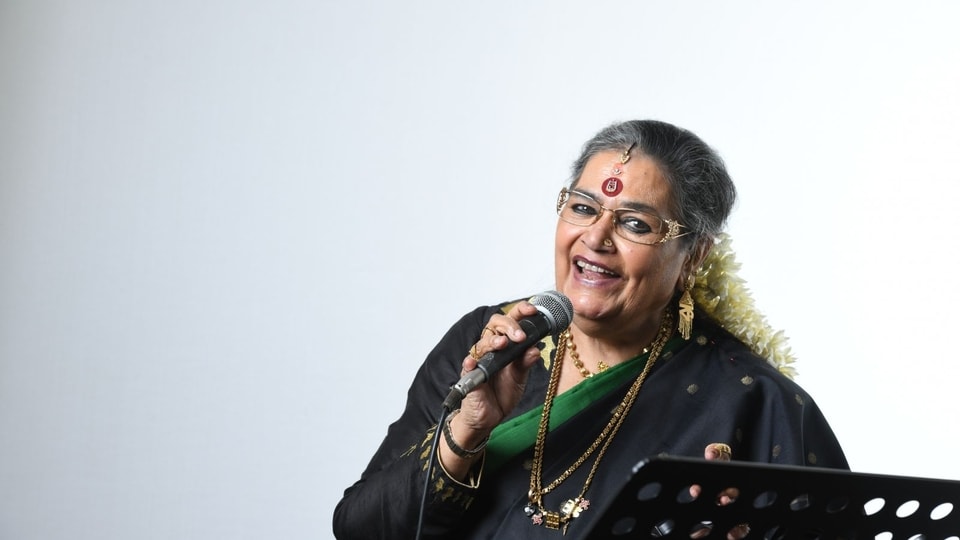
Trincas is the iconic heritage restaurant and tea room, and a much-sought out venue for live music in Kolkata, where Uthup performed in her early years, and continues to do so occasionally.
Also Read | ‘Beginning of another’: How Hindustan Times reported freedom on August 15, 1947
There is no triumphalism in her voice about the song she first struck to life decades ago being reinvented; instead, a quiet acceptance that only someone who spent many years under the sun can understand.
Likewise, when the 79-year-old artiste-performer – born in the year India got her Independence from colonial rule – looks back, there is little rose-tinted nostalgia, but a measured remembrance of a country that shaped her.
“I am strongly attached to the idea of India even though much has changed over a period of time,” she says. “I am the fifth of six children from a middle-class family bearing orthodox and patriotic values – everything was black and white. It was a privilege to have been brought up at a time like that.”
Also Read | Independence Day 2026: Is it 79th or 80th Independence Day? Theme, significance and history explained
Brought up in the police quarters in Byculla (her father was deputy commissioner of police in the crime branch), Mumbai, she grew up in a world without barriers, she says. “The value of money and equality was instilled in us strongly and we were taught human values. I grew up with Muslims as neighbours and Christians in school; and as a Hindu I felt close to Christ when I rang the Anglican bell.”
The house in Byculla was a sprawling two-level British-era bungalow that was converted into apartments for separate families to reside in. While they lived on the ground floor, the upper floor was taken by a Muslim neighbour, the Pathans. The girls of that house – Shameem and Jameela – were to become Uthup’s friends for life. From their mother she learnt how to do the namaaz and stitch salwar kameezes. “I am still a great seamstress,” she says.
While Hindu pujas were celebrated at home, she learnt to keep roza with Jameela and Shameem. A special serving of khichda without mutton would be set aside for her every Eid. They also taught her how to drape a dupatta over her head, “which is aesthetic”.
“I want to belong to the place I am in.”
“We grew up watching Jawaharlal Nehru and Mahatma Gandhi – we heard stories about them every time Congress leaders came to Bombay and my father was on bandobast duty,” she says. “I urge those who express critical views about Gandhi today to look at what he had achieved and ask themselves if they have been able to achieve even a fraction of that.”
Also Read | Freedom the same night, but different dates: Why Pakistan marks its Independence Day on August 14
Independence and a free-thinking way of life at the time was completely instinctual. “I never thought about it, and only felt it during the Chinese aggression, when we packed shoes and blankets for the jawans,” she says. “We were Indians first; I don’t know how people argue that today.”
“I wish that feeling of secularism had survived – we have lost that amazing value to arguments, fights and endless debates,” she says, with a throwback to the time when she was introduced to Dilip Kumar and Meena Kumari’s films on a projector, seated along with Jameela and Shameem at their home.
“I still call Jameela, who runs a boutique with her daughter Simran, in Bengaluru, when I want to check on an Urdu word or the other,” she says. “While we don’t have the time to think about the old days, it is also up to us to bring it back. We are happy and in-love people. In love with love.”
The family’s three-storeyed ancestral home in erstwhile Madras perfectly captured the breezy spirit of that era.
A born performer, “known to stand up on the table and sing”, her earliest memories of music is that of an uncle listening to Beethoven or Mozart on one floor, another playing the Kingston Trio on another floor, and her aunts listening to Kishori Amonkar or MS Subbalakshmi. “That was our post-Partition eclectic way of life.”
While music entered her life without warning, Uthup was thrown out of her class choir “because the teacher could not find a proper place for my voice”. “But I wasn’t unhappy about that. I started playing the tambourine.”
An untutored singer, she started performing at 21, not confined into boxes, which led her to sing in varied Indian languages. After singing at Nine Gems, a nightclub in Madras, she moved to Talk of the Town in Bombay and Trincas in Calcutta. Persuaded by an aunt, she stepped into the clubs at a time when they were dominated by Anglo-Indian performers. She turned heads equally with her powerful textured voice that held a deep bass resonance and by turning up in decorous silk sarees paired with traditional jewellery, an arresting bindi and flowers in her hair. She commanded the stage as she moved with the music turning rhythm into absolute power. “I was a change at the clubs -- I wore sarees because I had no other garment of choice. And as I moved from club to club, I drew in families because women did not look at me as a threat. I was no sex symbol,” she says.
She sang Frank Sinatra, Barbra Streisand, Tom Jones, and continues to draw from those legends. She has borrowed from contemporary artistes – Adele’s Skyfall has been on every performance playlist since the Bond film released in 2012. Over time, Uthup tweaked her style quotient as well: she started pairing her Kanjeevaram sarees with what she calls Kanjeevaram sneakers – Reebok sneakers lined with the border of a Kanjeevaram saree.
“I sang in English, Bengali, Punjabi. I had no hard luck. I took everything in my stride. I did it my way. I wasn’t anxious about late shifts at work – I worked like nurses and air hostesses.”
If Uthup had to encapsulate the time between the 1950s and now in five snapshots, what would they be? Security and safety for all, cleanliness and hygiene, education, less poverty and more human connection with time for family.


