North India receiving upto 10 times higher rainfall: What’s causing the heavy downpour
Weather experts said that rainfall in this part of the country normally occurs when localised depressions caused by summer heat attract moisture laden winds, mostly from the Bay of Bengal
Updated on: Sep 25, 2018, 07:52:58 IST
Hindustan Times, New Delhi | By Chetan Chauhan, New Delhi
Incessant rainfall up to 10 times higher than normal in parts of north India, heavy snowfall in the upper reaches of the Himalayas, and a delay in the withdrawal of monsoon winds, can be attributed to a combination of strong westerly winds over Gujarat and a deep depression caused by Cyclone Daye over the coast of Odisha, weather experts said on Monday.
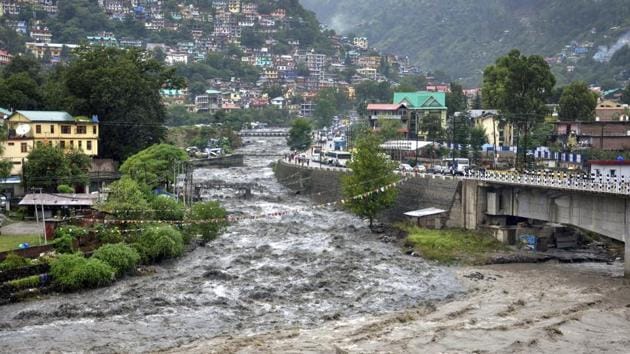
A swollen Beas river flows after heavy rains in Kullu district, Himachal Pradesh, on September 24, 2018. (PTI Photo)
{{^htLoading}} {{/htLoading}}
Since Friday, north-west India received 454% more rainfall than the normal for this period.
The departure was highest for Punjab, which received 1,193% more rainfall than usual, and lowest for western Rajasthan, which also got 317% more rain than normal.
Weather experts said that rainfall in this part of the country normally occurs when localised depressions caused by summer heat attract moisture laden winds, mostly from the Bay of Bengal. But the rainfall being experienced by the region at the moment is a result of moisture from both the Bay of Bengal to the east and the Arabian Sea to the west.
“The large low pressure area caused by Cyclone Daye, extending to the coast of Gujarat, got ‘hooked’ with the westerly winds coming from Arabian sea, taking the moisture upwards towards north,” said India Meteorological Department (IMD) director general KJ Ramesh.
{{^htLoading}} {{/htLoading}}
{{^usCountry}}
Although Cyclone Daye made a landfall at Gopalpur in Odisha on Friday morning after weakening substantially, the winds covered a large part of India — from the Telangana-Karnataka region to the Madhya Pradesh-Gujarat-southern Rajasthan region, bringing widespread rainfall, he added. The north would have also received normal rainfall, but strong westerly winds pulled the moisture from Cyclone Daye upwards, giving a “double dose” of rainfall to the region, Ramesh said.
{{/usCountry}}
{{#usCountry}}
Although Cyclone Daye made a landfall at Gopalpur in Odisha on Friday morning after weakening substantially, the winds covered a large part of India — from the Telangana-Karnataka region to the Madhya Pradesh-Gujarat-southern Rajasthan region, bringing widespread rainfall, he added. The north would have also received normal rainfall, but strong westerly winds pulled the moisture from Cyclone Daye upwards, giving a “double dose” of rainfall to the region, Ramesh said.
{{/usCountry}}
{{^htLoading}} {{/htLoading}}
The condition has led to a dip in temperature — by three to five degree Celsius — and caused snowfall in the upper reaches of Himachal Pradesh and Jammu & Kashmir, which is highly unusual in September. The tribal belt of Himachal Pradesh and Ladakh in Jammu & Kashmir received about one feet of snow on Sunday,damaging potato and apple crops,according to local farmers.
The heavy rainfall has also damaged paddy crop in large parts of Punjab and Haryana. According to farmers, paddy, which is at the maturing stage, has got flattened at several areas. “Paddy grown in low-lying areas is vulnerable to damage due to rains, as it usually gets submerged in water. We are assessing the damage,” said JS Bains, a director of the Punjab agriculture department.
{{^htLoading}} {{/htLoading}}
Farmer Surjit Singh inspects his paddy field that was damaged during heavy rains on Sunday at Verka in Amritsar, on September 24, 2018.
Not just the north, even parts Andhra Pradesh, Telangana and Karnataka received excess rainfall due to depression cause by the Cyclone Daye.
In Bangalore, several low-lying areas were inundated because of heavy rainfall leading to flooding of roads and uprooting of trees.
{{^htLoading}} {{/htLoading}}
“Bengaluru got between 12 to 20 cm of rain due to south-west monsoon in the last 24 hours,” said IMD’s Bengaluru director CS Patil. This was double the normal rainfall for this period of the season. Ramesh said that monsoon is expected to start retreating from north India later this week, which will lead to a rise in temperature. Normally, the south-west monsoon withdraws from the southern peninsula in first week of October.
Chetan Chauhan is the National Affairs Editor looking into all aspects of news and features from across India. A Chevening scholar with over three decades of experience in reporting and news management, Chetan has extensively covered all important aspects of the social sector, political economy, environment and climate change nationally and internationally. He did a journalism course at the Reuters Institute of Journalism in Oxford and Digital Media training at Nanyang Technological University in Singapore. He started as a reporter with The Statesman in 1996 and joined the Hindustan Times in 2000 in the metro bureau covering environment, crime and Delhi politics. He covered hot local news, from the Jessica Lal murder case to the rebellion of Delhi Congress MLAs against then Chief Minister Sheila Dikshit, to the replacement of toxic vehicle fuel with cleaner compressed natural gas (CNG) in the national capital. Some of his stories on air pollution became part of the Supreme Court’s landmark MC Mehta versus Government of India case in the National Capital Region (NCR), forcing the government to take corrective measures. As part of the national political bureau since 2004, he covered important central sectors such as environment, education, social justice, labour, rural development, water resources, renewable energy, agriculture, broadcasting and the Planning Commission for more than a decade producing several exclusive and investigative breaking stories. His specialisation is the environment, having covered at least a dozen United Nations global conferences on climate change, biodiversity and wildlife including climate summits in Paris, Copenhagen and Bali. He also covered India’s two five-year plans ---11th and 12th and reported on drafting and execution of right based laws such as Right to Education, Right to Information and rural job guarantee law, MG-NREGA, now being introduced in new format as VG-RAM-G Act. He has in-depth knowledge of social sector issues. He was one of the first to report on tigers vanishing from Sariska and Panna wildlife reserves in 2004 and 2008, respectively, leading to the setting up of the National Tiger Conservation Authority (NTCA) and the introduction of stringent penal provisions for poaching. He has written extensively on the rising human-animal conflict in India and the degradation of India’s biodiversity hotspots because of mining and other activities. Since 2004, Chetan has covered Parliament comprehensively and participated in training on the nuanced coverage of Parliament proceedings. He has travelled extensively across India to cover national and provincial elections since 1998, especially in the Hindi heartland states, considered India’s road to power. He writes a regular column for Hindustan Times, Ecostani, on important national politics, economy, Himalayan ecology and environmental issues. His other responsibilities include providing inputs for edits and edit page articles for the publication, apart from managing news flow from across India.
Get real-time updates on CJP Delhi Protest LIVE , breaking headlines, and top India News, breaking headlines, and real-time updates from across the nation. Stay informed on politics, government policies, crime, Today Weather, and major developments on Hindustan Times
Get real-time updates on CJP Delhi Protest LIVE , breaking headlines, and top India News, breaking headlines, and real-time updates from across the nation. Stay informed on politics, government policies, crime, Today Weather, and major developments on Hindustan Times