
 E-Paper



Delhi’s old drainage system unable to cope with heavy concretisation
Delhi Traffic Police updates showed there were at least five cave-ins on key roads, and long traffic jams due to heavy waterlogging was reported from at least 13 major localities or stretches.

 Prefer HTon Google


The Capital’s decades-old drainage system is unable to keep pace with unplanned construction, and much of its stormwater management features are either blocked or have disappeared, leading to a few hours of heavy rain triggering widespread chaos, according to several urban experts.
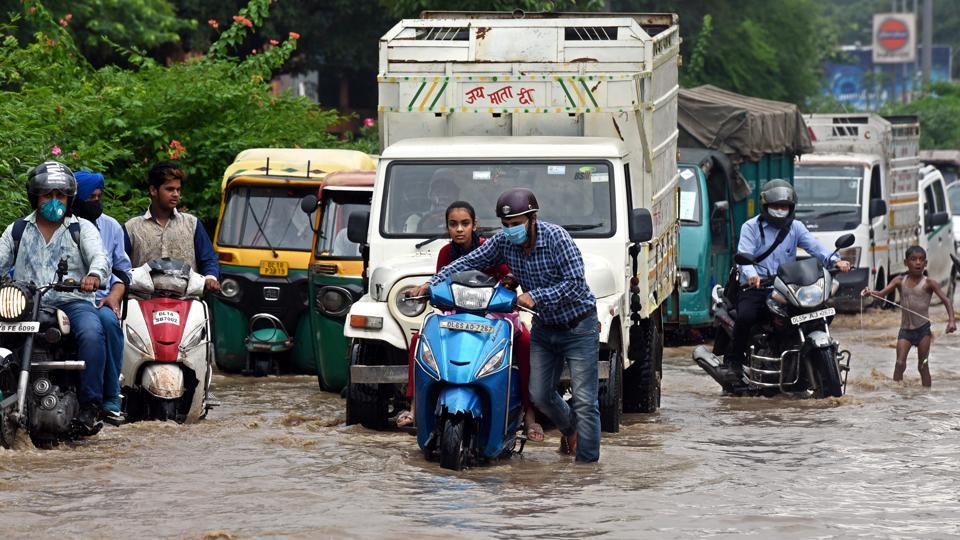
On Wednesday, Delhi Traffic Police updates showed there were at least five cave-ins on key roads, and long traffic jams due to heavy waterlogging was reported from at least 13 major localities or stretches.The mayhem, which exposed the fragile civic infrastructure in the Capital, was the consequence of around four hours of heavy rain in the morning.
AK Gosain, professor of civil engineering at Indian Institute of Technology, Delhi, said the problem lies in three distinct issues: increase in paved area means less volume is absorbed by the ground and rains lead to heavier water run-off; stormwater drains are being used for sewage; and most of these stormwater drains do not let water flow freely.
Gosain presented a master plan to the government in 2018 identifying the issues that made the problem most acute and suggested a road map of how the drainage network — which still follows the 1976 master plan — can be revamped.
Waste water from rains are meant to follow a system separate from the one that carries sewage from homes and industries.
This includes a network of streams, natural and seasonal water bodies, and urban stormwater channels that are meant to further drain into the Barapullah canal, the Najafgarh canal, or the Yamuna.
The report by Gosain’s team found many of these were either encroached upon, blocked with waste, or were disappearing. Around 19 out of the 201 natural drains mentioned in the 1976 Master Plan could not be traced.
“Last drainage Master Plan for Delhi was prepared in the year 1976, when the population of Delhi was 60 lakh. Population of Delhi as per Census 2011 stands at 167 lakh (1.67 crore) and the projected population as per projection in Master Plan Delhi 2021 is 250 lakh (2.5 crore),” said a release from the chief minister’s office on August 1, 2018, when the Gosain panel’s report was submitted.
According to the release, the main recommendations were to ensure there are no encroachments on such drains, sewage is routed through separate sewage channels, dumping of construction and demolition debris is stopped, effective de-silting is carried out and that new stormwater drains are designed and built in such a way that existing run-off estimates and architecture are taken into account.
“The document is circulated among various departments who pass their judgment and drainage work is given in bits and pieces by the government to contractors. The drainage plan is ahead of its time and cannot be comprehended by contractors,” said Gosain in an interview to HT.
Representatives of the Delhi government did not respond to requests sent on Thursday for comments on the status of the plan.
Two other experts supported Gosain’s assessment of the situation.
“Delhi’s groundwater recharging area has reduced drastically because of concretisation in the form of roads, paved pedestrian paths, buildings. Where will rain water from a very large surface area go? It will come on to the highways where underpasses don’t have proper drainage. Where they have drainage, it’s not cleaned, it’s choked with plastic,” said CR Babu, professor emeritus at the Centre for Environment Management of Degraded Ecosystems at Delhi University.
“Tree cover along highways can help. They can slow the way rain water falls on the ground and open ground can then be recharged with it,” he added.
Manu Bhatnagar, principle director, Natural Heritage Division, INTACH, said: “Unusual flooding is because of very poor engineering and too much paved hard surface. The converse of waterlogging is water harvesting. Even on top of the Barapullah elevated road, water was standing after rain. This shows poor planning and maintenance.”


