
 E-Paper



Olive ridley turtles return to Odisha beach for nesting
Gahirmatha beach in Kendrapara district is acclaimed as the world’s largest-known nesting ground of these endangered marine species. Apart from Gahirmatha, these aquatic animals turn up at Rushikulya river mouth and Devi river mouth for mass nesting.

 Prefer HTon Google


Pairs of olive ridley sea turtles have begun emerging on the swirling sea waters off Gahirmatha in Odisha, marking the commencement of the annual natural heritage of mass nesting, forest officials said on Thursday.
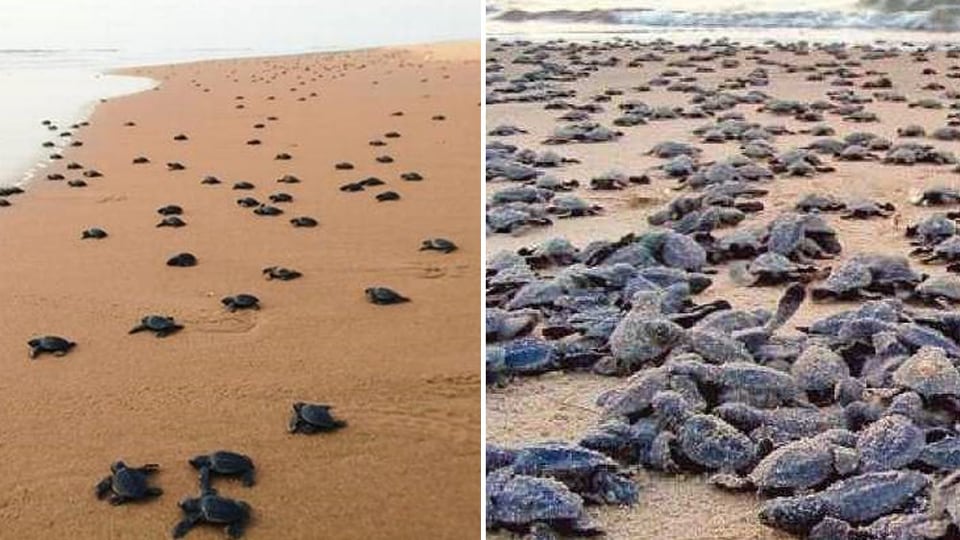
Forest personnel on patrolling drives have sighted pairs of mating turtles. For undisturbed breeding of the aquatic animals, prohibition on sea fishing continues to remain in force in the marine sanctuary, they said.
Gahirmatha beach in Kendrapara district is acclaimed as the world’s largest-known nesting ground of these endangered marine species. Apart from Gahirmatha, these aquatic animals turn up at Rushikulya river mouth and Devi river mouth for mass nesting.
“On the serene surface of sea waters, the turtle surveying teams spotted hundreds of mating pairs along the Gahirmatha coast. Fishing prohibition is presently clamped in Gahirmatha zone to ensure disturbance-free mating of the marine animals,” said Divisional Forest Officer, Rajnagar Mangrove, Bikash Chandra Dash.
After the end of the mating season, most of the male turtles usually return, leaving behind the female turtles to lay their eggs, he said The female turtles virtually invade the nesting beaches, usually at the dead of the night for laying eggs, the phenomenon described as ‘arribada’.
After indulgence in instinctive egg-laying, the turtles leave the nesting ground to stride into the deep seawater. Hatchlings emerge from these eggs after 45-60 days.
It is a rare natural phenomenon where the babies grow without their mother, the officer said.
The ban on sea fishing remains in force round the year in Gahirmatha marine sanctuary as the seawater here is the most conducive habitat for these delicate species.
The rise in the mortality rate of mating turtles along the coastal water surface led to the clamping of prohibition as the gill nets used by the trawls prove to be messengers of death for breeding turtles.
The mute species, accorded schedule-1 animal under Wildlife Protection Act for its highly threatened status, get entangled in the nets for prolonged periods and die of asphyxiation. Many turtles also perish after getting hit by the fast-moving propeller of the fishing trawlers, forest officials said.
The rate of mortality of these endangered species is quite high. An olive ridley usually lays about 120 to 150 eggs from which hatchlings emerge after about 45 to 60 days. But not all eggs remain intact as predators devour it.
Besides, eggs are also washed away by sea waves during high tide. The eggs are incubated in the nest and grow, sans mother, to emerge as hatchlings, they said.
Around 7.30 lakh olive ridley turtles had turned up for their annual sojourn of mass nesting in the 2019-20 season. The female turtles had emerged from the sea to crawl on to the serene beach and dig pits to lay millions of eggs.


