In a closely guarded move, Prime Minister Narendra Modi accompanied by Chief of Defence Staff (CDS) General Bipin Rawat and Army Chief Gen M N Naravane landed at Leh on Friday morning to review the tri-services preparedness against the aggressive People’s Liberation Army (PLA) as well as understand the proposed de-escalation and disengagement process at the four stand-off points.
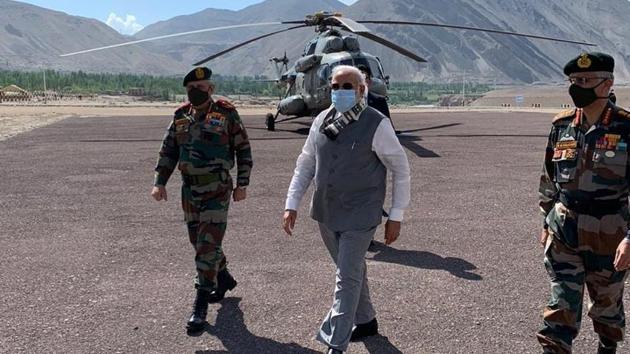
PM Modi will address Indian troops at Thiksey near Leh. He will also meet injured soldiers at the hospital in Nimu near Leh.
The decision for PM Modi to visit Ladakh sector was taken last evening with National Security Advisor (NSA) Ajit Doval handling the last minute detailing with Gen Rawat. PM Modi, Doval and Rawat stood together to face the Chinese aggression in Doklam plateau in 2017.
PM Modi was briefed by the Northern Army Commander Lt Gen Y K Joshi and XIV Corps Commander Lt Gen Harinder Singh at Nimu Army headquarters.
The visit of PM Modi and Army brass will be a huge morale booster for Indian troops deployed in East Ladakh. With NSA Ajit Doval coming out of self imposed isolation, the Leh visit is a huge signal to China as it conveys how seriously does India view the stand-off with PLA.
Although the Ministry of External Affairs spokesman on Thursday called for expeditious dis-engagement from the border, the de-escalation process will take time with the PLA not in the mood to walk the talk between the two governments on ground. Despite talking about peace and dis-engagement, the PLA troop withdrawal from Galwan, Gogra, Hot Springs and Pangong Tso will take a lot of time and serious persuasion.
{{/usCountry}}Although the Ministry of External Affairs spokesman on Thursday called for expeditious dis-engagement from the border, the de-escalation process will take time with the PLA not in the mood to walk the talk between the two governments on ground. Despite talking about peace and dis-engagement, the PLA troop withdrawal from Galwan, Gogra, Hot Springs and Pangong Tso will take a lot of time and serious persuasion.
{{/usCountry}}According to military commanders, the PLA continues to earmark its territory at all the stand-off points by physical deployment while undertaking superficial thinning in the rear by withdrawing a few vehicles and few men. The PLA stands amassed at Galwan River Valley and consolidated at Pangong Tso with massive infrastructure upgrade.
Faced with a recalcitrant adversary, the Indian Army and Air Force are fully deployed to prevent any further aggression from the PLA. The morale of the forces appears to be very high particularly after the June 15 flare-up at Galwan. “ We have no intentions of initiating any skirmish but any aggression from the other side will be fully repelled,” said a senior military commander.
With temperatures in East Ladakh and Tibet well over 20 degree Celsius and high velocity winds sweeping the region, air operations in the area are a challenge with weight limits being imposed during take-offs particularly in Russian origin platforms. While IAF will use the air bases in the plains in the worst case scenario, the PLA Air Force will have serious difficulty in operating from Tibetan Plateau. The coming days will also be a test of unproven Chinese air platforms, missiles and land systems as their battle worthiness has never been challenged.