
In the last photographs taken of him, Mohammed Naeem is pleading to a group of villagers as blood trickles down from his head. Half of his body is soaked in red. His shirt presumably ripped away, and dirt marks on his pants suggest he was kicked repeatedly. Hands folded, the father of three struggles to convince the people surrounding him that he is innocent.
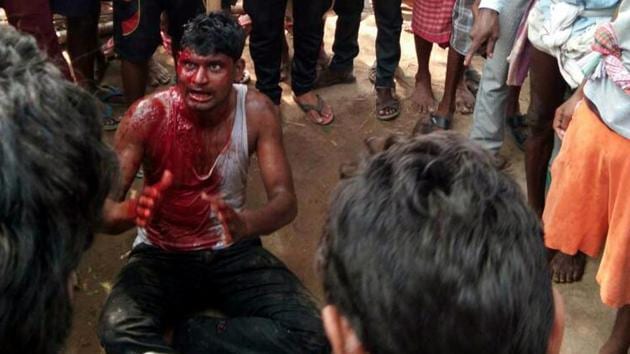
But they lynch him anyway.
Naeem was the last of four people to be beaten to death on Thursday by villagers in Sobhapur, less than an hour’s drive from Jamshedpur, Jharkhand’s most populous city.
Another group of three were lynched less than 20 kilometres away.
Naeem’s last moments became the face of a string of attacks in the state triggered by rumours spread on WhatsApp that child abduction gangs are on the prowl.
Villagers, mostly tribal people, along the borders of Seraikela-Kharsawan, East Singhbhum and West Singhbhum districts picked up weapons such as sticks and bats, and were attacking strangers. Sobhapur falls under the Seraikela-Kharsawan district.
Two people were killed over similar suspicions earlier in the week. None of the victims were involved in kidnapping.
{{/usCountry}}Two people were killed over similar suspicions earlier in the week. None of the victims were involved in kidnapping.
{{/usCountry}}Naeem’s last moments bring back memories of Gujarat tailor Qutubuddin Ansari, whose image of pleading to a rioting mob in Gujarat in 2002 became the face of one of India’s worst communal violence. Ansari was rescued.
Naeem was not as fortunate.
A resident of Ghatsila in East Singhbhum district, Naeem and his cattle trader companions were passing through Sobhapur early in the morning on Thursday.
Villagers along the Tata-Chaibasa road stopped their SUV, dragged the four people out and tortured them for four hours before killing them.
Naeem was the last to die, even though the police had reached the spot before the last of fatal blows landed on him.
Outnumbered, the police did not intervene.
Jalauddin said Naeem, his brother-in-law, was an affable man. He took good care of his aging parents and groomed his children well. Naeem’s wife is a deputy village head.
The family declined to accept a compensation of Rs 2 lakh offered by the district administration. They, and people in their villagers, demanded the chief minister meet them and promise justice.
ABOUT THE AUTHOR
Follow the latest breaking news, major developments and agenda-setting stories from India and around the world with the newsdesk at Hindustan Times. Operating round the clock, the desk brings together experienced editors, reporters and correspondents to deliver fast, accurate and contextual reporting across subjects that influence public policy, governance, business, society and international affairs. The HT News Desk covers politics, elections, government policies, the economy, business and markets, science and technology, the environment, law and order, infrastructure, education, climate issues and geopolitics, while closely tracking developments across states, institutions and global capitals. The team also leads coverage of major breaking news events, policy announcements, court proceedings, natural disasters, public emergencies and significant international developments. Reports published by the newsdesk are based on information gathered from reporters on the ground, official statements, government agencies, court records, regulatory filings, recognised institutions and other authoritative sources. Stories undergo editorial scrutiny and verification processes to ensure accuracy, fairness and relevance, and are updated as events evolve and additional information becomes available. Whether covering a key political decision in New Delhi, an economic policy shift affecting millions, a landmark court ruling or a major global event, the HT News Desk aims to provide readers with reliable, fact-based journalism that delivers not only the latest developments but also the context and analysis needed to understand their wider implications.