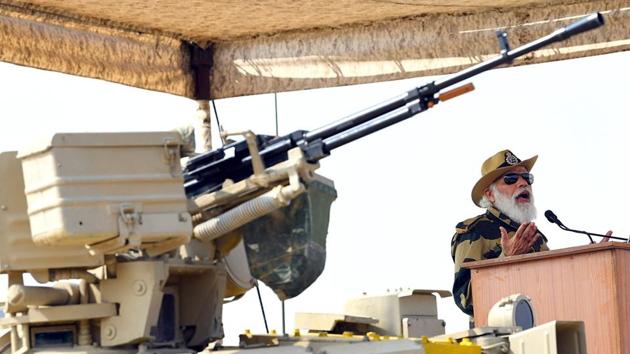
Prime Minister Narendra Modi’s friends and detractors know that there is nothing casual about the man from Gujarat. He practises his speeches, measures his words, then articulates the message for maximum impact. Over the weekend, addressing the tri-services at historic Longewala, where a Punjab regiment company and Air Force Hunters destroyed 40 Pakistani tanks in the 1971 conflict, Modi spelt out the Indian war strategy and it was certainly not pacifist. He said that India is willing to understand or make the adversary understand but there will be fiery retaliation if the enemy tries to test its military might. Simply put, India is not seeking confrontation but will stand its ground in case it is confronted. In Modi’s speech there was a message for both domestic and international audience. He skipped the East Asia Summit to be with Indian troops on Diwali Day and deputed External Affairs Minister S Jaishankar to speak in his stead.
Modi’s stand has been consistent. For instance, during the Balakot strike on February 26, 2019, after the Pakistani propaganda machine started posting pictures of a captured and bleeding Wing Commander Abhinandan, Modi let it be known to Islamabad that India would launch a missile strike if any harm came to the Indian Air Force pilot. He asked Indian Prithvi Missiles to be deployed in the Rajasthan sector. Such was the impact of the message that MiG 21 Indian pilot was set free by the Pakistan government the very next day.
In Longewal, like he has done previously, PM Modi criticised the expansionist policies of the present Chinese regime (although he did not name the country) by saying that it was a product of a 18th century twisted mindset and that India would firmly oppose it. This was a counter to the Chinese description of rapidly emerging QUAD grouping of India, the US, Japan and Australia as a product of Cold War mindset.
At Longewala, Modi again reiterated the Indian resolve to take the battle to the enemy or extinguish the threat to India at source. This new offensive-defensive doctrine of India has been accompanied by the building of airborne and expeditionary force projection capability, something that will ensure that future battles are not fought on Indian soil.
{{/usCountry}}At Longewala, Modi again reiterated the Indian resolve to take the battle to the enemy or extinguish the threat to India at source. This new offensive-defensive doctrine of India has been accompanied by the building of airborne and expeditionary force projection capability, something that will ensure that future battles are not fought on Indian soil.
{{/usCountry}}Prime Minister Modi’s statement should not be seen in isolation but in the context of what his National Security Advisor Ajit Doval said on banks of River Ganga at Rishikesh on October 22 and what External Affairs Minister S Jaishankar said at the East Asia Summit on Diwali day. The message from both was not sugar coated; it was an expression of what India expects from the neighbours in terms of (tamping down on) cross-border terrorism and (enhancing) freedom to navigate the South China Sea and resist any attempts to make it into Chinese pond. Without seeking any acrimony or confrontation with Beijing, what Jaishankar conveyed on Saturday was a reiteration of PM Modi’s conversation with the then Japanese Prime Minister Shinzo Abe during the first summit meeting in 2014. At the time, Modi’s strong position alarmed some Indian mandarins but the PM has stayed true to that. It is another matter that Jaishankar was among the more moderate voices on the South China Sea at the East Asia Summit.
While India and China are on track to disengage and de-escalate from East Ladakh to mutual satisfaction, New Delhi is neither over-negotiating with PLA to bring the Depsang bulge issue into the current resolution nor is it willing to cede an inch of territory from the friction points at Galwan, Gogra-Hot Springs and the finger 4 spur on the north banks of the Pangong Tso.