Pockets of rising infections emerge even as Covid-19 wave ebbs across India
Currently, at the national level, Covid-19 cases continue to decrease, a trend that has largely sustained since the peak of the second wave on May 9, when the daily cases averaged 391,819.
In the week ended November 17, India reported 10,978 new cases of Covid-19 every day on average. This is the lowest that the seven-day average (a number that denotes a region’s Covid curve) has dropped to since the week ended June 14, 2020 – a time when the first wave of the pandemic was just kicking off in the country.
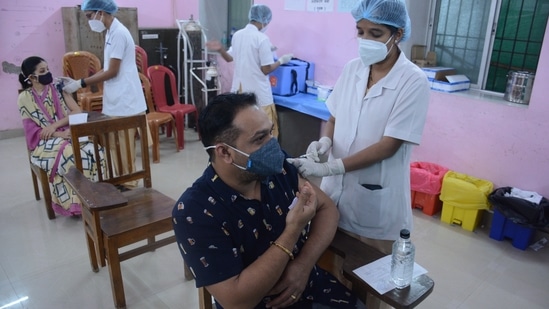
Although over 80% of adults in India have now received at least one dose of the vaccine, 44% of the country’s districts were below this threshold on November 17. (HT_PRINT)
Currently, at the national level, Covid-19 cases continue to decrease, a trend that has largely sustained since the peak of
{{^usCountry}}{{/usCountry}}
Cases have also increased in a few districts of states with declining cases
As is to be expected, in most of India’s districts, cases have declined. Of the 707 districts (Delhi’s districts merged as one) for which data is compiled by How India Lives, the seven-day average of daily cases has decreased between October 15 and November 15 in 222 districts. In another 379 districts, of which 317 reported no cases in the week ending October 15, the average has not changed.
Only 106 districts have registered an increase in the 7-day average of daily cases in the past month. Even among these, only 26 reported an average of 10 or more cases a day in the week ending October 15. Of these 26 districts, 10 are in West Bengal alone and two in Assam, states where cases have increased from a base of relatively higher caseload. 12 of the 26 districts are, however, located in states where cases have decreased in the past month, suggesting the bump may be localised (for now at least). Of these 12 districts, six are in Maharashtra, three in Telangana, and one each in Tamil Nadu, Odisha, and Mizoram.
How much have cases increased in districts?
Among districts that have registered an increase in the 7-day average of daily cases in past one month, five had 100 or more cases a day in the week ending October 15. From October 15 to November 15, Kolkata (44%) and Mumbai (37%) have registered the biggest increase among them.
In other districts, the percentage increase might be higher but that is the result of their low caseload earlier. For example, Kamrup Metropolitan (the district where Guwahati is located) has registered a 292% increase in the past month. But in absolute numbers, the increase is from 25 cases to 98 cases a day. Aurangabad in Maharashtra (22 cases to 38 cases a day) and Srinagar in Jammu and Kashmir (35 cases to 56 cases a day) are other districts with a big percentage growth among districts that saw 20-100 cases a day. Although this growth is modest in absolute numbers and can be easily contained, it does emphasise the need for continuing with pandemic-appropriate behaviour such as wearing masks in public places and avoiding crowded spaces.
In 2/3rd districts, less than half of all adults are fully vaccinated
Isolated districts reporting an increase in cases also emphasises the need for enhancing vaccine coverage. Although over 80% of adults in India have now received at least one dose of the vaccine, 44% of the country’s districts (274 of 628 districts of 2011 census with Delhi and Mumbai districts merged into one) were below this threshold on November 17. In 18 districts (eight of them in Nagaland, seven in Arunachal, Manipur and Meghalaya, and one each in Uttar Pradesh, Chhattisgarh, and Tamil Nadu), the first dose coverage is under 50%.
Just one dose of a Covid-19 vaccine also offers less protection from the infection than complete vaccination. At the national level, the share of fully vaccinated adults went past the share of partially vaccinated for the first time on November 16. As of November 17, this was yet to happen in 316 of the 628 districts. While over 40% of adults in the country have been fully vaccinated, at the district level, this threshold has not been reached in almost half (305 of 628 districts) of the districts in the country.
Share of fully vaccinated adults
In 75 districts, the share of fully vaccinated adults is 25% or less and in almost 2/3rd districts (414 of 628 districts), the share of fully vaccinated adults is 50% or less.
Since district-level population projections are not available, this analysis uses data on number of electors in the district at the time of the 2019 Lok Sabha polls as a proxy for adult population.
Abhishek Jha is Assistant Editor-Data at Hindustan Times. He uses statistical programming to generate newsworthy insights from large datasets. He is part of the team that produces Number Theory, a daily data story feature of the paper’s print edition. Since March 2024, he has been writing Weather Bee, a weekly column for the Hindustan Times website. He is a chemical engineer by training, who specialises in stories related to weather, climate, and the environment. Jha has been at HT since 2018, where he offers data-driven perspective and analysis on politics, environment, weather, climate, economy and society. His work includes data coverage of elections in India and abroad, including the 2019 and 2024 Lok Sabha elections; the disasters and extreme weather resulting from changing climate, such as floods, droughts, heat waves, cold waves, and dwindling snow cap in the Himalayas; the factors that drive poor air quality in northern India; the changing patterns of land use; the Covid-19 pandemic and its impact on labour market conditions; the changing pattern of consumer spending seen in the new consumer spending surveys; and social norms seen in the surveys such as the National Family Health Survey.
Get Latest News, breaking headlines, and top India News, and today real-time updates from across the nation. Stay informed on politics, government policies, crime, Today Weather, and major developments on Hindustan Times
Get Latest News, breaking headlines, and top India News, and today real-time updates from across the nation. Stay informed on politics, government policies, crime, Today Weather, and major developments on Hindustan Times
Home/India News/Pockets of rising infections emerge even as Covid-19 wave ebbs across India
{{^htLoading}}
Advertisement
{{/htLoading}}
SHARE THIS ARTICLE ON
{{#usCountry}}{{/usCountry}}
Notifications
Get breaking alerts directly from the newsroom
Notifications are on!You'll be notified when news breaks