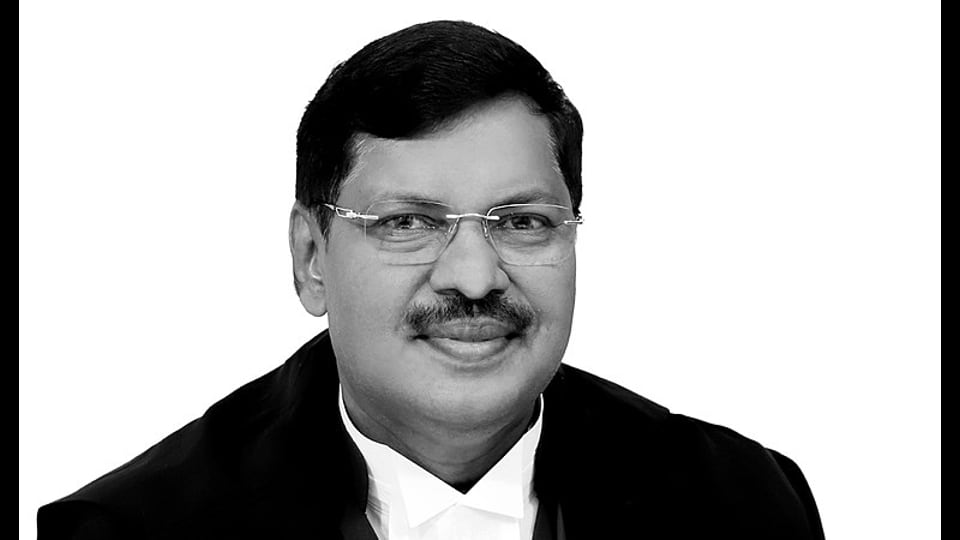
The judiciary has a duty to do more than merely interpret the law and overturn any legislation or governmental actions that conflict with the Constitution, Supreme Court judge Bhushan R Gavai has said, emphasising the courts must also correct the current situation by ensuring the appropriate course of action that the political branches ought to take for adhering to constitutional requirements.
Supreme Court judge Bhushan R Gavai. (Wikipedia)
“As recognised by the courts, making policy is not within the judiciary’s realm. However, in numerous cases, the courts have laid down policy guidelines or issued administrative directives to the government and its instrumentalities to act in the interest of the people. Increasingly, countries across the globe see judicial review as not only a mechanism for checks and balances but also a tool to ensure that the institutions work in the interest of its citizens,” said the judge.
Delivering a lecture at the Harvard Kennedy School on Thursday, Justice Gavai elucidated the intricate facets of judicial review, shedding light on its paramount importance in regulating legislative and executive actions as well as evolving new constitutional mechanisms and legal principles to benefit people.
“The Court’s mission extends beyond just interpreting the language of the law in a vacuum and striking down legislation or administrative activities that are inconsistent with the Constitution. It shall also extend to remedying the situation at hand by issuing frequent directives and prescribing correct recourse that political branches need to do to meet constitutional standards,” he said.
Justice Gavai began the lecture by summarising the basics of judicial review and citing its function as a safeguard for constitutional supremacy and the conformity of legislative and executive acts to core values. He underscored how judicial review empowers the courts to scrutinise laws, administrative decisions, and even constitutional amendments, thereby safeguarding individual rights and maintaining the balance between the three pillars of the State.
Highlighting the roots of judicial review in India’s constitutional framework, Justice Gavai, who is in line to become the Chief Justice of India (CJI) in May 2025, elucidated how the Indian judiciary, inspired by the US Constitution, has entrenched the concept of judicial review as a fundamental feature of the Indian Constitution.
“Judicial review ensures the supremacy of the Constitution, as it can be used as a check on the actions of wayward majorities...The Courts have to review and keep the actions of the different organs of the State, ie, legislature and executive, in check and remove any inconsistency with the ideals and provisions of the Constitution,” said the judge, stressing the judiciary’s pivotal role in preserving constitutional values and serving as the guardian of citizens’ rights.
Justice Gavai spoke about how judicial review influences policy through different avenues.
He referred to the relationship between court rulings and policy-making and how courts review legislative actions against established principles, striking down laws that contravene constitutional provisions or violate fundamental rights. The judge illustrated this with landmark cases where the Supreme Court of India invalidated statutes deemed unconstitutional, such as the abolition of mandatory death sentences and the decriminalisation of consensual same-sex relationships.
Justice Gavai highlighted the judiciary’s role in filling constitutional vacuums and legislative gaps, citing instances where the Supreme Court invoked Article 142 to ensure “complete justice” and laid down guidelines in the absence of legislation. He lauded the judiciary’s progressive interpretation of the Constitution, which has expanded the ambit of fundamental rights to encompass emerging rights such as the right to privacy and the right to education.
Explaining how the judiciary promotes communication between the government, the court, and litigants to guarantee accountability, openness, and constitutional observance, Justice Gavai emphasised the “dialogical aspect” of judicial review. The judge gave instances of how the constitutional courts in India examined governmental actions to protect fundamental rights and encourage reasonable decision-making during the Covid-19 pandemic.
Justice Gavai underlined the global prevalence of judicial review as a mechanism for constitutional supervision, noting its evolution from a tool of checks and balances to a catalyst for policy reform. Concluding his address, the judge highlighted the judiciary’s pivotal role in upholding constitutional principles, protecting individual rights, and steering policy changes in line with the constitutional mandates.
Utkarsh Anand is the National Legal Editor at Hindustan Times, where he leads the newspaper's coverage of the Supreme Court, constitutional law, the judiciary and the Union law ministry. He joined Hindustan Times in 2020 after stints at Press Trust of India (PTI), The Indian Express and CNN-News18, and has over two decades of experience reporting on law, governance and public policy.
His work has focussed on some of India's most consequential constitutional and legal developments, including the Supreme Court's judgments on Article 370, marriage equality, decriminalisation of homosexuality, the Babri Masjid dispute, electoral reforms and judicial appointments. He specialises in making complex legal proceedings and judgments accessible to readers while examining their wider social and political impact.
Beyond daily reportage, Utkarsh has led investigative projects and enterprise reporting that have shaped public debate and prompted institutional responses. His work has received several journalism awards, including the Ramnath Goenka Excellence in Journalism Award. As National Legal Editor, he has also played a key role in expanding Hindustan Times' legal journalism footprint, mentoring reporters and strengthening coverage across platforms.
A Chevening South Asia Journalism Programme Fellow, Utkarsh regularly writes analyses on the judiciary and constitutional issues, and his reporting is widely followed by lawyers, judges, policymakers, academics and readers seeking clarity on India's evolving legal landscape.Read More

 E-Paper