Improvements in the clinical management of hospitalised patients with new drugs, oxygen therapy and other treatments have substantially improved the survival rate for coronavirus disease (Covid-19), which is killing fewer people infected with the pandemic virus than it was doing six months ago.
India’s case fatality rate — the percentage of deaths in an infected population — has steadily declined from a high of 3.23% on March 22 to 1.49% on October 31. This is significant because the reduction in deaths has occurred despite the majority of people infected with Covid-19 being treated in home isolation, unlike in March when everyone who tested positive was being admitted for treatment in designated hospitals.
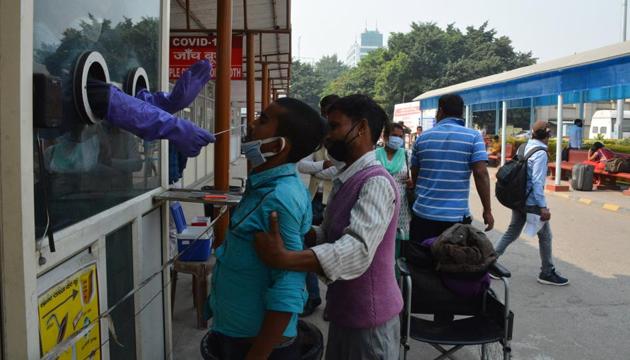
More people are getting tested today than ever before, with states like Kerala conducting 3,258 tests per million people per day, followed by Delhi with 3,225, which is well above the minimum of 140 tests per million people per day recommended by the World Health Organization (WHO).
Where India must focus its energy next is containing the spread of infection, which can be done only with active public participation.
Respiratory viruses are transmitted when people inhale infected droplets expelled by infected persons coughing, sneezing, speaking or breathing. This means infection occurs through direct contact with an infected person, from touching a surface contaminated with droplets, through inhalation of respiratory droplets that contain the virus around a sick person, and through the airborne transmission of small droplets with the virus that remain suspended in the air for longer and travel further than heavy droplets.
{{/usCountry}}Respiratory viruses are transmitted when people inhale infected droplets expelled by infected persons coughing, sneezing, speaking or breathing. This means infection occurs through direct contact with an infected person, from touching a surface contaminated with droplets, through inhalation of respiratory droplets that contain the virus around a sick person, and through the airborne transmission of small droplets with the virus that remain suspended in the air for longer and travel further than heavy droplets.
{{/usCountry}}New research has found that virus transmission through contaminated surfaces is rare even though the Covid-19 virus survives on surfaces for days. “Attempts to culture the positive swabs on Vero E6 cells were unsuccessful, suggesting that patient fomites and surfaces are not contaminated with viable virus. Our findings suggest that environmental contamination leading to SARS-CoV-2 transmission is unlikely to occur in real-life conditions, provided that standard cleaning procedures and precautions are enforced,” reported scientists in the journal, The Lancet, on September 29.
It was initially thought that droplet transmission was the main method of transmission, but now there is conclusive evidence of that the virus can stay suspended in tiny droplets called aerosols, which can disperse beyond 2 metres from an infected person under certain conditions.
Several outbreak investigation reports have confirmed cases of transmission from people more than 2m apart in enclosed spaces with poor ventilation. The chances of infection are higher in cases of extended exposure to an infected person for more than 30 minutes.
Covid-19 virus transmission is particularly efficient in crowded, confined indoor spaces such as workplaces, restaurants, parties, shopping centres, dorms, cruise ships and transport, according to the European Centre of Disease Control (ECDC) guidance on ventilation of indoor spaces. In a study of 318 outbreaks in China, transmission in all cases except one occurred in indoor spaces, with the only case of outdoor transmission identified in this study involving two people.
On July 9, WHO said airborne transmission of the coronavirus is possible indoors, especially when people spend extended periods in crowded and poorly ventilated rooms. On October 5, the US Centers for Disease Control and Prevention updated its guidelines to say Covid-19 can occur from airborne transmission under certain circumstances, but it is not the primary route of spread of the disease.
With lockdown fatigue setting in and people stepping out to work, socialise and celebrate their renewed freedom, new waves of infection are inundating several countries in Europe and Americas. In India, too, Covid-19 is surging in pockets. Delhi, for example, has registered a steady increase in new cases.
How protected we are as we navigate public spaces over the next couple of weeks will decide whether Covid-19 will wax or wane by December.