The QUAD virtual summit tomorrow will send a message that it is there to stay and reject the veto it had inadvertently allowed China on its foreign policy 15 years ago when it first met in 2007.
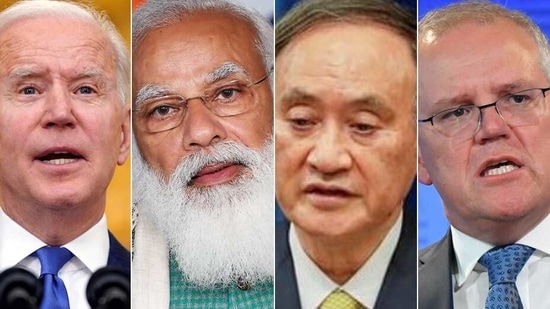
“The real test of the QUAD summit tomorrow will be whether it can send a credible message to the world that democratic rule-based countries can join hands-on shared political and economic values,” said a former Indian foreign secretary.
The QUAD grouping’s first meeting at the level of senior officials was held on the sidelines of the ASEAN Regional Forum (ARF) in Manila in 2007. The same year, a naval exercise under the banner of Malabar was held in the Bay of Bengal with the participation of QUAD plus Singapore. However, the move dissipated when China served a demarche on all the countries asking them to explain whether this was an anti-Beijing alliance in the making. With the Left supported UPA-I at the helm in Delhi, the Ministry of External Affairs went to great lengths to assuage China that QUAD had nothing to do with cooperative security and defence. The message from Beijing was so sharp that 2008 Malabar exercises turned bilateral with the US and Indian navies participating in the Arabian Sea. Australia also reacted in a similar way and went out of its way to pacify Beijing.
In the past 15 years, China has shown that it is not bothered about any other country when it comes to its self-defined core interests, while the US has come off its horse playing the lone ranger. India, under Narendra Modi, has moved towards the global stage by leading in disaster management, peacekeeping forces, solar energy and becoming the pharmacy of the world by supplying needy countries and friends with drugs from hydroxychloroquine, paracetamol to Covid-19 vaccine without any quid pro quo. India today not only shares the collective concerns of QUAD, who are natural rule-based democracies but also has become a credible force in the Indo-Pacific.
{{/usCountry}}In the past 15 years, China has shown that it is not bothered about any other country when it comes to its self-defined core interests, while the US has come off its horse playing the lone ranger. India, under Narendra Modi, has moved towards the global stage by leading in disaster management, peacekeeping forces, solar energy and becoming the pharmacy of the world by supplying needy countries and friends with drugs from hydroxychloroquine, paracetamol to Covid-19 vaccine without any quid pro quo. India today not only shares the collective concerns of QUAD, who are natural rule-based democracies but also has become a credible force in the Indo-Pacific.
{{/usCountry}}The QUAD summit tomorrow signifies three things.
One is that the democratic world cannot afford to ignore India as it is a principal player on the global stage, which has the confidence to converge with other countries to serve its national interest. The days of wishy-washy non-aligned are gone as India demonstrated during the East Ladakh stand-off with PLA that it can stand up to any country if its national security is threatened.
Second, the QUAD summit is also an indicator of a humbler America, which is now keen to forge cooperative mechanisms with like-minded countries to serve larger global interests. “Earlier, the US wanted to lead on its own but today Washington realises that it cannot achieve all its objectives without the support of like-minded middle powers like India, Australia and Japan. The days of the wild west are over,” said a former Indian Ambassador to the US.
Third, the QUAD summit clearly sends a message that it cannot allow an expansionist China to have a veto on foreign policies of democratic countries. While the global community was unsure of Chinese political objectives in 2007, the 2008 crackdown on Buddhists in Tibet, Uighurs in Xinjiang, incorporation of Hong Kong, the ruthless domination of South China Sea, its moves to co-opt Taiwan have shown the true colours of Communist rulers of Beijing. Besides, the trade action on Australia, coercive moves against the US in the South China Sea against the US navy, expanding the Senkaku Island dispute with Japan and aggression on East Ladakh against India under the garb of a sweeping global coronavirus pandemic have shown that the Middle Kingdom wants to move to be the centre-stage of the world. Thankfully, this time the QUAD countries including the US with its failed Asian Pivot policy is pushing back to Chinese expansionist moves.
While the many strategists debate whether the QUAD will be institutionalised or not and Chinese supporters among them will say that India has dumped old ally Russia for QUAD, the fact is that QUAD is a forceful idea whose time has come.