
Spells of heavy rain for short periods, bigger catchment areas of streams and topographical conditions are leading to cloudbursts, flash floods and landslides in the hilly regions of Uttarakhand, say experts.
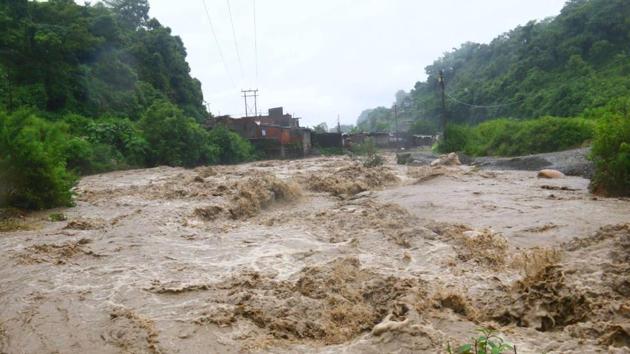
Over 40 people have died in rain-related disasters in Uttarakhand in the current monsoon.
Piyoosh Rautela, executive director of Disaster Mitigation and Management Centre in Uttarakhand said, “In the hills, the catchment area of even small streams is very large, these streams can be seasonal also, but during monsoons with heavy rainfall the water spills. This heavy rainfall leads to flash floods or rain-induced disasters.”
He also said that due to the topographical conditions, likelihood of cloudbursts or flash floods happening in the hills is more compared to plains.
“The physiography or geomorphic conditions of the mountains is such that the wind gets a sudden upward thrust which leads to cloud formation. But due to the topography of mountains or valleys, in particular, the winds rise to form clouds and then rainfall occurs in a small area or the clouds get trapped in a valley amid mountains as the monsoonal winds are not able to cross the topographic barriers (mountains). Due to this the rainfall recorded in those areas is high leading to disasters,” said Rautela.
According to the state disaster control room, three cloudburst incidents have been reported so far this year since June 15 in Pithoragarh district.
{{/usCountry}}According to the state disaster control room, three cloudburst incidents have been reported so far this year since June 15 in Pithoragarh district.
{{/usCountry}}Officials from the control room said that 33 people have died due to cloudbursts and flash floods due to heavy rain and 11 have died due to landslides across the state. Around 18 people have been injured due to landslides, flash floods and cloudbursts, while four are missing.
Officials from the Meteorological Centre in Dehradun said that an incident of rainfall is termed as a cloudburst only when a particular area receives 100 mm of rainfall within an hour.
Bikram Singh, director of Regional Meteorological Centre said, “Landslides take place with continuous rainfall, it could be due to heavy or moderate rainfall, but cloudbursts leading to flash floods happen when a particular area receives minimum 100 mm of rainfall within an hour. This year, as per rainfall records, 100 mm rainfall has not been witnessed at any particular location. In 2017, around 9 4mm rainfall was recorded in Dehradun, which was considered as a cloudburst.”
He added that in the hills, even 50 mm to 60 mm hourly rainfall can cause harm as water levels in streams rise leading to flash floods.
According to the MeT department, Uttarakhand has received 558.6mm of rainfall from June to August 5 compared to 655.1 mm for these months. Bageshwar district has received the maximum rainfall with a 148% departure from normal rainfall limit.
ABOUT THE AUTHOR
Follow the latest breaking news, major developments and agenda-setting stories from India and around the world with the newsdesk at Hindustan Times. Operating round the clock, the desk brings together experienced editors, reporters and correspondents to deliver fast, accurate and contextual reporting across subjects that influence public policy, governance, business, society and international affairs. The HT News Desk covers politics, elections, government policies, the economy, business and markets, science and technology, the environment, law and order, infrastructure, education, climate issues and geopolitics, while closely tracking developments across states, institutions and global capitals. The team also leads coverage of major breaking news events, policy announcements, court proceedings, natural disasters, public emergencies and significant international developments. Reports published by the newsdesk are based on information gathered from reporters on the ground, official statements, government agencies, court records, regulatory filings, recognised institutions and other authoritative sources. Stories undergo editorial scrutiny and verification processes to ensure accuracy, fairness and relevance, and are updated as events evolve and additional information becomes available. Whether covering a key political decision in New Delhi, an economic policy shift affecting millions, a landmark court ruling or a major global event, the HT News Desk aims to provide readers with reliable, fact-based journalism that delivers not only the latest developments but also the context and analysis needed to understand their wider implications.