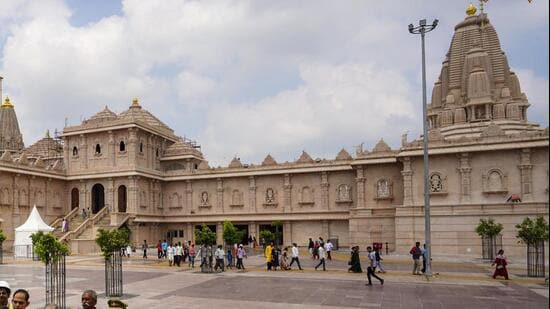
The Supreme Court on Monday closed its monitoring of the alleged theft of donations at the Ram temple in Ayodhya after the Uttar Pradesh government informed it that a charge sheet had been filed against eight accused, allowing petitioners to assist the trial court in the proceedings in view of the public interest involved.
A bench, comprising Chief Justice of India Surya Kant and justices Joymalya Bagchi and V Mohana, directed the judicial magistrate to proceed with the case in accordance with law, making it clear that the top court’s order should not prejudice any party as it had expressed no opinion on the merits of the allegations.
“Since there is an element of public interest involved, liberty is granted to the petitioner to assist the court of judicial magistrate as the law enables the victims of crime to also assist the court,” the bench said in its order, disposing of the writ petition and connected matters.
The order came after solicitor general Tushar Mehta, appearing for the Uttar Pradesh government along with additional advocate general and senior counsel Sharan Dev Singh Thakur, informed the bench that the investigation had been completed and the charge sheet filed.
“Theft was done at the time of counting and those counting were stealing. Although the recorder can have recordings up to 45 days, we traced it back to their bank accounts and purchase of properties, including land etc. There has been an audit as well. All artefacts and donations have been accounted for,” Mehta told the bench.
{{/usCountry}}“Theft was done at the time of counting and those counting were stealing. Although the recorder can have recordings up to 45 days, we traced it back to their bank accounts and purchase of properties, including land etc. There has been an audit as well. All artefacts and donations have been accounted for,” Mehta told the bench.
{{/usCountry}}The charge sheet, running into more than 60,000 pages, was filed before the anti-corruption court in Ayodhya in September.
The court was also informed about a fresh petition filed by the Ram Janmabhoomi Case Trust seeking some directions with regard to the Supreme Court’s 2019 judgment that paved the way for the construction of the temple. This plea sought an independent, technically qualified survey and verification of the land adjudicated in the 2019 judgment, including production of revenue, cadastral, survey, acquisition, and planning records, to determine whether the present Ram Janmabhoomi temple stands on the exact adjudicated premises.
The bench, however, told the trust that it could approach a civil court with these prayers.
In July, the Supreme Court constituted a second special investigation team (SIT), headed by Lucknow range inspector general of police Kiran S, to investigate allegations of pilferage of donations and irregularities in the handling of valuables at the temple.
The SIT identified 105 instances of alleged unauthorised removal or concealment of cash during the counting of donations inside the temple premises, according to the state’s submissions in the top court. It also examined the movement of counted cash from the temple to banks, but found no evidence of pilferage at that stage.
The probe covered three broad areas -- cash collections and their handling, valuable donations received by the temple, and the financial dealings and assets of the accused. Investigators examined CCTV footage, witness statements, electronic records, banking documents and recovery material, besides conducting a forensic audit, the status report had highlighted.
The SIT also physically verified 803 valuable articles for which receipts had been generated through the temple trust’s software and another 86 articles for which receipts were not available. It found no discrepancy in the reconciliation of the articles, officials said. Around 944.411 kg of silver sent for melting to the Security Printing and Minting Corporation of India Ltd was also verified.
The investigation also covered specific donations referred to in media reports, including 200 kg and 38.288 kg silver bricks, a silver necklace, a pair of charan paduka and a donated copy of the Ramcharitmanas, the court was earlier informed.
The investigation further examined the financial transactions, properties, vehicles, jewellery and expenditure of the eight accused and their close relatives to assess whether their assets were commensurate with their known sources of income. As many as 173 witnesses, including temple functionaries, donation-counting personnel, bank officials, security staff, CCTV operators, chartered accountants and vendors, were examined.
The controversy surfaced on June 7 when Samajwadi Party leader Tej Narayan ‘Pawan’ Pandey alleged that donations worth ₹5 crore to ₹7.5 crore had been siphoned off from the temple offerings. The state government constituted an SIT on June 13, following which eight employees associated with the handling and counting of donations were arrested on June 26.
The first SIT, headed by Lucknow divisional commissioner Vijay Vishwas Pant, had submitted its final report in August, flagging gross lapses in the functioning of the temple trust while exonerating two of its top former functionaries. The Supreme Court subsequently constituted the second SIT to independently investigate the allegations.