A rare white stork (Ciconia ciconia) was spotted at the Okhla Bird Sanctuary, located at the intersection of the Delhi-Noida border for the last three days, since November 1, drawing a steady stream of naturalists, ornithologists, and wildlife photographers to the wetlands.
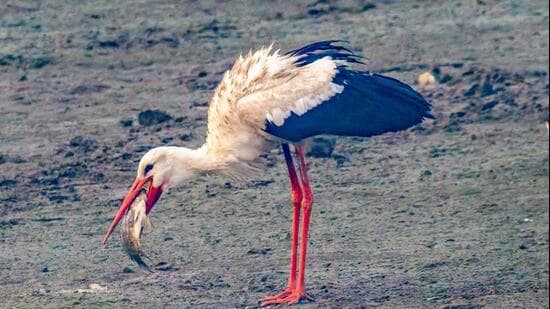
Last spotted in NCR in March 2019 near Jewar, the species only has four records in the region in nearly three decades, birders say.
Past white stork sightings in the region
Prior to that, data showed there were records of a sighting at Okhla in March 1992 and February 2005, along with a sighting at Palwal in 2004-05.
The bird was first spotted at the sanctuary on November 1, by a birder Dr Tejaswi Kumar.
Also Read: A first: Two shrike species spotted at Pong lake in Himachal
“It was around 8am and a little foggy but I immediately spotted this bird at a distance and noticed a bright red bill. That is what caught my eye and it was bigger in size than the herons around it,” Kumar said, stating after clicking a photograph, he immediately recognised it as a white stork.
“I have seen the species in 2009-10 at Gujarat’s Nal Sarovar, where one tends to see a lot of these white storks and could immediately make out what this was,” he added.
{{/usCountry}}“I have seen the species in 2009-10 at Gujarat’s Nal Sarovar, where one tends to see a lot of these white storks and could immediately make out what this was,” he added.
{{/usCountry}}Birders also believe this could possibly be a subspecies of the white stork, called the Ciconia ciconia asiatica.
“This distinct and isolated population breeds in Central Asia, primarily across most of Uzbekistan and the deep south of Kazakhstan, with a total global population estimated at fewer than 2,000 individuals. Their migration route traditionally takes them south toward wintering grounds stretching from Iran into the Indian subcontinent,” said birder Nikhil Devasar, stating according to historical field data, there are only four records of the white stork being spotted in Delhi-NCR in the last three-and-a-half decades.
Also Read: Two suspected smugglers arrested with 26 rare Tokay Geckos: Assam Police
White stork characteristics and habitat
White storks have a bright white body, black wing feathers, alongside a long red bill and red legs. It is a long-distance migrant, which can prey on insects, fish, amphibians, reptiles, small mammals and even small birds.
Fellow birder Rohit Sharma said the rare sighting is beginning to draw birders from across NCR to the sanctuary.
“After hearing about the sighting, everyone wants a glimpse of the bird, which is rarely seen here in NCR. This also shows how crucial these protected wetlands are and the need to safeguard such habitats,” he added.