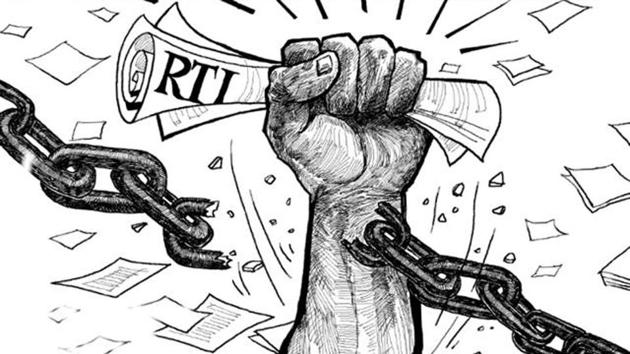
An analysis by a Delhi-based advocacy group of over 80,000 applications filed under the Right To Information Act with 24 major public sector undertaking (PSU) banks shows that their rate of rejection increased in 2015-16 as compared to the previous 3 years.
Illustration: Jayanto
{{^htLoading}} {{/htLoading}}
These 24 banks, which blamed the transparency law enacted in 2005 for governance constraints, accounted for about 40% of the RTI applications filed with the finance ministry. A Reserve Bank of India appointed PJ Nayak committee had cited RTI as one of the “constraints” on the governance in the banks.
{{^usCountry}}{{/usCountry}}
Ventakesh Nayak of the Commonwealth Human Rights Initiative Nayak studied the Central Information Commission’s annual report on RTI and found that as compared to 2014-15, the rejection rates have gone up in 50% of the public sector banks indicating that the banks were reluctant in providing the information sought.
In banks such as Andhra Bank and State Bank of Hyderabad, the rejection rate was higher than 50% of the applications received. For most banks, the average rejection rate was 20-30% much higher than average of 10% by the central government ministries.
{{^htLoading}} {{/htLoading}}
{{^usCountry}}
Most of the applications received by the banks are related to non-performing assets, discrepancies in bank accounts of applicants and reasons for not opening an account.
{{/usCountry}}
{{#usCountry}}
Most of the applications received by the banks are related to non-performing assets, discrepancies in bank accounts of applicants and reasons for not opening an account.
{{/usCountry}}
“As regards the RTI load on public sector banks, the average applications received in a branch was not more than 2 thereby debunking the constraint theory projected by PJ Nayak committee,” Nayak said.
His theory is based on the argument that most banks have adequate staff to deal with rising RTI applications but were reluctant to provide information citing constraint on resources.
Nayak also found no co-relation between non-performing assets of the banks and the volume of the RTI applications filed, saying to establish the link a more detailed analysis was required.
The banks had opposed RTI applications seeking information about loan defaults citing privacy provisions but the Supreme Court in 2016 directed them to provide information citing larger public interest.
{{^htLoading}} {{/htLoading}}
“A content analysis of the RTI applications received and the manner of their disposal by these banks will be necessary to establish any positive or negative correlation in this regard. Such a study is the urgent need of the hour,” Nayak said.
Among the banks, the State Bank of India received one-third of the total information requests followed by the Punjab National Bank and Bank of Baroda.
Chetan Chauhan is the National Affairs Editor looking into all aspects of news and features from across India. A Chevening scholar with over three decades of experience in reporting and news management, Chetan has extensively covered all important aspects of the social sector, political economy, environment and climate change nationally and internationally. He did a journalism course at the Reuters Institute of Journalism in Oxford and Digital Media training at Nanyang Technological University in Singapore. He started as a reporter with The Statesman in 1996 and joined the Hindustan Times in 2000 in the metro bureau covering environment, crime and Delhi politics. He covered hot local news, from the Jessica Lal murder case to the rebellion of Delhi Congress MLAs against then Chief Minister Sheila Dikshit, to the replacement of toxic vehicle fuel with cleaner compressed natural gas (CNG) in the national capital. Some of his stories on air pollution became part of the Supreme Court’s landmark MC Mehta versus Government of India case in the National Capital Region (NCR), forcing the government to take corrective measures. As part of the national political bureau since 2004, he covered important central sectors such as environment, education, social justice, labour, rural development, water resources, renewable energy, agriculture, broadcasting and the Planning Commission for more than a decade producing several exclusive and investigative breaking stories. His specialisation is the environment, having covered at least a dozen United Nations global conferences on climate change, biodiversity and wildlife including climate summits in Paris, Copenhagen and Bali. He also covered India’s two five-year plans ---11th and 12th and reported on drafting and execution of right based laws such as Right to Education, Right to Information and rural job guarantee law, MG-NREGA, now being introduced in new format as VG-RAM-G Act. He has in-depth knowledge of social sector issues. He was one of the first to report on tigers vanishing from Sariska and Panna wildlife reserves in 2004 and 2008, respectively, leading to the setting up of the National Tiger Conservation Authority (NTCA) and the introduction of stringent penal provisions for poaching. He has written extensively on the rising human-animal conflict in India and the degradation of India’s biodiversity hotspots because of mining and other activities. Since 2004, Chetan has covered Parliament comprehensively and participated in training on the nuanced coverage of Parliament proceedings. He has travelled extensively across India to cover national and provincial elections since 1998, especially in the Hindi heartland states, considered India’s road to power. He writes a regular column for Hindustan Times, Ecostani, on important national politics, economy, Himalayan ecology and environmental issues. His other responsibilities include providing inputs for edits and edit page articles for the publication, apart from managing news flow from across India.
Get Latest News, breaking headlines, and top India News, and today real-time updates from across the nation. Stay informed on politics, government policies, crime, Today Weather, and major developments on Hindustan Times
Get Latest News, breaking headlines, and top India News, and today real-time updates from across the nation. Stay informed on politics, government policies, crime, Today Weather, and major developments on Hindustan Times