The Supreme Court on Tuesday refused to entertain a fresh petition challenging the Places of Worship (Special Provisions) Act, 1991, observing that it will not allow multiple proceedings on the same issue.
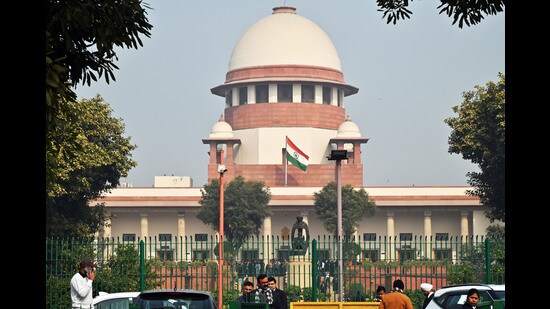
“This is the same plea. Stop filing petitions and applications,” observed a bench comprising Chief Justice of India Sanjiv Khanna and justice Sanjay Kumar, dismissing attempts to draw a distinction between the new petition and the earlier ones.
The court, however, granted the petitioner, law student Nitin Upadhyay, the liberty to move an application in the batch of cases where the constitutional validity of the law is already under scrutiny.
Upadhyay’s petition challenged the constitutional validity of a provision in 1991 Act, which mandates that the religious character of a place of worship must be maintained as it was on August 15, 1947, barring any changes.
When Upadhyay’s counsel argued that there was a “subtle difference” between his petition and others, the court remained unconvinced. The order stated: “It would be open for the petitioner to file an application in the case already pending if there are new grounds.”
Enacted by Parliament under the PV Narasimha Rao government, the act was introduced against the backdrop of the Ram Mandir movement and effectively froze the religious character of places of worship as they stood at the time of India’s Independence, with the sole exception of the Ram Janmabhoomi-Babri Masjid dispute, which was already the subject of litigation.
{{/usCountry}}Enacted by Parliament under the PV Narasimha Rao government, the act was introduced against the backdrop of the Ram Mandir movement and effectively froze the religious character of places of worship as they stood at the time of India’s Independence, with the sole exception of the Ram Janmabhoomi-Babri Masjid dispute, which was already the subject of litigation.
{{/usCountry}}Following the Supreme Court’s 2019 verdict, a Ram temple was constructed at the Ayodhya site. However, the act continues to operate as a legal barrier against any attempts to change the status of other disputed religious sites, including the Krishna Janmabhoomi-Shahi Idgah in Mathura and the Kashi Vishwanath-Gyanvapi Mosque in Varanasi. Notably, the law does not apply to ancient monuments or archaeological sites governed by the Ancient Monuments and Archaeological Sites and Remains Act, 1958.
In a significant interim order issued on December 12, 2024, the Supreme Court restrained courts across India from registering fresh suits or ordering surveys concerning the religious character of existing religious structures. This stay order directly impacted pending legal proceedings, including those related to the Kashi Vishwanath-Gyanvapi mosque, Krishna Janmabhoomi-Shahi Idgah, Sambhal Jama Masjid, Bhojshala, and Ajmer Sharif Dargah disputes, preventing lower courts from passing any effective or final orders on such matters. The top court clarified that it was actively reviewing both the validity and scope of the 1991 Act.
In his petition, Upadhyay has sought a directive allowing courts to determine the original religious character of a place of worship and has specifically challenged Section 4(2) of the Act, which prohibits any legal proceedings aimed at altering a site’s religious identity. He argued that the law violated the basic structure of the Constitution by restricting judicial remedies, asserting that barring individuals from approaching courts infringes upon their fundamental rights.
During an earlier hearing in February, the Supreme Court had expressed concern over the sheer volume of petitions related to the Act. On February 17, 2025, the bench, led by CJI Khanna, rebuked the repeated filings, stating: “There is a limit to which petitions can be filed. Enough is enough. There has to be an end to this…Too many petitions filed.”
The legal battle over the Places of Worship Act has attracted a broad spectrum of political and ideological stakeholders. The Congress has approached the Supreme Court to defend the law, arguing that it is crucial for maintaining communal harmony in India. Several other political figures and parties have joined the legal battle. Those supporting the law include the Communist Party of India (Marxist), Indian Union Muslim League (IUML), NCP (Sharadchandra Pawar) MLA Jitendra Awhad, RJD MP Manoj Kumar Jha, MP Thol Thirumavalavan, and AIMIM chief Asaduddin Owaisi.
Several petitioners, including BJP leader Ashwini Kumar Upadhyay and former Rajya Sabha MP Subramanian Swamy, have called for the annulment or modification of the act.
.