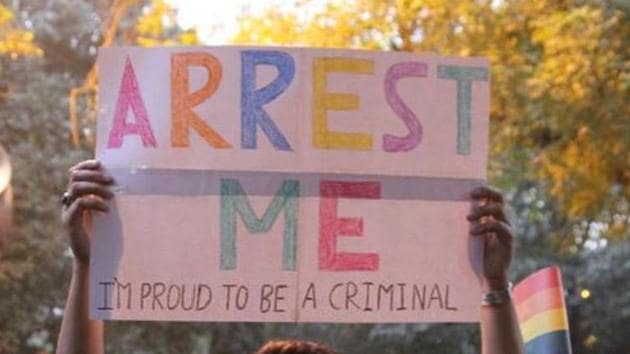
The Delhi High Court decriminalised gay sex in 2009 but its judgment was overturned by the Supreme Court. Last year, the top court said it will review its order. Here’s a timeline of Section 377 in the courts:
2001: A Delhi-based NGO, Naz Foundation, files a public interest litigation in the Delhi High Court challenging Section 377.
September 2004: High court dismisses the PIL, saying Naz Foundation has no locus in the case.
December 2004: Activists approach the Supreme Court against high court’s order.
April 2006: The Supreme Court directs the high court to reconsider the matter on merit.
September 2008: Centre seeks more time to take stand after contradictory statements by the home ministry, which backs Section 377 and health ministry, which admits law is hampering fight against HIV/AIDS. Later that month, Centre says “gay sex” is immoral.
October 2008: High court pulls up the Centre for relying on religious texts and asks it to come up with a stand based on scientific reports.
July 2009: High court reads down Section 377 to remove consensual same-sex acts in private from its purview.
{{/usCountry}}July 2009: High court reads down Section 377 to remove consensual same-sex acts in private from its purview.
{{/usCountry}}December 2013: Supreme Court sets aside the Delhi high court order, asks Parliament to come up with law.
January 2014: Supreme Court dismisses a central government petition seeking a review of its verdict.
January 2016: Supreme Court agrees to hear a curative petition — the last available judicial recourse — in open court.
June 2016: Supreme Court refers a petition filed by five well-known members of the LGBT community to the Chief Justice for “appropriate orders”.
August 2017: Supreme Court passes landmark ruling declaring individual privacy a guaranteed fundamental right and calling sexual orientation an “essential attribute” of privacy.
January 2018: Supreme Court refers Section 377 to a larger bench of the court, saying its 2013 decision requires reconsideration.