
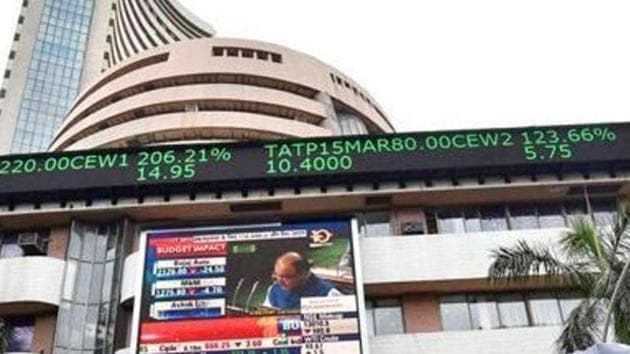
Indian equities closed at a new record on optimism that the country’s central bank will cut interest rates to kick-start sputtering economic growth.
Lower crude oil prices also boosted the prospects of a cut in interest rates amid hope that Prime Minister Narendra Modi will introduce structural reforms to help Asia’s third-largest economy unlock its growth potential.
Indian markets have been on the rise since the Modi-led coalition won a massive mandate to form the government for the second consecutive time. BSE’s benchmark Sensex has gained nearly 8% since May 15, a few days before the exit polls which indicated Modi’s comeback with a full majority.
On Monday, the Sensex surged 553.42 points, or 1.39%, to 40,267.62 while the National Stock Exchange’s Nifty index rose 1.395% to 12,088.55. Global markets were largely weak as trade war fears between the US and China heightened. Markets in Japan and Australia fell nearly 1%.
Hero MotoCorp Ltd advanced about 6% and was the top gainer on both the indexes. The Nifty Auto index rose over 2%.
“Indian markets went against the trend seen in most other markets. The markets were buoyed by the falling crude oil prices and the inflows from foreign portfolio investors, while traders kept building positions ahead of the RBI’s policy meet and next month’s budget,” said Deepak Jasani, head of retail research at HDFC Securities.
In the past five sessions, Brent crude oil prices have fallen over 13%, declining 3% on Monday. A surge in crude oil prices stokes inflation as India is among the countries most vulnerable to rising energy costs, importing more than 80% of its oil requirements.
{{/usCountry}}In the past five sessions, Brent crude oil prices have fallen over 13%, declining 3% on Monday. A surge in crude oil prices stokes inflation as India is among the countries most vulnerable to rising energy costs, importing more than 80% of its oil requirements.
{{/usCountry}}According to a Mint survey, RBI’s monetary policy committee (MPC) is likely to cut the key policy rate by 25 basis points (bps) as inflation cooled and economic growth slowed to a five-year low. India’s gross domestic product (GDP) for the March quarter grew 5.8%, the slowest pace in five years, according to official data released on Friday.
As high-frequency indicators relating to exports, domestic consumption and investments point to a slowdown in the economy, the monetary policy expectation is not just limited to rate cuts, said Edelweiss Securities Ltd.
“Even the global environment is becoming conducive for rate easing. Global trade and industrial activity is clearly slowing while the Federal Reserve/European Central Bank (ECB) and other central banks have given up tightening and turned marginally dovish. This too offers room to emerging markets central banks, including India,” it said in a note on 3 June. Analysts are concerned that the market rally does not have fundamental support. “Even with a largely optimistic bias, domestic industry earnings within the Nifty 50 (excluding financials and exporters) are expected to grow at 6% and excluding commodities at 13% in FY20 due to weak private investments and slowdown in consumption,” said ICICI Securities in a note on June 3.
A Mint analysis of 1,619 listed companies showed that aggregate profit growth, after adjusting for one-time gains or losses, declined 0.7% in the three months ended March 31, the first drop in six quarters. In the December quarter, adjusted net profit growth for the same set of companies was at 7.61%.
Net sales growth of the firms was at 8.24%, a five-quarter low, from 13.5% in the preceding December quarter, according to Capitaline.
Reuters contributed to this story.
ABOUT THE AUTHOR
Follow the latest breaking news, major developments and agenda-setting stories from India and around the world with the newsdesk at Hindustan Times. Operating round the clock, the desk brings together experienced editors, reporters and correspondents to deliver fast, accurate and contextual reporting across subjects that influence public policy, governance, business, society and international affairs. The HT News Desk covers politics, elections, government policies, the economy, business and markets, science and technology, the environment, law and order, infrastructure, education, climate issues and geopolitics, while closely tracking developments across states, institutions and global capitals. The team also leads coverage of major breaking news events, policy announcements, court proceedings, natural disasters, public emergencies and significant international developments. Reports published by the newsdesk are based on information gathered from reporters on the ground, official statements, government agencies, court records, regulatory filings, recognised institutions and other authoritative sources. Stories undergo editorial scrutiny and verification processes to ensure accuracy, fairness and relevance, and are updated as events evolve and additional information becomes available. Whether covering a key political decision in New Delhi, an economic policy shift affecting millions, a landmark court ruling or a major global event, the HT News Desk aims to provide readers with reliable, fact-based journalism that delivers not only the latest developments but also the context and analysis needed to understand their wider implications.