Supreme Court judge Dhananjaya Y Chandrachud on Saturday underlined that citizens should get basic education to realise the value of their votes and exercise their right of speaking “truth to power”.
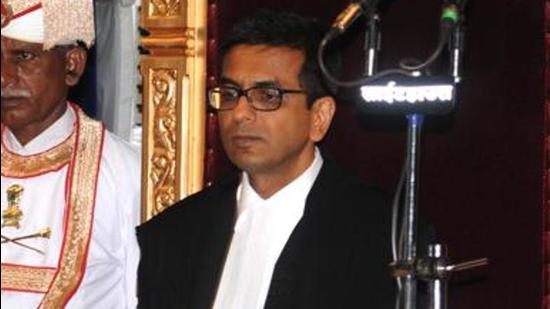
According to justice Chandrachud, democracy needs truth to survive and it is not only the right of every citizen to speak truth to power but equally a duty cast upon him or her.
“Since democracies are spaces of reasons, truth is important, as reasons cannot be based on falsehoods. Truth is also important to instil public faith in democracy... As citizens of a democracy, we need to commit ourselves to the search for truth as a key aspiration of our society,” emphasised the senior top court judge.
Justice Chandrachud was speaking at an online lecture organised in memory of justice MC Chagla, a former chief justice of the Bombay high court who also served as a cabinet minister from 1963 to 1967.
Delivering his address on the topic “Speaking Truth to Power: Citizens and the Law”, justice Chandrachud was categorical that while democracy was the form of government to avoid tyranny of the law and of the few who get elected, it is imperative for the citizens to strengthen public institutions to hold the governments accountable.
{{/usCountry}}Delivering his address on the topic “Speaking Truth to Power: Citizens and the Law”, justice Chandrachud was categorical that while democracy was the form of government to avoid tyranny of the law and of the few who get elected, it is imperative for the citizens to strengthen public institutions to hold the governments accountable.
{{/usCountry}}“As citizens, we must strive to ensure that we have a press which is free from influence of any kind, be it political or economic, which can provide information in an unbiased manner. Similarly, schools and universities need to be supported to ensure that they create an atmosphere where students can learn to differentiate truth from falsehood and develop a temperament to question power,” said the judge.
Citizens, justice Chandrachud underscored, must not only acknowledge the plurality of opinions in a country as diverse as India but celebrate this plurality since it would allow open space for more opinions.
“We also need to protect the integrity of our elections, seeing elections not only as a right but also as a duty. To do this, we need to ensure all citizens are given basic education to realize the value of their vote,” highlighted the judge, adding that as citizens of a democracy, people should commit themselves to the search for truth as a key aspiration of our society.
The judge added that by “citizens”, he does not mean just the elite and the privileged class alone, especially in the context of women, Dalits and others belonging to marginalised communities which did not traditionally enjoy power and their opinions were not conferred with the status of truth.
“Since they did not enjoy the freedom to express their opinion, their thoughts were confined, crippled and caged. After abolition of the British Raj, the truth became the belief and opinion of upper caste men,” said justice Chandrachud.
“With progress in society and annihilation of notions of patriarchy and caste supremacy, their opinions are slowly and gradually starting to be regarded as truth in India. The sooner we do it, the better as a society,” stressed the judge.
Justice Chandrachud further said that citizens cannot bank only on the State to find the truth, particularly when totalitarian governments are associated with a constant reliance on falsehoods in order to establish dominance.
“It can’t be said that the State will not indulge in falsehood for political reasons even in democracies. The role of the US in the Vietnam War did not see the light of day until the Pentagon papers were published. In the context of COVID, we see that there is an increasing trend of countries across the world trying to manipulate data. Hence, one cannot only rely on the state to determine the truth”, said the judge.
Senior advocate Iqbal Chagla, Bombay HC judge Riyaz Chagla, Dr Rajesh Varhadi (head, department of law, University of Mumbai) and Dr Rashmi M Oza (chair professor, Justice Chagla Chair) also attended the online 6th MC Chagla memorial lecture.