The Supreme Court on Friday accepted the resignation of Professor Ravi Chopra as chairperson of a panel formed to oversee widening of roads under the Centre’s ₹12,000 crore ambitious Char Dham project, and appointed its former judge A K Sikri as the new chairman.
Chopra, who was appointed as the chairperson of the high powered committee (HPC) in 2019, had in January written to the top court, saying he wanted to resign as the road ministry was ignoring the committee’s recommendations.
A bench of Justices D Y Chandrachud and Surya Kant accepted Chopra’s resignation and appointed Justice (retd) Sikri as the chairperson following a recommendation from the Centre. Attorney General KK Venugopal, Centre’s counsel, said since Justice (retd) Sikri was already appointed by this court as chairperson of the oversight committee to look after environmental concerns and other issues related to the Char Dham project, it would be better if he is appointed as the chairperson.
After his resignation was accepted, Chopra said careful implementation of the road project in the ecologically-fragile Bhagirathi eco-sensitive zone stretch will be a critical task for the panel. Bhagirathi eco-sensitive zone is on one of the feeder routes of the Char Dham pariyojana. It stretches from Gaumukh to Uttarkashi, covering an area of 4179.59 sqkm.
“A very important aspect of the judgment given by the honorable court is that it is conditional upon ministry of road transport and highways (MoRTH) and ministry of defence (MoD), both observing the unanimous decisions of the HPC. The HPC has unanimously recommended that any work that is to be done in the Bhagirathi eco-sensitive zone should be preceded by an honest environment impact assessment,” Chopra said.
{{/usCountry}}“A very important aspect of the judgment given by the honorable court is that it is conditional upon ministry of road transport and highways (MoRTH) and ministry of defence (MoD), both observing the unanimous decisions of the HPC. The HPC has unanimously recommended that any work that is to be done in the Bhagirathi eco-sensitive zone should be preceded by an honest environment impact assessment,” Chopra said.
{{/usCountry}}“I would like the oversight committee headed by Justice (retd) Sikri to ensure that the recommendations of the HPC are totally followed. The Bhagirathi eco-sensitive zone is so far an almost pristine stretch of the Char Dham Pariyojana highways. The MoRTH had assured the committee that the Jhala-Jangla stretch of the eco-sensitive zone will be of intermediate width (5.5m). That assurance needs to be put into practice,” he added.
After years of protests by local environmentalists, a notification by the environment ministry on December 18, 2012, had sought to protect the entire fragile Himalayan region by restricting hydropower projects of over 2 MW, riverbed mining and change of land use.
The notification was, however, amended on April 16, 2018, following the Uttarakhand government’s objections that it was ‘anti-development’.
The top court, in 2019, ordered the setting up of a committee to take a view on whether the Centre’s ambitious project needs to be “revised” to minimise its ecological damage. It also appointed Chopra as the chairperson of the panel.
In July 2020, the Centre approved the zonal master plan for the zone and made provisions for execution of the Char Dham project through the eco-sensitive zone.
On December 14 last year, the Supreme Court permitted the Union government to construct all-weather roads with 10m width as part of its Char Dham project in Uttarakhand, underlining that “the recent past has thrown up serious challenges to national security”, and that wide strategic feeder roads to Indo-China border areas were required for the infrastructural needs of the armed forces.
In its report to the top court earlier, the HPC had presented a divided opinion, with a majority in favour of wider roads on the Char Dham route, considering the strategic requirement and snow removal needs.
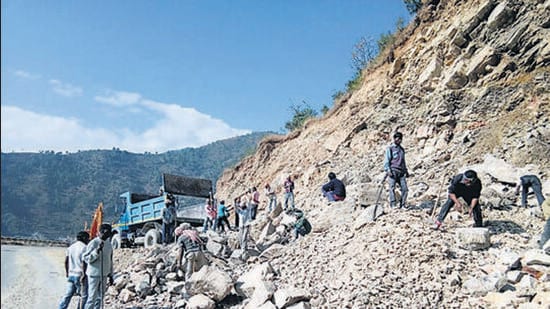
Several ecologists and geologists have, however, raised concerns about the impact of hill cutting, muck disposal and instability that will be caused by a double lane paved shoulder (DLPS) category road.
“The Bhagirathi ESZ is a very vulnerable region and has a special legal status. Any construction there has to be done with minimal environmental impact. The Supreme Court, however, has overlooked this aspect of the region and ordered blanket widening of all feeder routes. Thousands of deodar trees will be lost if the road is widened in the stretch and there will be nothing left to save. It is the last pristine stretch of flowing Ganga in the country. Ganga activist GD Agarwal gave his life to save this stretch,” Mallika Bhanot, environmentalist and member of the environment ministry appointed monitoring committee of Bhagirathi ESZ, said.
In his resignation letter, Chopra said the MoRTH had accepted a DLPS configuration for roads that come under the project’s ambit, despite the HPC’s recommendations against it.