
 E-Paper



'Supreme Court not opposition…': CJI DY Chandrachud on top court's real job
CJI DY Chandrachud clarified that the Supreme Court's responsibility is not to act as an opposition in Parliament

 Prefer HTon Google


Chief Justice of India DY Chandrachud on Saturday underlined the importance of preserving the role of the Supreme Court as the “people's court” and urged that it should not be perceived as opposition in Parliament.
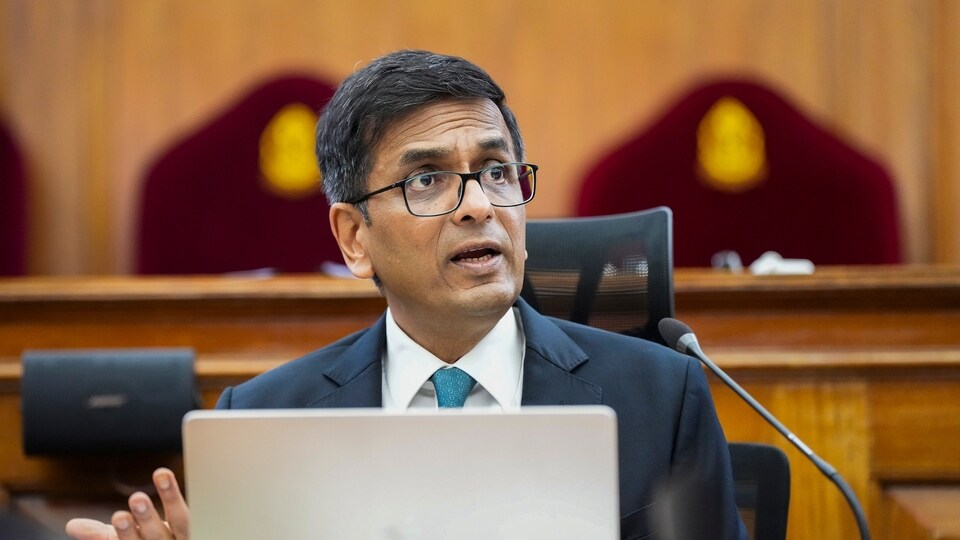
"Now, being a people's court is not to say that we fulfill the role of the opposition in Parliament," the CJI said.
The CJI clarified that the Supreme Court's responsibility is not to act as an opposition in Parliament adding that while criticism of the court for legal inconsistencies or errors is acceptable, its role and work should not be judged based on outcomes and nature of cases, PTI reported.
READ | Mumbai Police's big update on Baba Siddique murder: 5 arrested accused had sought ₹50 lakh, but…
The CJI made the statements while addressing the first Supreme Court Advocates On Record Association (SCAORA) Conference in South Goa.
People's Court: CJI on Supreme Court's real job
During his address, CJI Chandrachud highlighted the need to maintain the access to justice paradigm developed over the last 75 years.
He also warned the judges against the perception that the top court should only focus on major cases, emphasising that it is a people's court and must continue to serve that function.
READ | Yamuna river covered in toxic froth ahead of Chhath Puja, netizens react
The Chief Justice of India also discussed the public's divided opinions about the apex court and noted that the top institution is always praised when decisions are favourable and criticised when they are not and thus, such things shouldn't impact their mindset, the news agency added.
"I think, particularly in today's times, there is this great divide between everybody who thinks that the Supreme Court is a wonderful institution when you decide in their favour, and it is an institution which is denigrated when you decide against them," he said.
CJI Chandrachud also emphasized the importance of judges' independence in deciding cases and encouraged the legal profession to understand and respect this independence.
CJI on judiciary and technology
Furthermore, the CJI also mentioned the Supreme Court's technological advancements, such as the e-filing of cases, digitization of case records, and live-streaming of court proceedings.
READ | RG Kar protest: Doctors set Oct 21 deadline for Mamata govt, warn strike in Bengal
The top judge also acknowledged the impact of live-streaming in bringing court proceedings to the public and dispelling the perception that the court only handles cases involving the wealthy and influential.
"I do believe that live-streaming is something which has taken the work of the Supreme Court of India to home and the heart of people. There was a perception on the ground that the Supreme Court does cases only involving the rich and the resourceful clients," he said.
The CJI highlighted how live-streaming has shed light on the court's attention to even the smallest problems faced by ordinary citizens, demonstrating the court's commitment to serving the people.
(With PTI inputs)


