
Militants killed 235 people at a mosque in Egypt’s north Sinai region on Friday, detonating a bomb and shooting at fleeing worshippers and ambulances, the state television reported, quoting the public prosecutor.
It was one of the deadliest attacks in the region’s Islamist insurgency. No group claimed immediate responsibility, but since 2014 Egyptian security forces have battled a stubborn Islamic State affiliate in the north of the mainly desert Sinai, where militants have killed hundreds of police and soldiers.
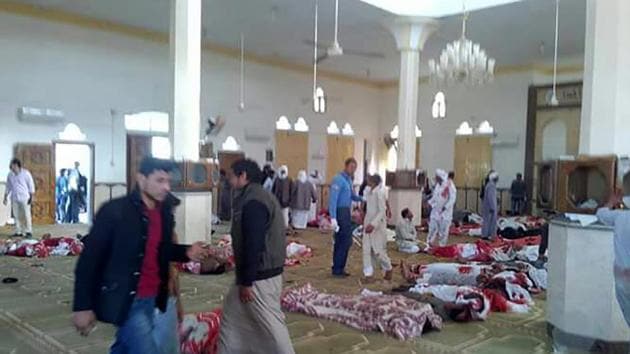
State media showed images of bloodied victims and bodies covered in blankets inside the Al Rawdah mosque in Bir al-Abed, west of the city of El Arish.
State television and the official news agency MENA reported that 235 people had been killed. Another 125 were wounded, according to state media.
“They were shooting at people as they left the mosque,” a local resident whose relatives were at the scene told Reuters. “They were shooting at the ambulances too.”
President Abdel Fattah al-Sisi, a former armed forces commander who presents himself as a bulwark against Islamist militants, convened an emergency meeting with his defence and interior ministers and intelligence chief soon after the attack, the presidency’s Facebook page and state television said.
{{/usCountry}}President Abdel Fattah al-Sisi, a former armed forces commander who presents himself as a bulwark against Islamist militants, convened an emergency meeting with his defence and interior ministers and intelligence chief soon after the attack, the presidency’s Facebook page and state television said.
{{/usCountry}}The government also declared three days of mourning.
Militants have mostly targeted security forces in their attacks since bloodshed in the Sinai worsened after 2013 when Sisi, then an armed forces commander, led the overthrow of President Mohamed Mursi of the Muslim Brotherhood.
But jihadists have also targeted local Sinai tribes that are working with the armed forces, branding them traitors for cooperating with the army and police.
In July this year, at least 23 soldiers were killed when suicide car bombs hit two military checkpoints in the Sinai, an attack claimed by Islamic State.
Militants have tried to expand beyond the largely barren, Sinai Peninsula into Egypt’s heavily populated mainland, hitting Coptic Christian churches and pilgrims.
In May, gunmen attacked a Coptic group travelling to a monastery in southern Egypt, killing 29.
ABOUT THE AUTHOR
Follow the latest breaking news, major developments and agenda-setting stories from India and around the world with the newsdesk at Hindustan Times. Operating round the clock, the desk brings together experienced editors, reporters and correspondents to deliver fast, accurate and contextual reporting across subjects that influence public policy, governance, business, society and international affairs. The HT News Desk covers politics, elections, government policies, the economy, business and markets, science and technology, the environment, law and order, infrastructure, education, climate issues and geopolitics, while closely tracking developments across states, institutions and global capitals. The team also leads coverage of major breaking news events, policy announcements, court proceedings, natural disasters, public emergencies and significant international developments. Reports published by the newsdesk are based on information gathered from reporters on the ground, official statements, government agencies, court records, regulatory filings, recognised institutions and other authoritative sources. Stories undergo editorial scrutiny and verification processes to ensure accuracy, fairness and relevance, and are updated as events evolve and additional information becomes available. Whether covering a key political decision in New Delhi, an economic policy shift affecting millions, a landmark court ruling or a major global event, the HT News Desk aims to provide readers with reliable, fact-based journalism that delivers not only the latest developments but also the context and analysis needed to understand their wider implications.