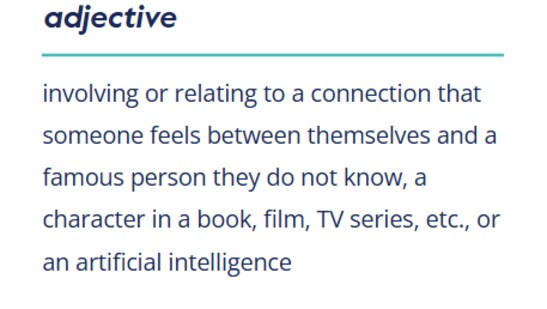
Who saw this coming? Cambridge Dictionary has named Parasocial as the Word of the Year for 2025. It defines the term as “involving or relating to a connection that someone feels between themselves and a famous person they do not know, a character in a book, film, TV series, etc, or an artificial intelligence.”
The word itself is not new. It’s been around since 1956, though it was coined for people’s relationship with a different kind of screen. American sociologists used it to describe TV viewers’ increased interest with/in on-screen personalities. But Parasocial stayed comfortably in the realm of academia all this time. “It’s only fairly recently that it’s made a shift into popular language and it’s one of those words that have been influenced by social media,” says the dictionary’s chief editor Colin McIntosh.
Of course, it would. Pop-culture loyalties are no longer passive – people pay them with each Like and Share, each Reel replay, each comment, each defensive tweet, each red-carpet critique, each first-look of a trailer, and each time they queue up to be the first to buy celebrity-branded merchandise. Groupies no longer fits the current baseline of obsession. The Japanese call their superfans Otaku, the Korean term is Sasaeng. Millennials used to fall back on Stan, from the Eminem song about a criminally obsessed fan. Parasocial, then, is merely a mainstream term whose time has come.
Dictionary searches for the word spiked on June 30, right after YouTube streamer IShowSpeed blocked an obsessive fan who called himself the streamer’s “number 1 parasocial”. The word kept coming up after August 26, as the world woke up to news of Taylor Swift’s engagement to footballer Travis Kelce, causing her fans to celebrate as if she were a member of their own family. And it was on search lists once again just last week, when Johnson Wen, a 26-year-old Australian Instagrammer was sentenced to nine days in jail for jumping over a barricade and grabbing actor and singer Ariana Grande at a movie premiere in Singapore earlier this month. Wen clearly sees no boundaries between himself and female celebrities; he also jumped up on stage and interrupted a Katy Perry concert in June.
{{/usCountry}}Dictionary searches for the word spiked on June 30, right after YouTube streamer IShowSpeed blocked an obsessive fan who called himself the streamer’s “number 1 parasocial”. The word kept coming up after August 26, as the world woke up to news of Taylor Swift’s engagement to footballer Travis Kelce, causing her fans to celebrate as if she were a member of their own family. And it was on search lists once again just last week, when Johnson Wen, a 26-year-old Australian Instagrammer was sentenced to nine days in jail for jumping over a barricade and grabbing actor and singer Ariana Grande at a movie premiere in Singapore earlier this month. Wen clearly sees no boundaries between himself and female celebrities; he also jumped up on stage and interrupted a Katy Perry concert in June.
{{/usCountry}}It is clear now, a quarter of the way into the 21st century, that fandom is a force both for good and evil. Indians experienced parasocial joy after India’s women cricket team lifted the world cup – somehow these champions felt even more their own than the men. They collectively plunged into parasocial grief over the deaths of Bollywood character actors Satish Shah and Asrani last month. People even despair when a TV series ends.
Other words that it the dictionary found to have “significant impact” this year include Slop (lowbrow content, possibly AI-generated) and Memeify (to turn an event, image, person, etc into a meme). The terms that actually made it to the dictionary this year include Skibidi, Delulu and Tradwife. Meanwhile, Dictionary.com’s word of the year isn’t even a word, it’s a number: 67, the nonsense Gen Alpha term that has had grownups confused and fuming.
There’s a pattern here. Every new term has been birthed by the internet and is a determined effort to make sense of the online/offline duality that characterises the moment. And so it has been for much of this decade. Lexicographers and dictionaries crowned Brain Rot, Polarisaion and Demure last year; and Rizz, AI and Authentic the previous year.
Who’s going to come up with a term to define our bond to the internet?