
Two satellite-tagged female Amur falcons, ‘Longleng’ and ‘Tamenglong’, named after two districts of Nagaland and Manipur, flew non-stop for five days to cover 5,700 km to reach a stop-over site in Somalia on Saturday, said Wildlife Institute of India scientist (WII) R Suresh Kumar.
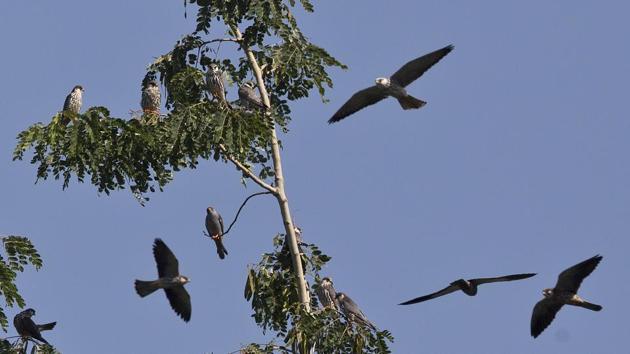
They were radio-tagged in the first week of November along with a male falcon as part of India’s first project to study the route of the long-distance migratory birds. The male falcon named Manipur was reportedly killed somewhere in Tamenglong district on November 9. Tamenglong started its non-stop migration on November 9 while Longleng started on November 19.
“Tamenglong reached Somalia around 1 pm (Indian time) on Saturday (November 24) while Longleng reached around 5 pm on Friday (November 23),” Kumar said. “They are likely to spend a few days in Somalia before embarking on their final journey to South Africa.”
The falcons spend their summers at their breeding grounds in southeast Russia and northeast China. They migrate to their wintering grounds in South Africa, from where they start their return journey in April-May through Afghanistan and East Asia, undertaking a yearly journey of about 20,000 km. In between, they stop in India’s northeast, where they have been killed in large numbers in recent years, and Somalia.
In their journey, these pigeonsized birds arrive in large numbers during October in Nagaland and Manipur besides a few places in northeast India. They leave the region in November after having enough food for their non-stop flight to Africa where they spend their winters.
{{/usCountry}}In their journey, these pigeonsized birds arrive in large numbers during October in Nagaland and Manipur besides a few places in northeast India. They leave the region in November after having enough food for their non-stop flight to Africa where they spend their winters.
{{/usCountry}}“They visit the northeast routinely because they know the availability of food in the region even though they pass through the Indian sub-continent during the journey,” Kumar said. “These birds feed on flying termites and insects etc.” Kumar said satellite tagging enables them to understand the birds and helps their conservation because through their migratory route they can study the environmental cues including wind pattern. The WII has radio-tagged 10 birds over the last five years.
The information gained can also help raise international awareness about the species and promote falcon conservation, he added. Kumar applauded local communities in Nagaland and Manipur for their conservation effort to save falcons in recent years.
In case of Manipur, Rainforest Club Tamenglong and state forest department have been observing Amur Falcon festival in November annually since 2015 to spread awareness about the bird among the masses.
ABOUT THE AUTHOR
Follow the latest breaking news, major developments and agenda-setting stories from India and around the world with the newsdesk at Hindustan Times. Operating round the clock, the desk brings together experienced editors, reporters and correspondents to deliver fast, accurate and contextual reporting across subjects that influence public policy, governance, business, society and international affairs. The HT News Desk covers politics, elections, government policies, the economy, business and markets, science and technology, the environment, law and order, infrastructure, education, climate issues and geopolitics, while closely tracking developments across states, institutions and global capitals. The team also leads coverage of major breaking news events, policy announcements, court proceedings, natural disasters, public emergencies and significant international developments. Reports published by the newsdesk are based on information gathered from reporters on the ground, official statements, government agencies, court records, regulatory filings, recognised institutions and other authoritative sources. Stories undergo editorial scrutiny and verification processes to ensure accuracy, fairness and relevance, and are updated as events evolve and additional information becomes available. Whether covering a key political decision in New Delhi, an economic policy shift affecting millions, a landmark court ruling or a major global event, the HT News Desk aims to provide readers with reliable, fact-based journalism that delivers not only the latest developments but also the context and analysis needed to understand their wider implications.