The foreign ministers of the Quadrilateral Security Dialogue or Quad on Friday assessed the security challenges posed by the situation in Myanmar and Ukraine and warned that “ungoverned spaces” in Afghanistan pose a direct threat to the security of the Indo-Pacific.
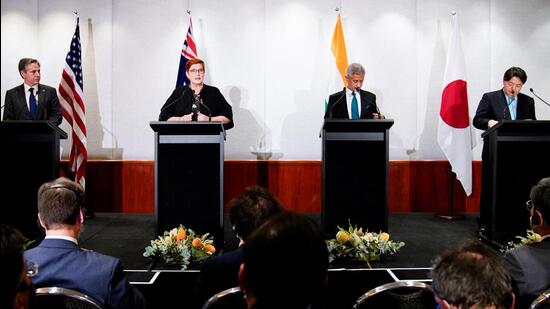
A joint statement issued after a meeting of the Quad foreign ministers in Melbourne said, without naming Pakistan, that all countries should ensure “territory under their control is not used to launch terror attacks and to expeditiously bring to justice the perpetrators of such attacks”.
The members of the Quad – India, Australia, Japan and the US – reiterated their condemnation of terror attacks in India, including the 2008 Mumbai and 2016 Pathankot attacks. They reaffirmed the UN Security Council resolution 2593, which states Afghanistan’s territory “should not be used to threaten or attack any country, shelter or train terrorists, or plan or finance terrorist acts,” and said “such ungoverned spaces” are a direct threat to the Indo-Pacific.
“We denounce the use of terrorist proxies for cross-border terrorism and urge countries to work together to eliminate terrorist safe havens; disrupt terrorist networks and the infrastructure and financial channels which sustain them; and halt cross-border movement of terrorists,” the joint statement said.
The Quad is exchanging information on evolving threats and working with Indo-Pacific countries and at multilateral forums to counter all forms of terrorism and violent extremism, it added.
{{/usCountry}}The Quad is exchanging information on evolving threats and working with Indo-Pacific countries and at multilateral forums to counter all forms of terrorism and violent extremism, it added.
{{/usCountry}}The Mumbai attacks were carried out by the Lashkar-e-Taiba (LeT) while the Pathankot attack was blamed on the Jaish-e-Mohammed (JeM) – both Pakistan-based groups. The reference to the two attacks and to cross-border terror in the joint statement was perceived as an endorsement of India’s position on terrorism.
The joint statement said the Quad is “gravely concerned” about the crisis in Myanmar following last year’s military coup, and the grouping called for an end to violence, the release of all arbitrarily detained persons, including foreigners, and unhindered humanitarian access.
“We reaffirm our support for Asean efforts to seek a solution in Myanmar and call on the military regime to urgently implement Asean’s Five-Point Consensus and swiftly return Myanmar to the path of democracy. We encourage the international community to work together to support an end to the violence,” the statement said.
External affairs minister S Jaishankar told a news conference, which he addressed along with Australian foreign minister Marise Payne, Japanese foreign minister Yoshimasa Hayashi and US secretary of state Antony Blinken, that all members of the Quad were troubled by Myanmar’s move away from the path of democratic transition.
India, as an immediate neighbour, has “very specific concerns” about insurgents operating in Myanmar who killed a senior military officer and his family, the Covid-19 pandemic and the lack of vaccination along the common border, and the humanitarian situation arising from food shortages, he said.
Jaishankar was referring to the ambush on an Assam Rifles convoy in Manipur in November last year that killed Col Viplav Tripathi, his family and four more soldiers. The killings were blamed on anti-India militants with bases in Myanmar.
Blinken said Myanmar’s junta has doubled down on repression and violence, and US President Joe Biden will focus on Asean’s five point consensus at an upcoming meeting with leaders of the Southeast Asian grouping in Washington.
Unlike Myanmar, the situation triggered by Russia’s massing of troops on the border of Ukraine didn’t find mention in the joint statement, reflecting the lack of unanimity among the Quad members. India has refrained from criticising the actions of Russia, a strategic partner and the main supplier of military hardware, and has only called for the situation to be resolved through diplomacy while safeguarding the “legitimate security interests of all countries”.
Hayashi confirmed the situation in Ukraine was discussed at the meeting, and Blinken said the US is working to “defend the core principles threatened by Russia’s aggression towards Ukraine” because the same principles are crucial for stability in the Indo-Pacific.
Blinken said the US and its partners have adopted a dual track approach to Russia – while they would prefer to resolve the Ukraine issue through diplomacy and dialogue, they were also clear on building deterrence and defence and telling Russia that it will face “massive consequences” if it chooses the path of “renewed aggression”. These consequences will include economic and financial sanctions and export controls, he said.
“What’s at stake is not simply...Ukraine’s territorial integrity, its sovereignty, its independence, but very basic principles that have...undergirded security, peace and prosperity for countries around the world,” Blinken said.
“If we allow those principles to be challenged with impunity, even if it’s half the world away in Europe, that will have an impact here as well,” he added.
Payne, responding to a question on a joint communiqué issued by Russia and China last week that endorsed their respective positions on Ukraine and Taiwan, said the statement doesn’t represent a global order that aligns with the Quad’s ambitions for freedom and openness. She said the Quad’s members are working as partners for a regional and global order based on rule of law, and stood for “freedom from coercion” and for states preserving their sovereignty and territorial integrity. Jaishankar added that the Quad is “for something, not against somebody”.
In her opening remarks, Payne highlighted the importance of the Quad’s work to support openness, protection of national sovereignty and observance of rules and fair play. “Our region is in a period of rising strategic uncertainty. The rules and norms that have provided a foundation for our stability, and hence our prosperity, are under pressure, in particular, from authoritarian regimes,” she said.
Jaishankar said in his opening remarks that the robust bilateral relations between the Quad members, their strategic convergences and shared democratic values have combined to make the grouping a vibrant and substantial framework. “We are building an agenda which seeks to further our shared vision of a free, open and inclusive Indo-Pacific,” he added.