
It is the end of April but it is unusually pleasant in Delhi. The maximum temperature has touched 40 degrees C here only once compared to eight days by this time last year. Even in other parts of the country, maximum temperatures are mostly below normal or normal, according to the India Meteorological Department (IMD). No heat waves have been recorded so far except in isolated pockets of Gujarat and Marathwada (and only for a day in both), which is unusual for this time of the year.
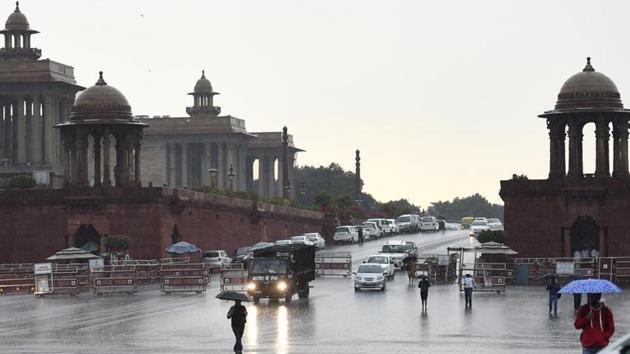
IMD scientists are also surprised by intermittent wet spells that have kept maximum temperatures down when the rest of the world is recording above normal temperatures.
In northwest India, this pattern is linked to back-to-back active western disturbances (WDs), which are not supposed to be around in April. By this time, these disturbances which start as low-pressure systems in the Mediterranean weaken and move to northern latitudes. Scientists said such changes may be due to weather anomalies in Europe. They could also be linked to favourable sea temperatures over the Pacific.
The WDs brought a lot of rain to northwest India; there is also moisture incursion in east and northeast India from the Bay of Bengal, which has been bringing good rains in the pre-monsoon season. According to IMD’s rainfall data, between March 1 and April 26, 13 states have recorded “large excess” of rains (60% above normal).
“Our models show that wind patterns will not support the development of heat waves till the end of the first week of May. There has been a lot of rain in the entire Indo-Gangetic Plains region. Rains will not subside immediately. There will be another strong wet spell in northwest India from May 4 to 6. We have not recorded any heat waves yet, except in isolated patches for a day,” said RK Jenamani, senior scientist at the National Weather Forecasting Centre.
{{/usCountry}}“Our models show that wind patterns will not support the development of heat waves till the end of the first week of May. There has been a lot of rain in the entire Indo-Gangetic Plains region. Rains will not subside immediately. There will be another strong wet spell in northwest India from May 4 to 6. We have not recorded any heat waves yet, except in isolated patches for a day,” said RK Jenamani, senior scientist at the National Weather Forecasting Centre.
{{/usCountry}}In Delhi and the National Capital Region, the below normal temperature has meant pleasant days and mildly cool nights. The maximum temperature on Saturday in Delhi was 7 degrees C below normal and minimum 5 degrees C below normal. “We had six WDs in March and six in April. Not all WDs brought rain but it has been mostly cloudy and winds are good which doesn’t allow maximum temperature to spike. In 2013 and 2014, we saw similar weather in April,” explained Kuldeep Srivastava, head of the regional weather forecasting centre.
“In April or May, the intensity of WDs reduce. There could be many reasons for this unusual pattern of active WDs this year. It could be linked to European climate anomalies,” said M Rajeevan, secretary, ministry of earth sciences.
Roxy Mathew Koll, climate scientist from the Indian Institute of Tropical Meteorology, agreed with Rajeevan, saying: “WDs are low pressure systems that generally originate over the Mediterranean region, propagate eastward with the help of the fast moving winds in the upper atmosphere — the westerly jet. This year we had a larger than usual number of WDs active over India. However, these short-lived WDs may not be the only factor that is regulating the temperatures. The ocean temperatures over the Pacific are also favourable since El Niño conditions have not developed. Usually if El Niño conditions (anomalously warm ocean temperatures) are present in the central-east Pacific, it can drive heat waves over India during April-May months. It seems that both these factors have been favourable for below normal temperatures over north India.”
While this could mean bearable weather in cities, continuous unseasonal rains in other parts of the country have led to crop damage.
“We haven’t seen any heat waves yet except 40+ temperatures in some isolated pockets. Temperature has been below normal to normal in Punjab, Haryana, Delhi-NCR, North Rajasthan and west Uttar Pradesh. There has been a lot of rain in the second half of April. Because of intense rains it has become cooler. Another WD is expected to affect northwestern India on April 30, which will again bring rain. Usually by April, WDs travel in upper latitudes. There is a lot of moisture incursion also. For the last two days, there has been a trough (region of low pressure) from Vidarbha to interior Tamil Nadu,” said Mahesh Palawat, vice president, climate change and meteorology at Skymet Weather.
India in March recorded a mean temperature of 24.92 degrees C ( 0.29 below normal), a maximum average of 31.08 degrees C (0.769 degree C below normal) and an average minimum temperature of 18.75 degree C ( 0.2 degree C below normal), according to IMD.
ABOUT THE AUTHOR
Follow the latest breaking news, major developments and agenda-setting stories from India and around the world with the newsdesk at Hindustan Times. Operating round the clock, the desk brings together experienced editors, reporters and correspondents to deliver fast, accurate and contextual reporting across subjects that influence public policy, governance, business, society and international affairs. The HT News Desk covers politics, elections, government policies, the economy, business and markets, science and technology, the environment, law and order, infrastructure, education, climate issues and geopolitics, while closely tracking developments across states, institutions and global capitals. The team also leads coverage of major breaking news events, policy announcements, court proceedings, natural disasters, public emergencies and significant international developments. Reports published by the newsdesk are based on information gathered from reporters on the ground, official statements, government agencies, court records, regulatory filings, recognised institutions and other authoritative sources. Stories undergo editorial scrutiny and verification processes to ensure accuracy, fairness and relevance, and are updated as events evolve and additional information becomes available. Whether covering a key political decision in New Delhi, an economic policy shift affecting millions, a landmark court ruling or a major global event, the HT News Desk aims to provide readers with reliable, fact-based journalism that delivers not only the latest developments but also the context and analysis needed to understand their wider implications.